Water Futures Exhibition
Together with the Hydrocolonialism Institute, tiat is proud to present an exhibition bringing together Bay Area artists, technologists, and cross-disciplinary makers exploring what it means to live and create in a time of accelerating environmental change and shifting water futures.
About the Exhibition
Water Futures is a solo show, but the artist is water. It emerges from a simple but disarming premise: we are all bodies of water, in constant flow with the world around us. Not discreet. Not contained. Fluid, leaky, unstoppable, interwoven with ecosystems, infrastructures, and histories far beyond our own. Through immersive, interactive, and multisensory works, the show traces how water shapes bodies, memories, technologies, cities, and shared survival. Visitors will encounter pieces that move, drip, freeze, boil, shimmer, splash, erode, respond, and invite participation. From meditations on global water flows and unequal access in Kenya, Oaxaca, Michigan and California to reflections on Indigenous stewardship, Hetch Hetchy, the Bay’s shifting shoreline, and nonhuman kinship, Water Futures foregrounds the ways water connects everything: infrastructure to intimacy, climate to care, biology to belonging, and humans to all other living creatures.
-1.png)
Artworks
Sholeh Asgary + the Ad Hoc Collective for Improvising Mourning Technologies for Future Griefs
Sholeh Asgary (b. Iran) engages performance, interdisciplinary forms, and collective processes to investigate, memorialize, and express the complexities of joy and survival inherent in diasporic and refugee experiences. Her work challenges colonial assumptions about what is heard, proposing new futures through sound.
Sound acts as a bridge between earth, voice, and memory. Asgary buries the end of a large black agricultural water tube into the sand of an industrial gravel lot and vocalizes lamentations into the earth. Donning headphones, she performs attuned to the echo that resonates from the sand of this staged “desert.” The video performance is augmented by audio recordings of melting snow over a day into a few minutes. In using sonics to reveal environmental events, Asgary imagines and records the grief of climate collapse. The Ad Hoc Collective for Improvising Mourning Technologies for Future Griefs is an ongoing collaborative performance project between Abou Farman and Asgary. It includes contributions from Julie Ezelle Patton and filmmaker Shelby Zoe Coley. Asgary builds upon prior performances in this video iteration using tubes as oral sound-transmitting devices. The composition is created from her voice as heard through the tubes, both near and far. The snow audio is recorded with the support of a MASS MoCA residency.
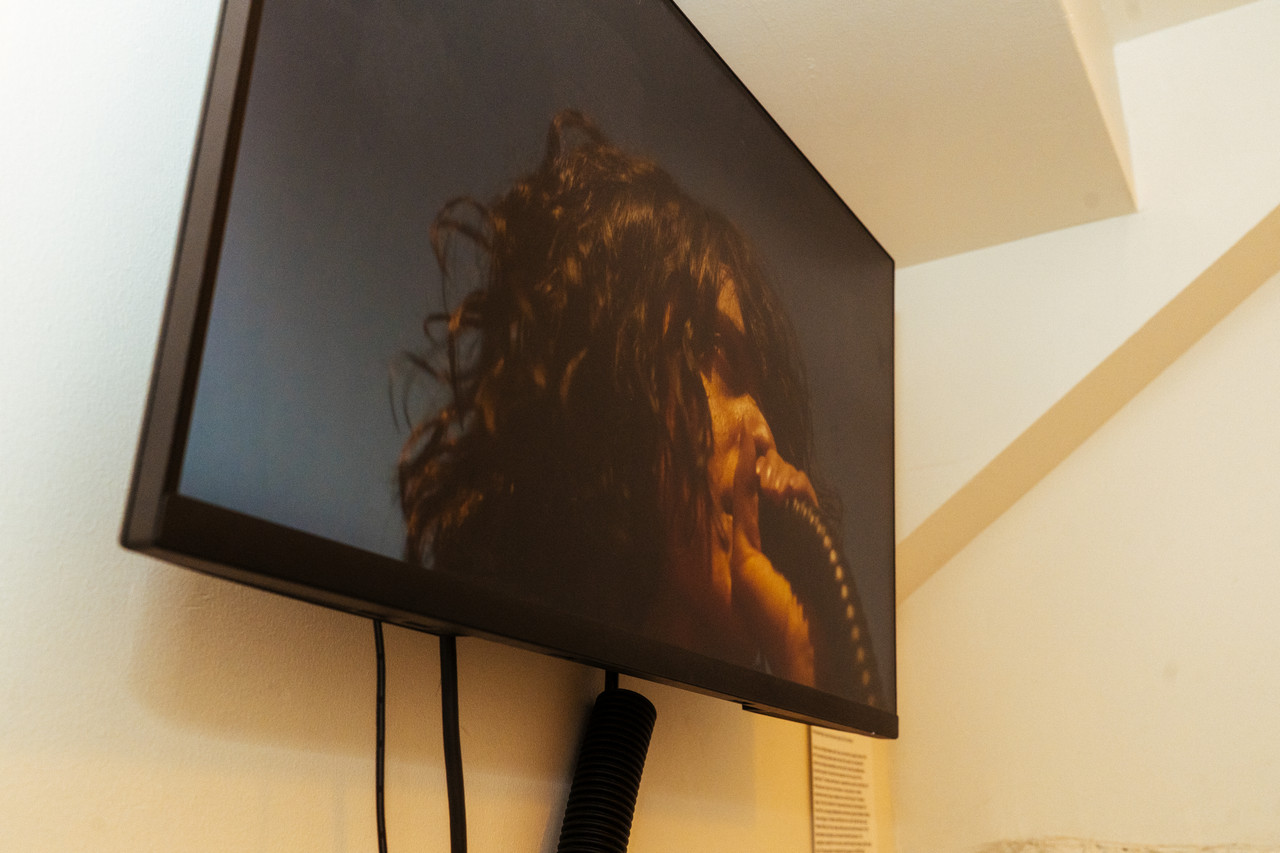
Photo: 480p
grief
Matthew Caren is a composer, computer scientist, cognitive scientist, and multimedia artist. His work uses sound to explore the affordances and opacities of the technologies we use to express ourselves. He studied computer science, music, and literature at MIT, and is currently a PhD student at Stanford. He is a fellow of the Hertz Foundation and Steve Jobs Archive.
Sewers hold everything we want evicted from public life. But what we send into the depths below is not gone, only hidden. What stories do we hear when we let ourselves face evidence of past life? An array of handmade microphones have been connected to the water pipes in this building. They summon an orchestra of discarded sounds—tapes, home video, shellac records. Water waste discarded conjures sonic waste rediscovered.
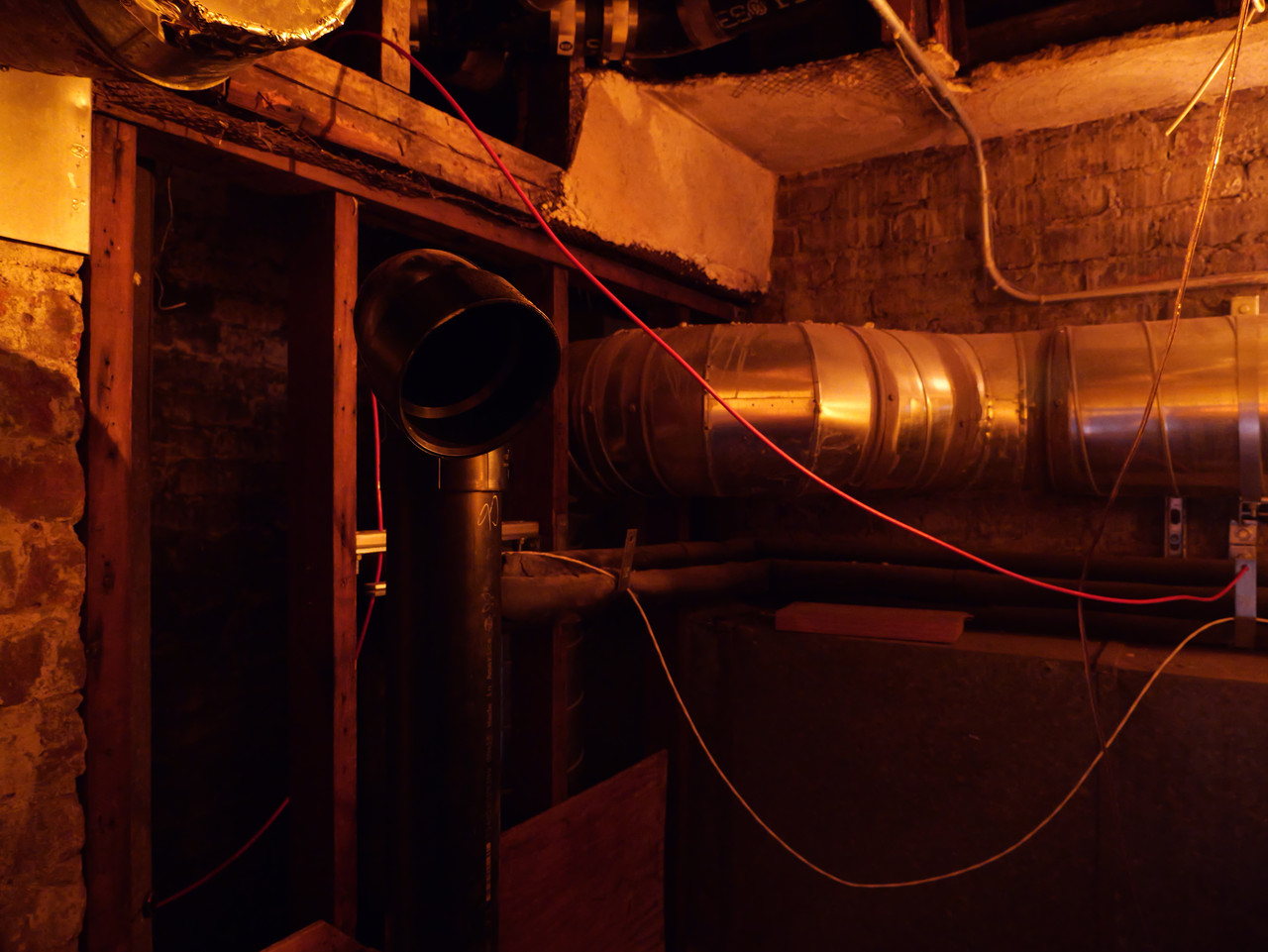
Photo: Toshi Hoo
Balseros
Jorji Cowan-Moreno (b. Miami, FL) is a queer Cuban-American interdisciplinary artist and Olorisa Olo Obatalá. Their practice engages ancestral knowledge systems to explore how diasporic histories are archived through contemporary technologies. Working across sculpture, installation, and performance, Cowan-Moreno approaches art as a form of ceremony and ethnographic research. Personal and political transmissions are reimagined as stories of devotion, migration, and survival that materialize through ritual labor. They attended the School of the Art Institute of Chicago and are completing a BFA at California College of the Arts in San Francisco. They are based in the Bay Area.
"Balseros" honors the ocean as a living ancestral force shaped by displacement, disappearance, and reverence. Archival images of refugees fleeing Cuba on rafts are handwoven with fishing line on the TC2 computer-assisted loom, emerging or vanishing as light shifts, inviting viewers to search for them and witness the ocean’s haunting beauty and memory. Invoking Yemaya and Olokun during the weaving transformed the loom into a ceremonial tool, a vessel for prayers and political traumas.
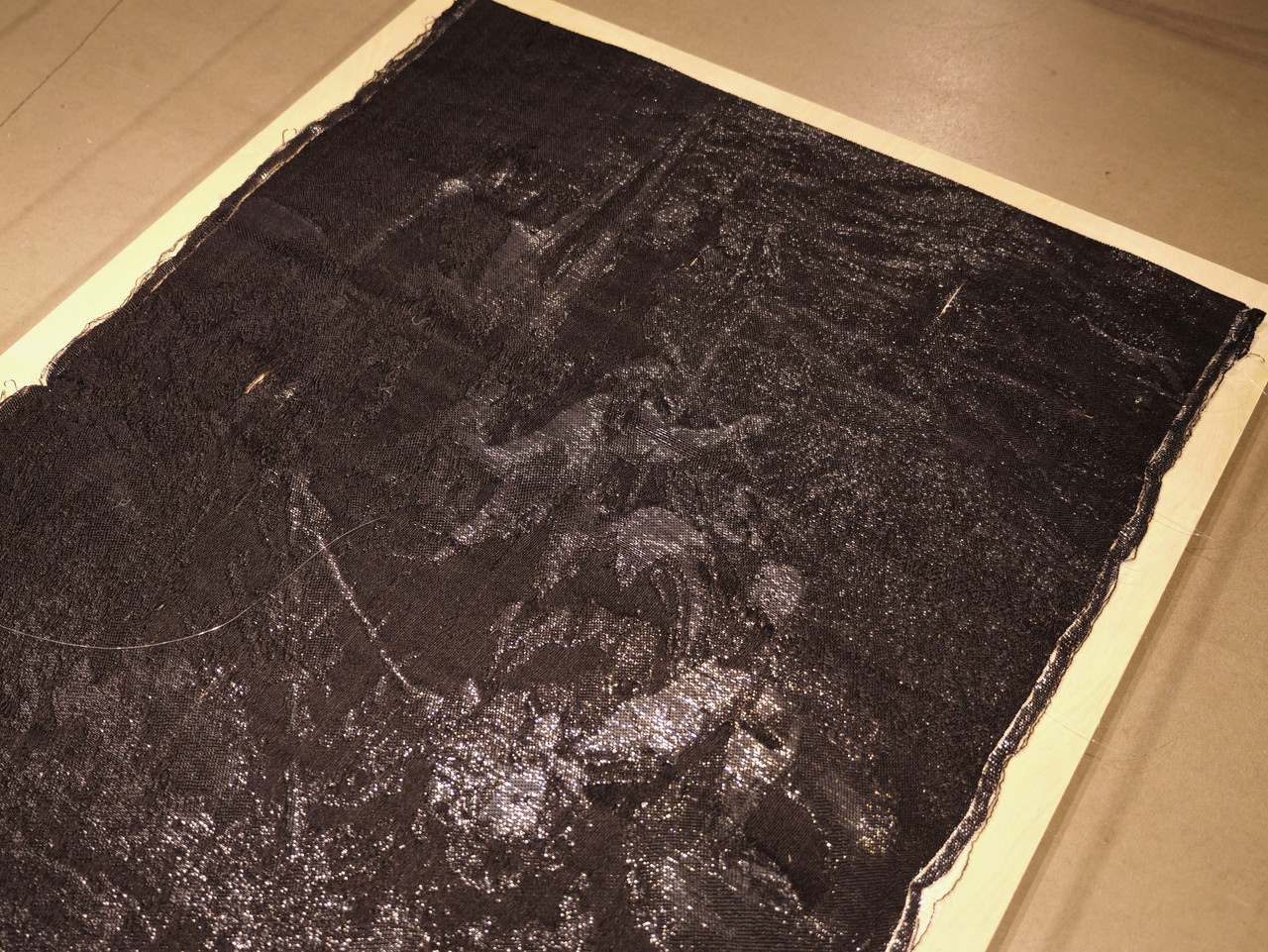
Photo: Toshi Hoo
On & Off Shore
Héloïse Garry is an artist working at the intersection of music, performance, and technology, drawing on a background as a classically trained pianist and later as a composer and technologist working across Paris, New York, and East Asia. She designs performance systems in which machine-learning models transform voice, movement, and embodied interaction into dynamic instruments, positioning AI not as a tool, but as an active collaborator in musical creation. Their research and performances have been presented at ICMC, NIME, and the Audio Engineering Society, contributing to ongoing conversations about how emerging technologies reshape musical practice and performance.
Stillness and movement are two defining qualities of the ocean. They coexist in the depth of its sounds and across the surface of its waters. Oceans know no boundaries. Yet their vastness is always shaped by the limits of land. "On and Off Shore" invites visitors to experience the tuned frequencies of underwater life and to move, between still image and motion, toward an encounter with the vastness and depth of the waters that surround us. Projection was paired with sound recordings of underwater life, captured in Monterey Bay.

Photo: Héloise Garry
Concerto in Glacial Time
Dan Gorelick is a Brooklyn and Bay Area based interdisciplinary artist who blends his classical cello and computation background to create immersive experiences, interactive installations, and improvisational performances. He explores how sound can create embodied and expressive works that blend acoustic, electronic, and digital techniques – finding ways to make the computer as expressive as the cello.
Concerto in Glacial Time is a generative audio-visual installation exploring water across geological timescales. Glacier sounds become the soloist, accompanied by ever-evolving cello lines. Interact with the touchscreen to play the glacier-sounds granular synth and change the visuals. Credits: Field recordings from ancient glacial air bubbles being released (H. Lentfer, NPS), Field recordings of glacier cracking (BBC), Cello recorded loops (by artist), Video footage (by artist) of rocky shoreline and waves in his hometown Jamestown, RI, processed via analog video synth techniques with Hydra video synth.
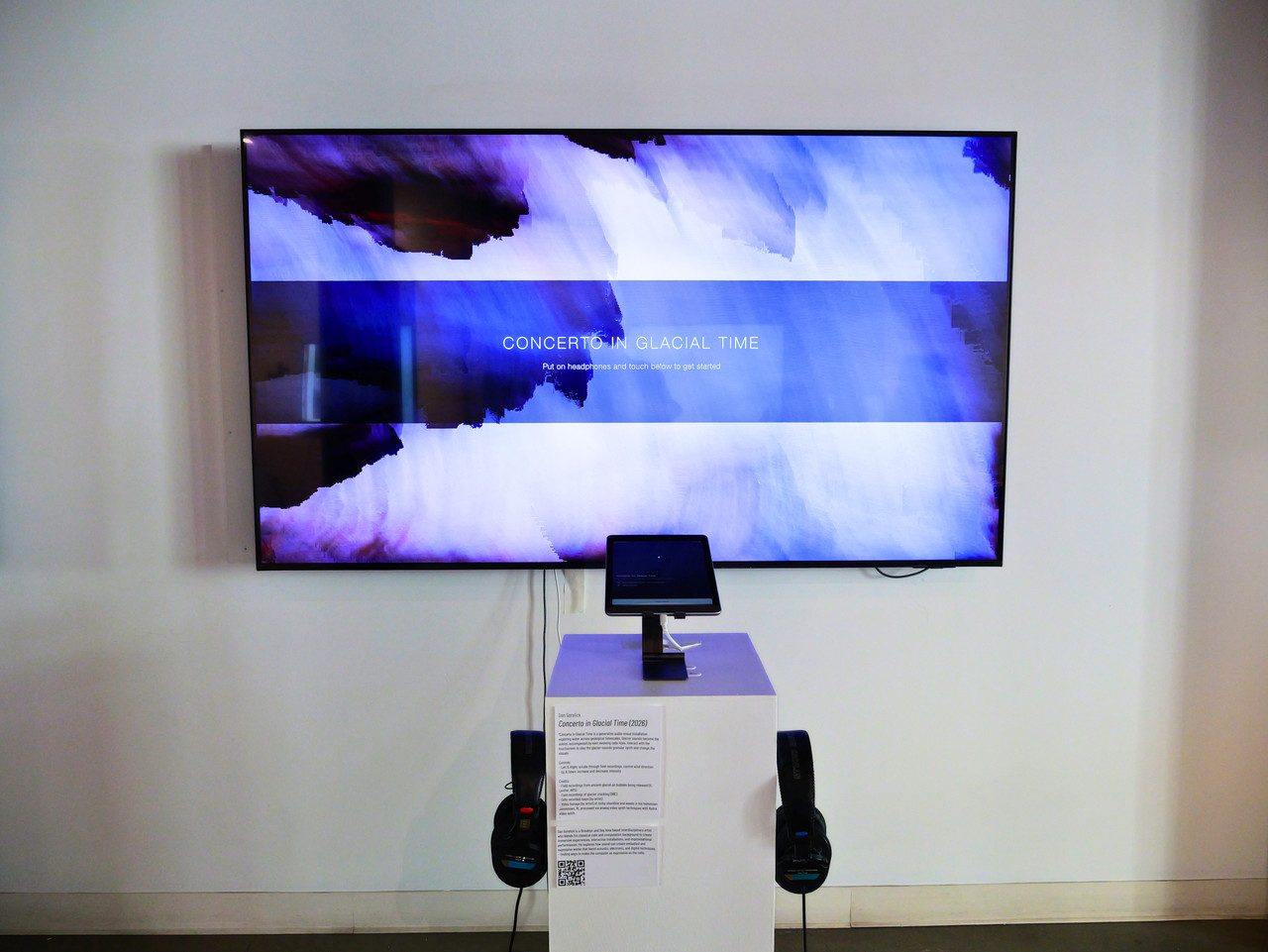
Photo: Toshi Hoo
Surface Tension
Ash Herr is an artist exploring play alongside emerging technologies.Scott Moore is an artist and curator from Toronto, Canada. His multimedia practice focuses on net art and sculptural hardware, reflecting on memory and time. Currently he serves as a board member of Gray Area.
A fourteen-second loop moves between mottled sunlight on water and electronic static. The CRT monitor, already antiquated, highlights our dreamlike memories of waves alongside the noise that threatens to erase them. The brevity of the loop denies contemplative distance, and insists on a more active relation between our pasts and possible futures. Will we watch something precious degrade and reform over and over again, or will we recapture our own attention as the infrastructure of care?
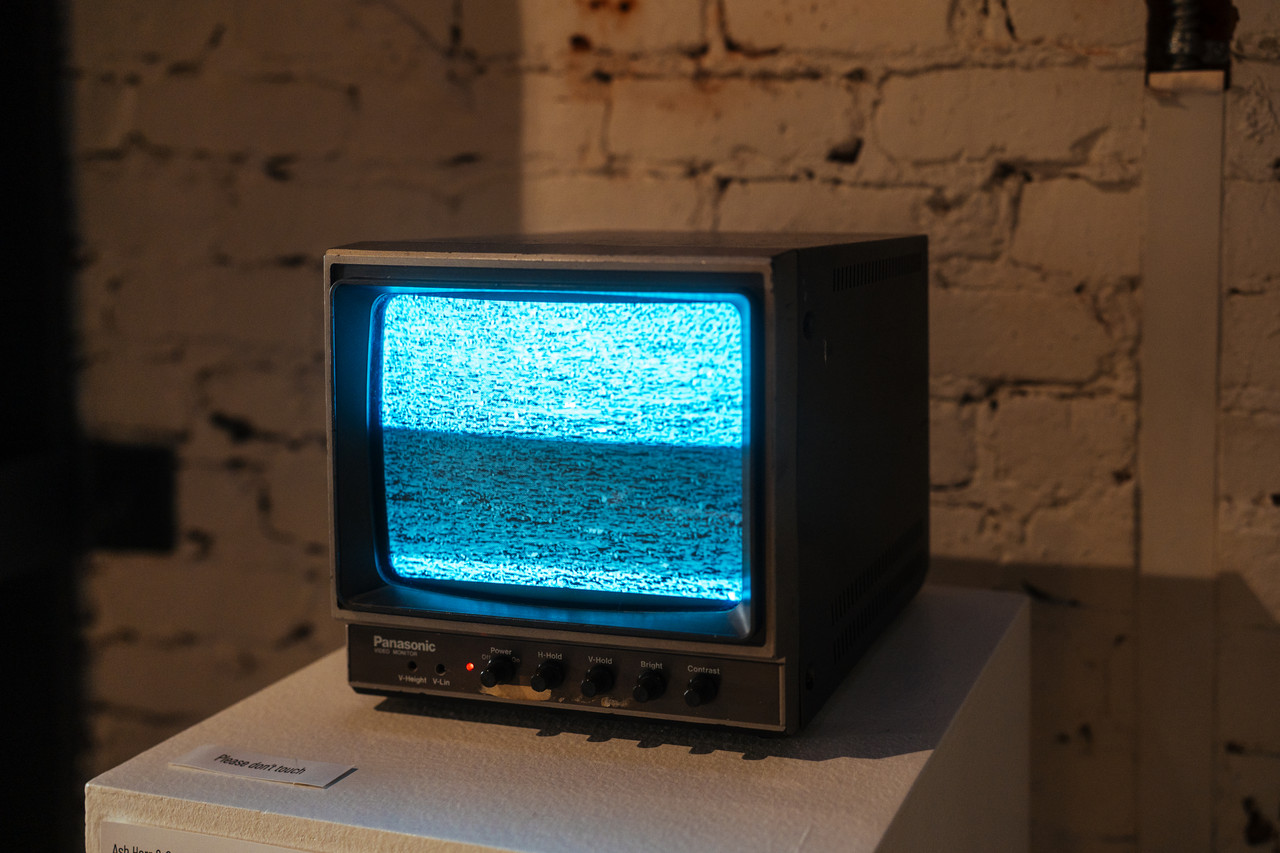
Photo: 480p
The Resolution of Water
pSpace Studio is the creative duo of Liza Bender & Toshi Hoo. Liza is a multidisciplinary artist with works shown at Meow Wolf, MASS ART, and Institute For The Future. Toshi is a media artist, creative technologist, experience designer and futurist whose projects have been featured at The United Nations, TED, Gray Area, and Ars Electronica. Together, pSpace Studio creates immersive installations at the intersection of art and technology. Their shared practice is driven by a love for spotting improbable moments of light and growing their optical garden. By transforming fleeting visions into tangible experiences, they are dedicated to making the improbable possible for the viewer.
The Resolution of Water is an interactive light lens magnifying human impact on a closed water system. With your interaction, the piece projects the immediate chaos and rhythmic return to stillness, embodying the dual meaning of "resolution": visual clarity and the labor of recovery. What is the resolution of water? It's a critical meditation for "Water Futures," asking: when we or nature disrupts our precious resource, are we prepared for the duration of its equilibrium?
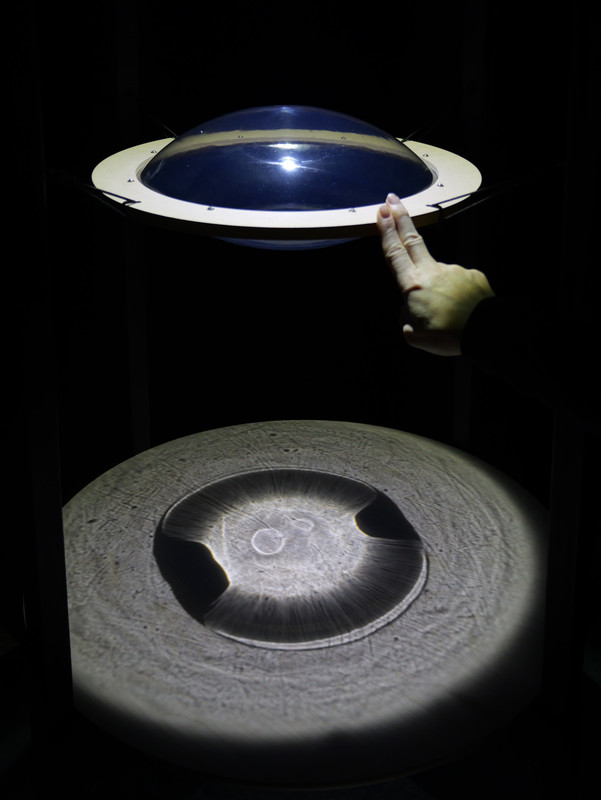
Photo: Toshi Hoo
Cryoscapes
Jiabao Li is an artist and associate professor at Northeastern University whose work explores climate change, interspecies co-creation, humane technology, and human perception. She works across wearable systems, robotics, AR/VR, performance, scientific experimentation, and immersive installation. In her TED Talk, she revealed how technology mediates and reshapes our experience of reality. Jiabao has received numerous honors, including Forbes China 30 Under 30, the iF Design Award, Falling Walls, NEA, STARTS Prize, Fast Company, Core77, IDSA, A’ Design Award, Webby Award, and Outstanding Instructor Award. Her work has been exhibited internationally at the Venice Architecture Biennale, MoMA, Ars Electronica, the Exploratorium, the Future of Today Biennial, Milan and Dubai Design Week, The Contemporary Austin, Ming Contemporary Museum, and the Museum of Design. Her academic papers appear in SIGGRAPH, CHI, ISEA, IEEE VIS.
Cryoscape began during Jiabao Li's Arctic Circle Artist Residency in Svalbard, inspired by water’s diverse forms—vapor in the clouds, snowflakes in the sky, liquid waves in the ocean, and the solid majesty of glaciers and sea ice. Each state reveals a distinct morphology, reminding us that we are connected through bodies of water. This encounter led to the creation of a 3D ice printer that captures ice formation while treating melting as a core aesthetic element. The printer produces forms across scales, from lunar terrain and snowy landscapes to microscopic crystals and sculptural references. A camera records the ice in real time, while an AI system translates these images into Haiku-inspired poems. Here, AI acts as a teacher. It invites us to see vast natural processes through a tabletop ice printer. Melting is the message. Unlike traditional sculpture, Cryoscape exists in constant transformation. As the work travels, local humidity, temperature, air quality, and water calcium reshape each ice formation, making every iteration site-specific and co-created with its environment. Each AI-generated poem carries an environmental cost, tied to the melting of a glacier. Cryoscape is a self-destroying machine.
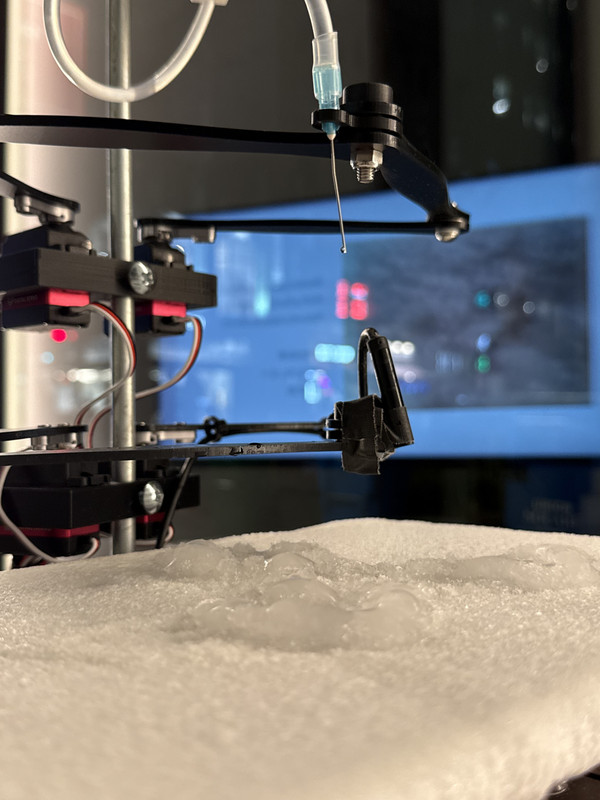
Photo: Ash Herr
Prompt Fountain-- Slop Generator
Jordan Metz is an experimental artist, researcher, and creative producer who works between digital and physical media. Her practice involves 3D scanning, digital fabrication, ceramics, and audiovisual programming as a means of forging connections between the real and virtual worlds. They code interactive computer vision systems in an attempt to generate embodied relationships with technology. They are interested in examining the global techno-heteropatriarchial infrastructure that supports digital life.
Prompt Fountain– Slop Generator is an interactive fountain installation that exposes the hidden water consumption of AI data centers. Six ultrasonic sensors monitor a three-foot detection zone around a ceramic vessel, measuring viewer proximity in real-time. An Arduino microcontroller processes these measurements, converting human presence into proportional water flow. Closer proximity and multiple visitors trigger exponentially higher flow rates, mirroring how data centers scale cooling infrastructure with computational demand. The weathered ceramic form is adorned with soldered circuit boards, juxtaposing ancient vessels with contemporary technology. As viewers approach, LED indicators illuminate and water consumption increases, making tangible the invisible cost of AI interaction. Each ChatGPT conversation consumes approximately 500ml of water in server cooling. This fountain transforms abstract statistics into immediate, physical experience and implicates viewers in the environmental consequences of artificial intelligence.
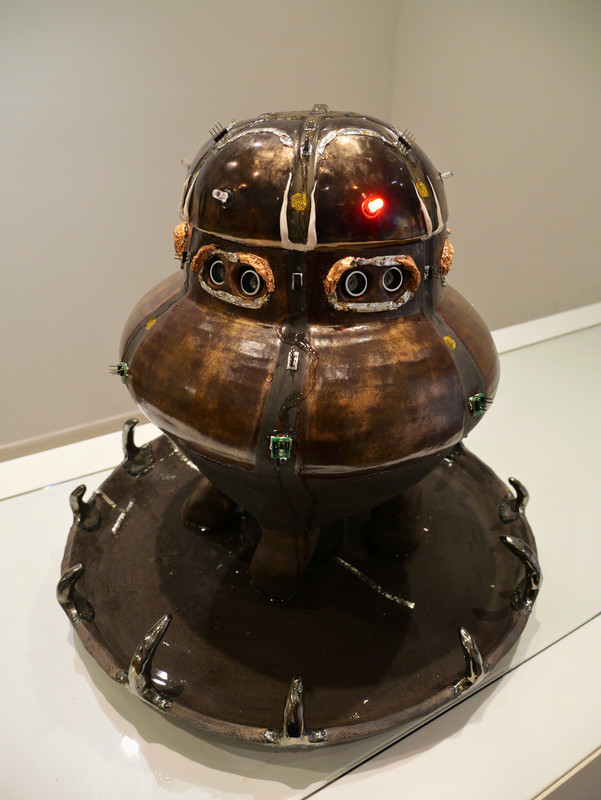
Photo: Toshi Hoo
Flow
Hila considers natural pattern formations, fluid dynamics, and physical materials as programmable matter to be discovered, designed, and re-invented. At the core of Hila’s work is a vision of accessible creative tools for interactive materials that translate material dynamics into tangible human perception. Her work has been published in venues like ACM CHI and exhibited internationally. She holds a Master of Media Arts and Sciences from MIT Media Lab and a B.Des Cum Laude in Product Design from Bezalel Academy. Through interdisciplinary collaboration, she works towards accessible material interfaces that transform how we experience and interact with our daily environments.
'Flow' is a visual study of water moving through paper using only cuts, ink, and water. The hypnotic rhythm of liquid advancing through fiber offers meditative visual rest while making visible the invisible forces of capillary action and chromatic separation. As black ink dissolves into unexpected gradients, each fiber acts as a tiny channel, demonstrating how simple geometric constraints choreograph complex fluidic phenomena.
Sacramento Paradox Triptych
Greg Niemeyer is a data artist and Professor of Media Innovation in the Department of Art Practice at UC Berkeley. He's the former director and co-founder of the Berkeley Center for New Media.
With the "Sacramento River Paradox" Niemeyer seeks to direct our attention to the awesome Sacramento River, which quenches the thirst of 1/3 of all California residents, grows their food, and washes their bodies. In a set of three images, Niemeyer visualizes the river's flow and water level throughout the Winter 2023 season. Flow and level are the result of snowmelt, temperature, wind and rainfall, connecting the most remote regions of California with the most densely populated urban centers. The images show this data through novel data visualizations. The left image in the triptych shows an AI forecast, the right image shows actual measurements, and the middle image shows the difference between the two.
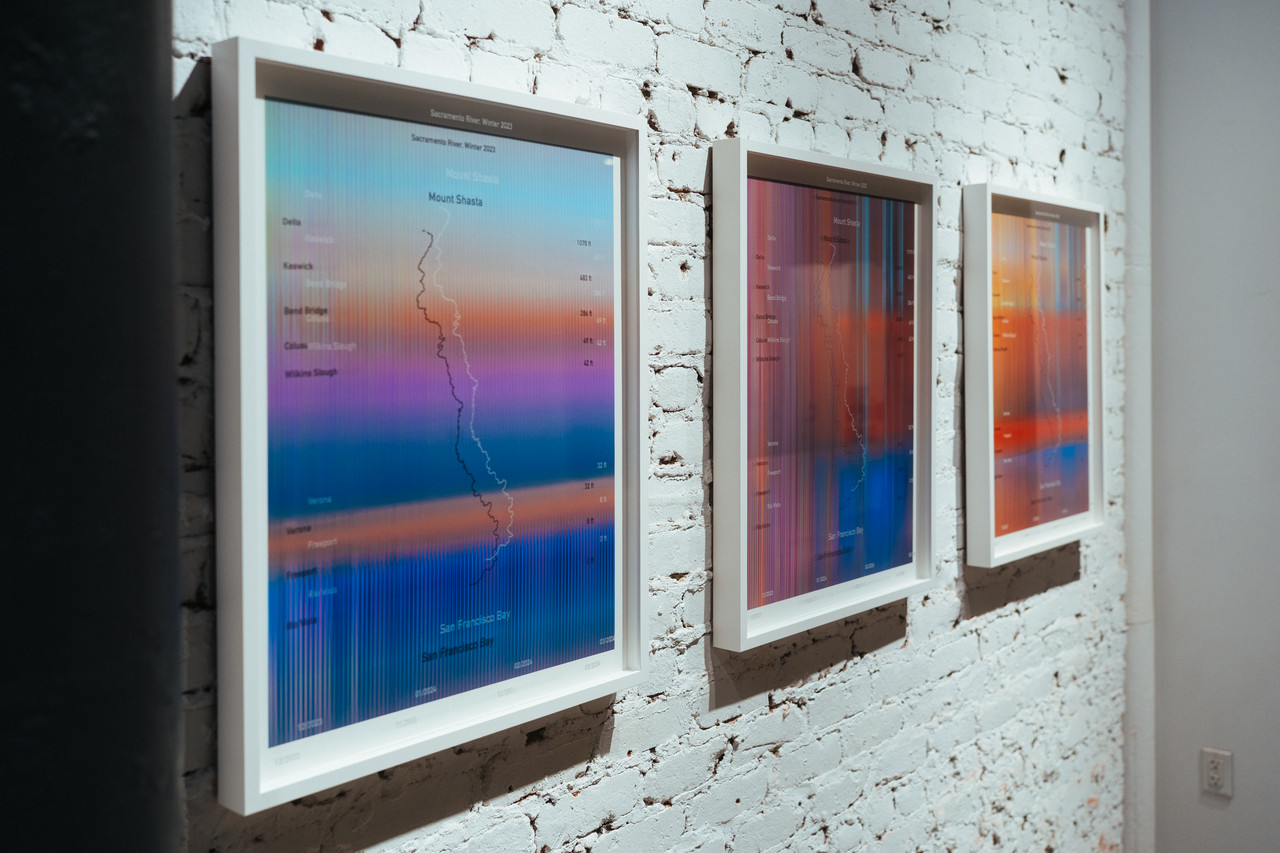
Photo: 480p
Altar
Norman Sheu is a research mathematician whose artistic practice is driven by a desire to understand systems from their foundations. This interest in first principles led him to undertake every stage of indigo production, from cultivating the seeds to managing the chemistry of the dye vat. Much like his approach to mathematics, his practice is an effort to deconstruct a complex result into its essential parts, honoring the rigor and labor required to build a process from the ground up.
Altar is a meditation on the cycles of water, labor, and growth. Surrounding a dried indigo plant, the quiet end of a lifecycle, are twelve panels of indigo-dyed fabric. Six shibori pieces represent the journey from seed to plant, a transformation that relies on the purity of water the artist used to grow the plants, extract the pigment, and dye the fiber. By touching your phone to the pestle, you are invited into a digital rain altar. Here, language is not preserved, but weathered as words fall, flicker, and dissolve into the depths, returning to the fluid state from which they emerged.
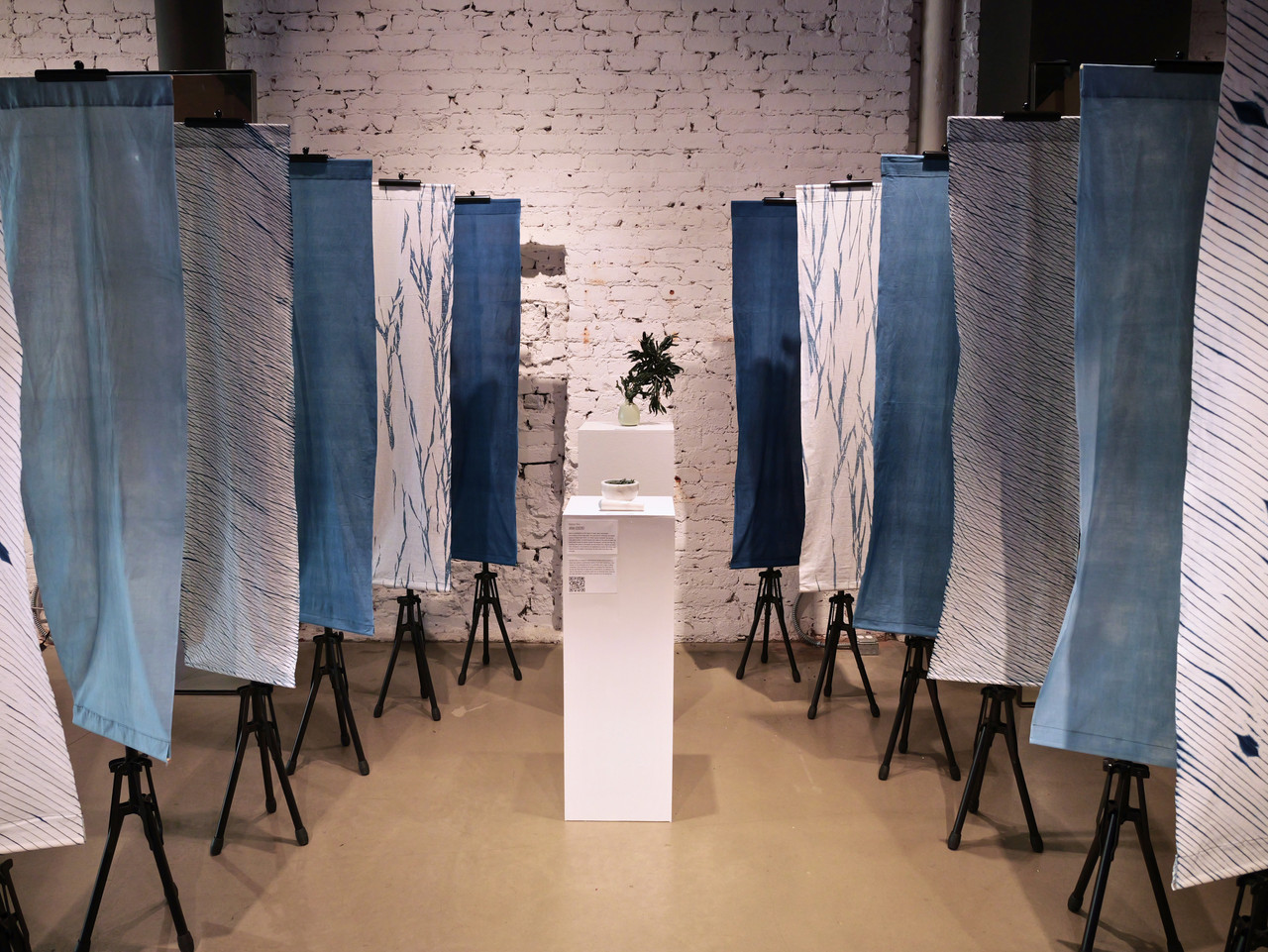
Photo: Toshi Hoo
Fountain
Yehwan is a Korean-born, New York–based web artist who critiques user-centered design. Their work examines how the internet became an environment that privileges efficiency while masking inequality. Using non-generic interfaces and performative friction, Yehwan exposes political, cultural, and economic assumptions embedded in UX, data extraction, and claims of universality itself.
Fountain uses water as a conductive touch input, dripping onto an iPad screen to repeatedly wake a face on a website and disturb the device. The iPad stands for polished, standardized interface design that trains users into automatic gestures, reducing content awareness. By interrupting this loop, the work forces renewed attention, framing disruption as a small act of self-care.
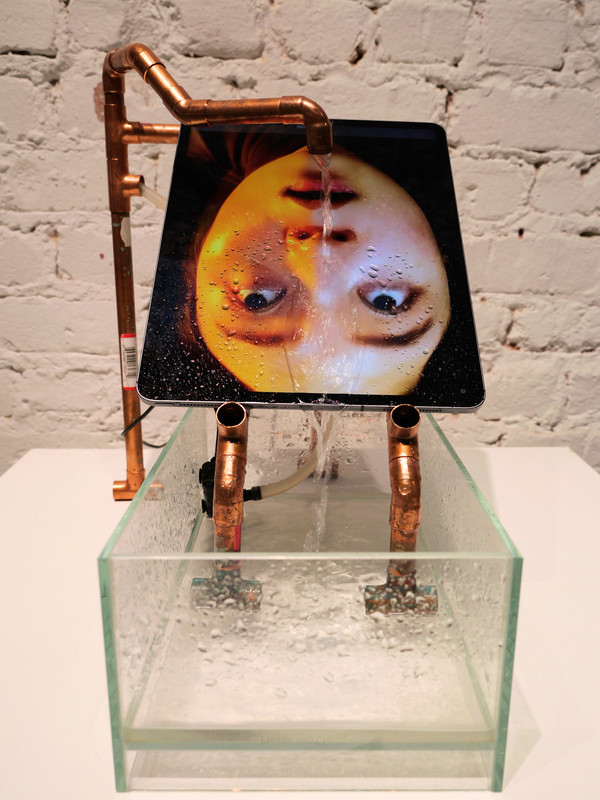
Photo: Toshi Hoo
Waterplay
Koh Terai is an artist and designer. He creates novel aesthetic experiences guided by beauty, simplicity, and excellence. He strives to create awe and wonder through his primary medium of light. As a designer and cinematographer, his work has been featured internationally, including the Cannes, Dubai Design Week, Singapore Good Design, and the InterCommunications Center in Tokyo. He studied Computer Science and explored the world during his time at NYU Abu Dhabi and studied Design at Stanford for his Masters.
Experience the effect a single droplet of water can have on a ray of light — a play of caustics, motion, and chance.
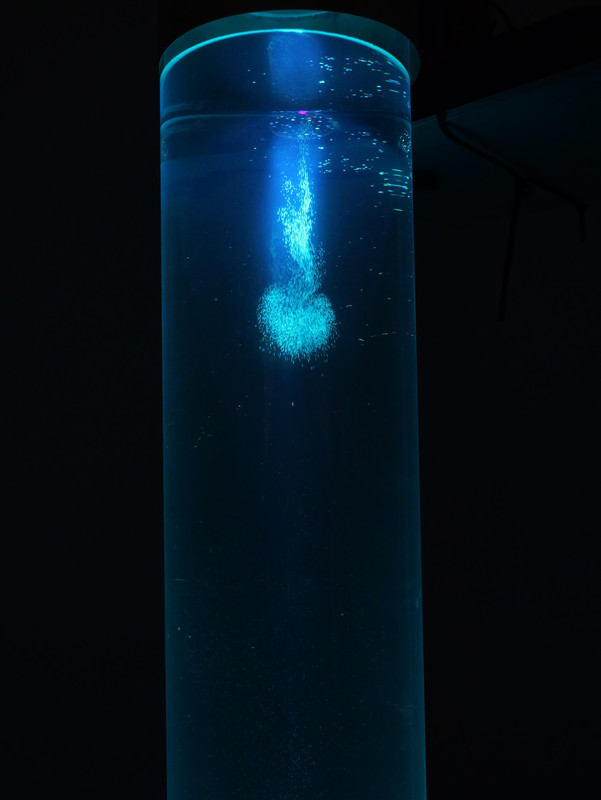
Photo: Toshi Hoo
Go With the Flow
Koh Terai is an artist and designer. He creates novel aesthetic experiences guided by beauty, simplicity, and excellence. He strives to create awe and wonder through his primary medium of light. As a designer and cinematographer, his work has been featured internationally, including the Cannes, Dubai Design Week, Singapore Good Design, and the InterCommunications Center in Tokyo. He studied Computer Science and explored the world during his time at NYU Abu Dhabi and studied Design at Stanford for his Masters.
Experience the effect a single droplet can have on a ray of light—a play of caustics, motion, and chance. Sound by Héloïse Garry
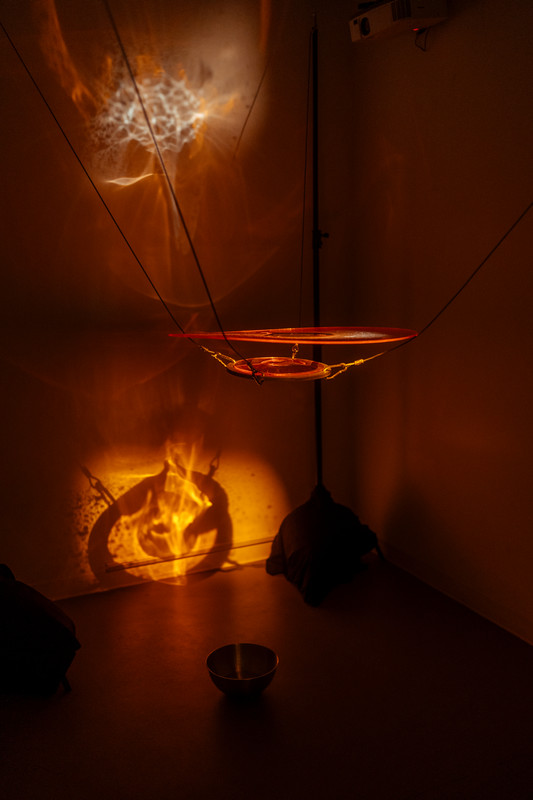
Photo: 480p
Space Palatte Pro
Tim Thompson is a software engineer, musician, and installation artist. His wide-ranging artistic work spanning four decades includes a programming language for MIDI, interactive installations at Burning Man and other festivals, musical performances with PlayStation dance pads and QWERTY keyboards, and real time video looping and processing with a handheld security camera. Recently, Tim has focused on the expressive potential of three-dimensional input in visual music instruments, using devices such as the Microsoft Kinect (in the original Space Palette) and the Sensel Morph (in the newer Space Palette Pro).
The Space Palette Pro is a visual music instrument played by finger-painting on pressure-sensitive pads. As a “casual instrument” it is immediately accessible and immersive, with expressive depth that rewards creative exploration. No pre-recorded media, sequences, or loops are used - everything is generated in realtime by your hands.
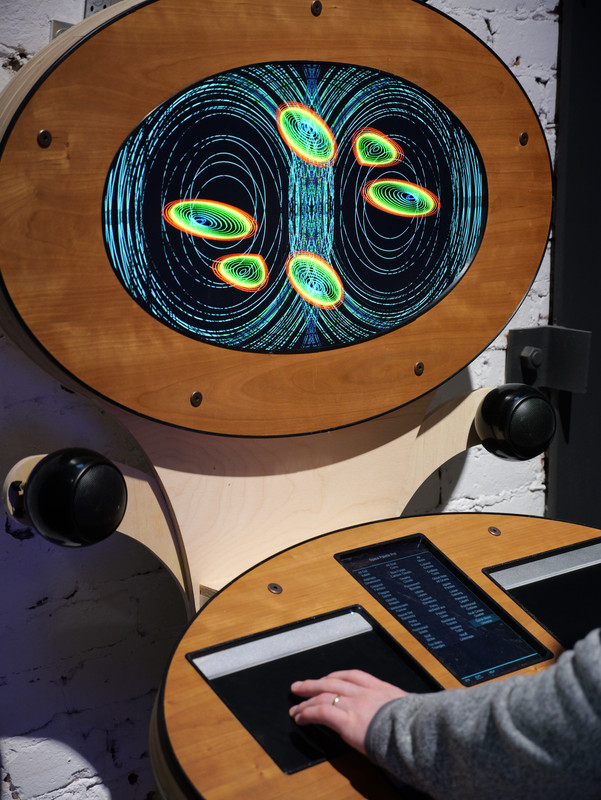
Photo: Toshi Hoo
Whispering Pond
Kuan-Ju (KJ) Wu is a creative technologist, new media artist, and interaction designer with a focus on material experiences. His practice revolves around research, innovation, and collaborations – with both humans and non-humans.
A listening space in the gallery receives voices. When breath enters, a fountain stirs in a distant pond, its movement returning as light and sound. Breath becomes flow. Against a time when experience is flattened into screens and commands, the work turns toward the hydrocommons—water as shared, relational, and unowned—where speaking is not control, but a joining, and water answers in its own way.
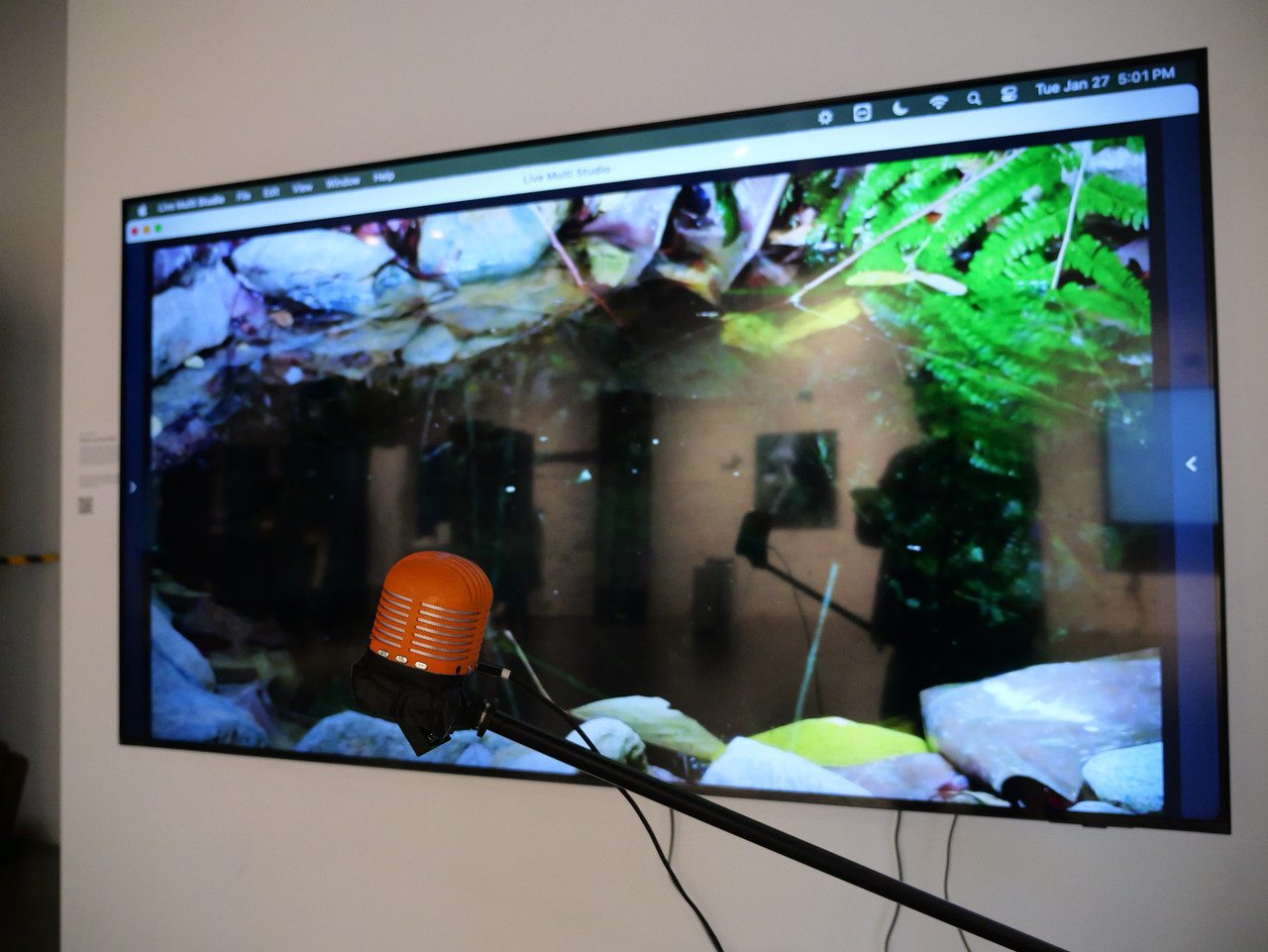
Photo: Toshi Hoo
-1.png)