Computer Love
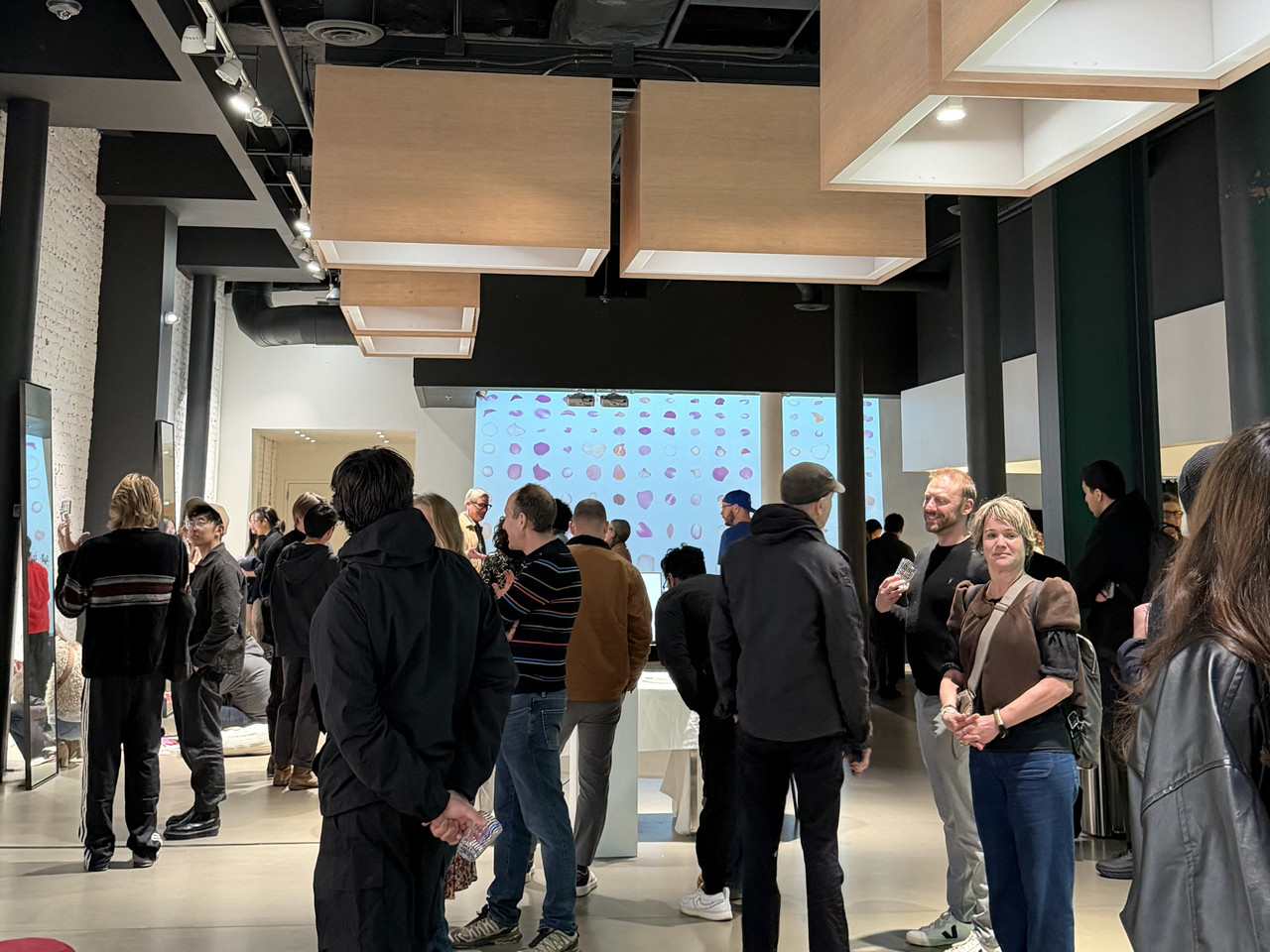
Computer Love is a group exhibition celebrating the love between, through, with and within our computers.
About the Exhibition
Computer Love explores love between computers, love from computers to humans, and the love humans develop for machines: the romantic, parasocial, devotional, transactional, and strange.
Artworks
The Sound of Love
Chia Amisola (b. 2000, Tondo, Manila; lives and works in New York & Manila) is an artist of agencies and ambiences. Their work is devoted to the internet's loss, love, labor, and liberation, particularly of the third world experience.
The Sound of Love (2022) gathers the comments left under love songs, calling attention to the love, loss, and longing in the YouTube comments section. Despite platforms and algorithms homogenizing experience and attention, humans continuously create pockets of intimacy on the internet. These comments have been handcurated by Chia Amisola since 2020.
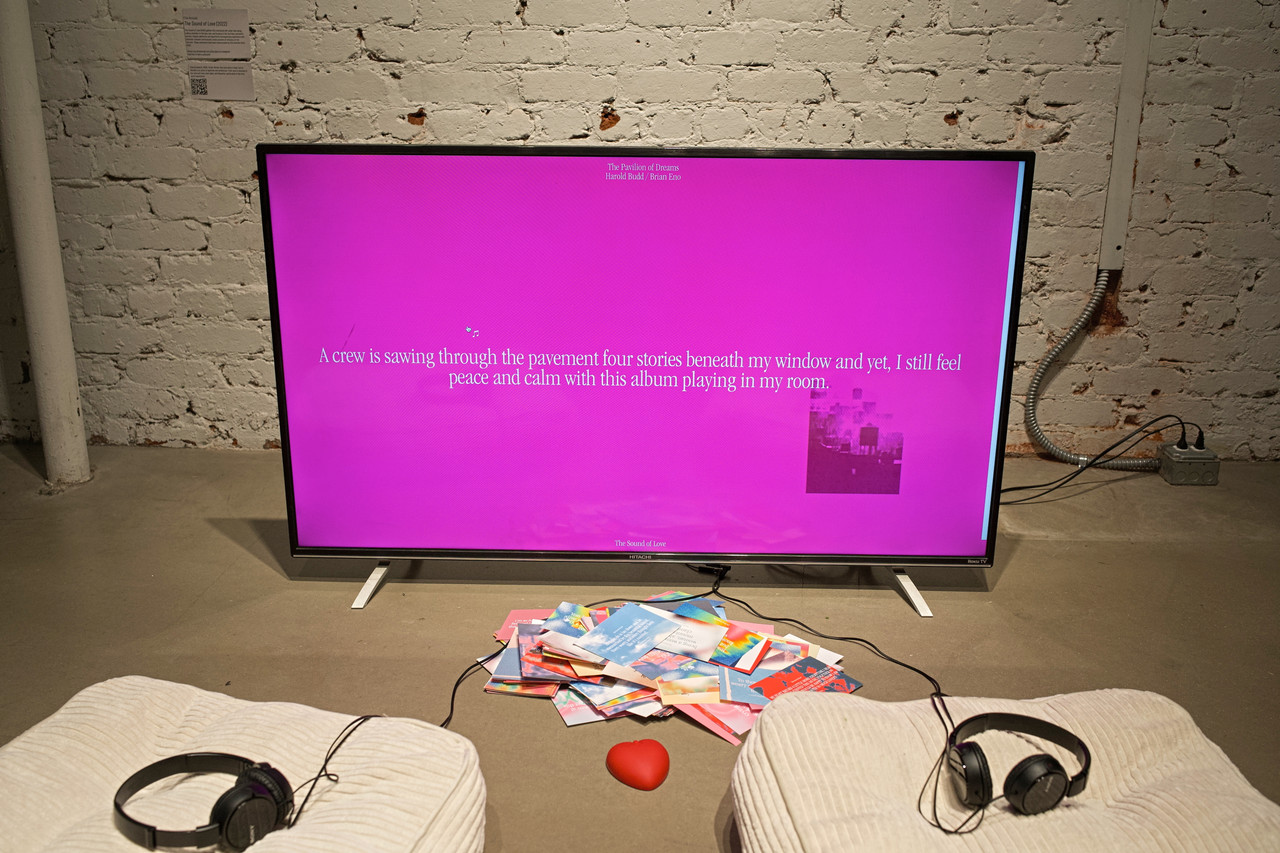
Photo: Ash Herr
The Body; Electric
Alex Perry is a punk creative technologist who goes by Get Circuit Bent because his name is completely un-googleable. Based out of West Oakland, he teaches electronics for creatives and circuit benders via workshops and YouTube.
The Body; Electric interrogates how we use computers in social, romantic, and sexual relationships: divorcing them from the physical and replacing literal interactions of bodies with a purely visual simulacrum. While this piece recognizes the strain of the insistence of these electric triggers on our bodies, it is also optimistic that technology could still enable the kinds of ultimately human relationships idealized by media of the dot-com and Y2K era.
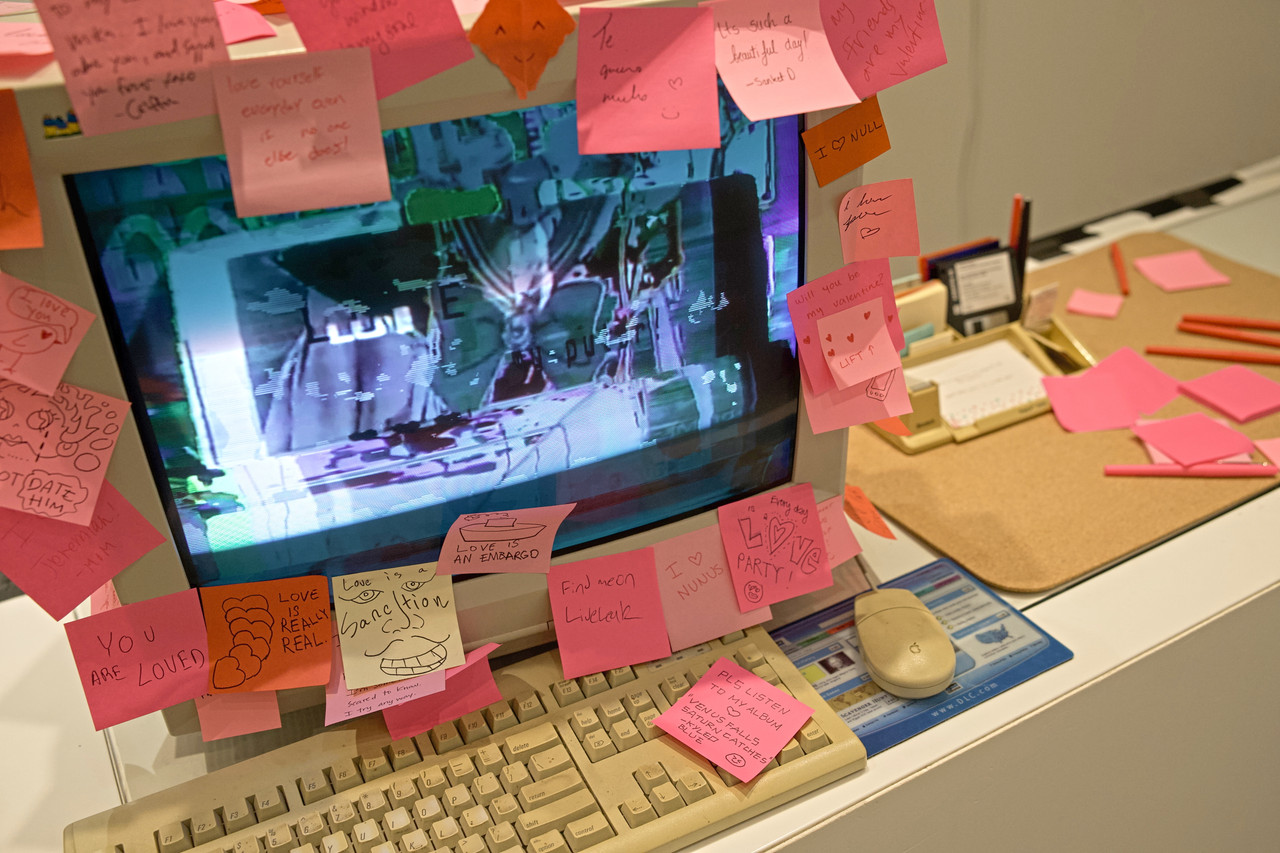
Photo: Ash Herr
the last sunrise in our shared icloud
fíona is a mixed media artist and self-taught designer. they hail from northern california, the pacific northwest, and the north of ireland. fíona's practices are inspired by growing up with the land (offline) and the early internet (online). their work has been published with institutions like metalabel, are.na annual, kernel mag.
composed of poetry, video art, and an original song to accompany visuals — this piece reflects on love + heartbreak in the internet age, media as memory + attachment, and new media creation as a vehicle to process grief.
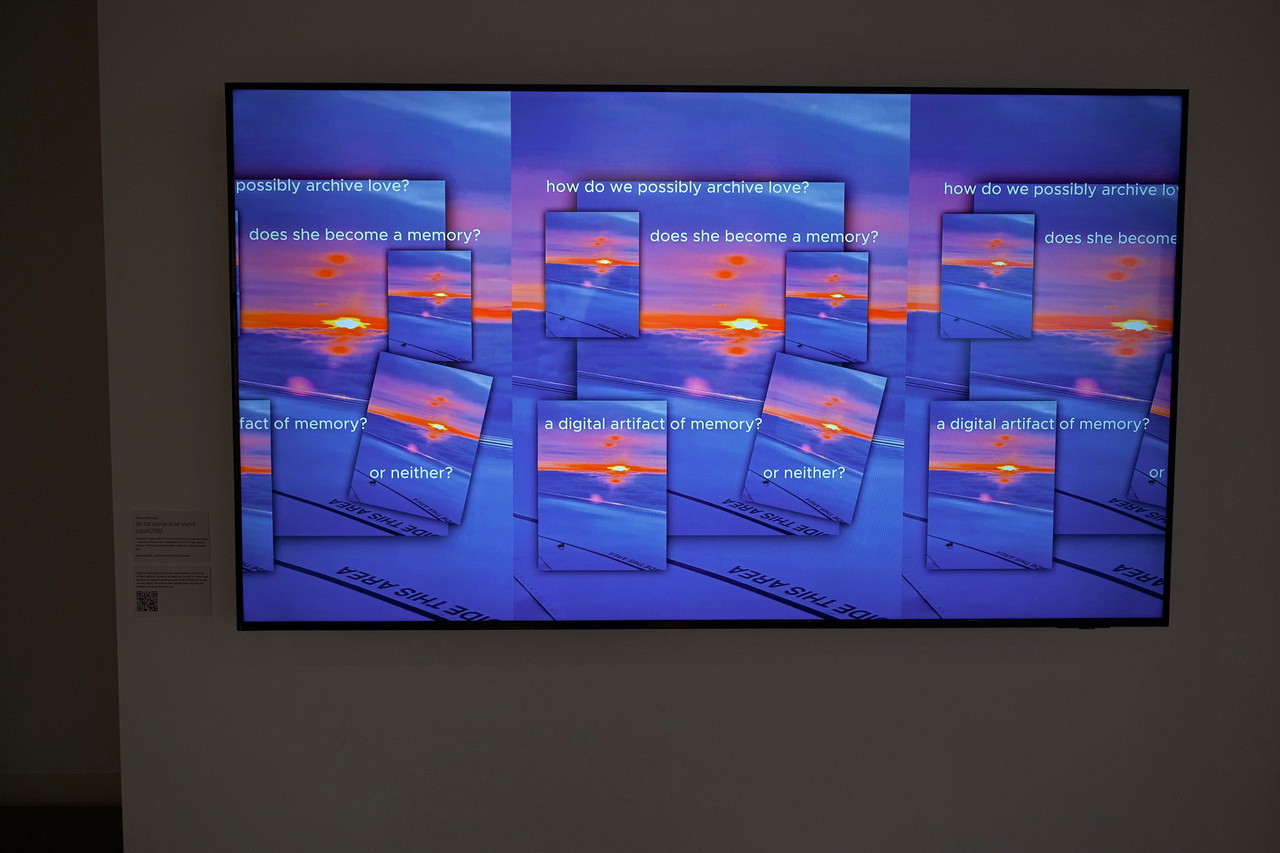
Photo: Ash Herr
Luminaria
Sophia Diggs-Galligan is an artist and researcher living in San Francisco, CA. Sophia’s background is in developmental cognitive science, but their curiosity about the human mind also inspires them to create interactive and tangible art installations that explore how people play, communicate, and collaborate. Torque Dandachi is a researcher currently working at Microsoft on developing a topological quantum computer.
The lanterns in this room are from our wedding. They respond to your voice, growing brighter as you speak. We were thinking about vows and how saying something aloud changes it. Speaking, especially with a witness, can be a kind of commitment or incantation. We share things with machines we might hesitate to say aloud to another person. This computer receives what you say without replying, holds it for a moment, and lets it go. Nothing is recorded.
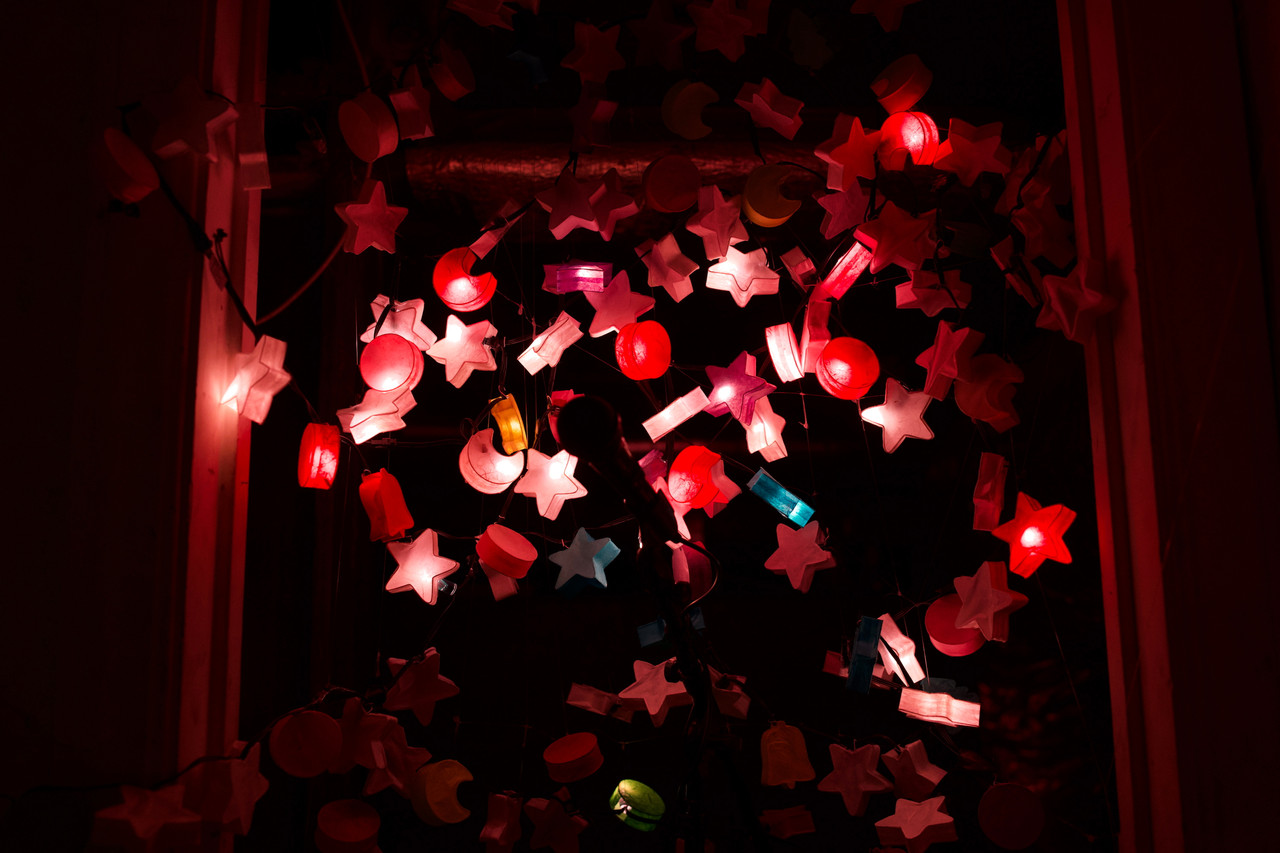
Photo: Ash Herr
R U REAL
hamsa fae (b. Los Angeles) is a Vietnamese-French contemporary artist who works across expanded performance, technology, and social engagement. With a decade of practice in land-based animism, she positions the body as a site of re-matriation. Her work as an artist is directly influenced by the political and spiritual mundane of trans womanhood. Through embodied actions, she cams with strangers online, walks a nude runway, plucks leg hair for several hours, and loops spectator voices for ancestral expression. Her eco-performances also translate into video and sound installations, employing internet nostalgia to queer codes of endurance and temporality. She invites audiences to participate in her site-specific interventions, archiving collective ritual to confront the cultural erasure of third gender peoples.
R U REAL is a looping, experimental video GIF that archives a durational livestream performance broadcast from a (trans) girl’s bedroom on the adult website Chaturbate. Over three hours, I tweeze leg hair while engaging 500+ viewers through chat, tipping, and webcam exchange. The work reframes erotic camming as a screen based ritual, exploring how devotion and care economies are shaped by platforms—trained by interfaces for self-gratification, algorithms of desire, and transactional attention.
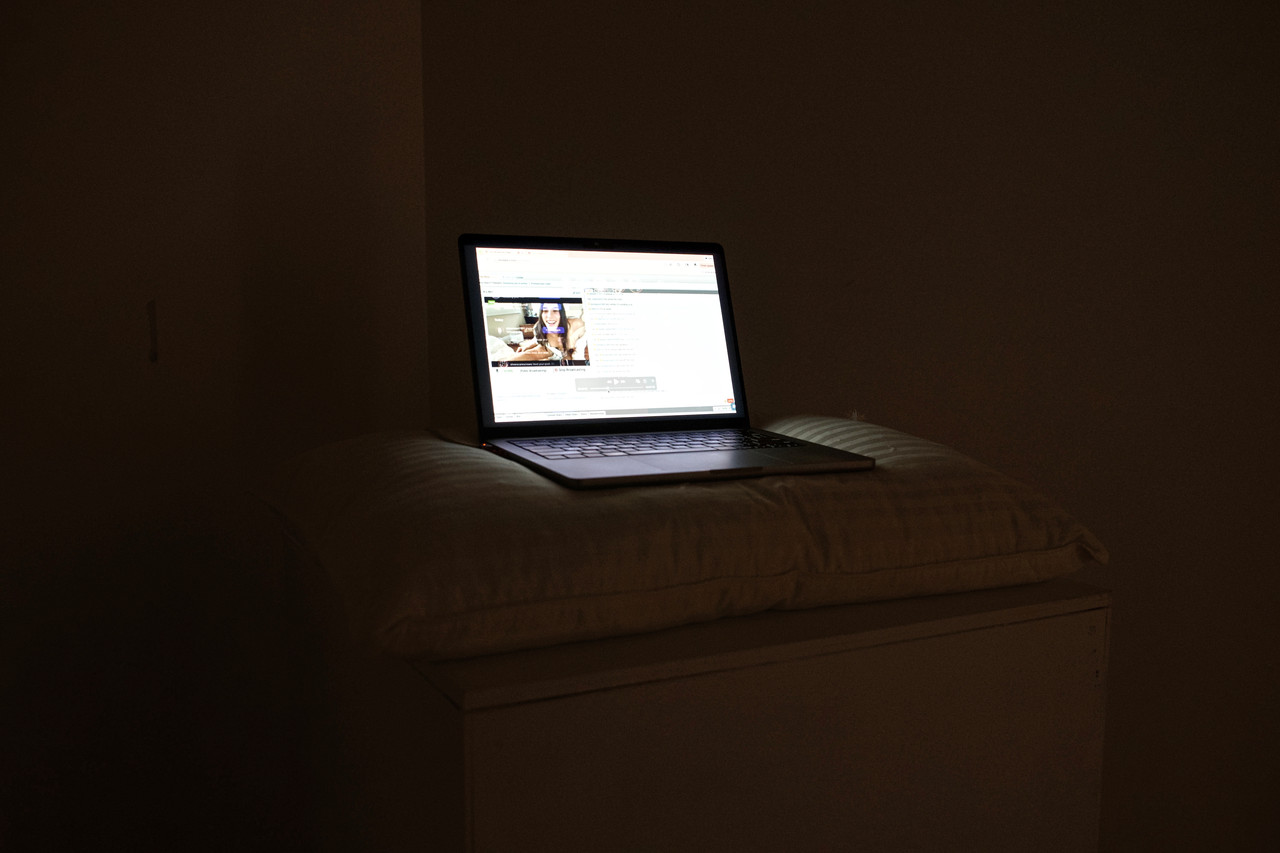
Photo: Ash Herr
Holding Patterns
Ash Herr is an artist exploring play alongside emerging technologies. Scott Moore is an artist and curator from Toronto, Canada. His multimedia practice focuses on net art and sculptural hardware, reflecting on memory and time. Currently he serves as a board member of Gray Area.
Two touch sensors register the electrical rhythm of the body. When held individually, each generates a sphere of light, a pulse made visible. When both are touched simultaneously, the signals begin to circulate between them. A heart form emerges in the space between, produced in real time by their combined currents. Holding Patterns considers connection as something negotiated rather than assumed. Each participant becomes a node within a temporary system, transmitting and receiving at once. The heart is not fixed or symbolic; it appears only while contact is sustained and dissolves the moment it is released. In an era where intimacy is mediated by networks and interfaces, the work returns to touch as a primary condition. It frames attunement to one’s own internal rhythm and to another’s as a subtle act of co-presence. What forms between the sensors is a shared circuit: contingent, luminous, and sustained only together.
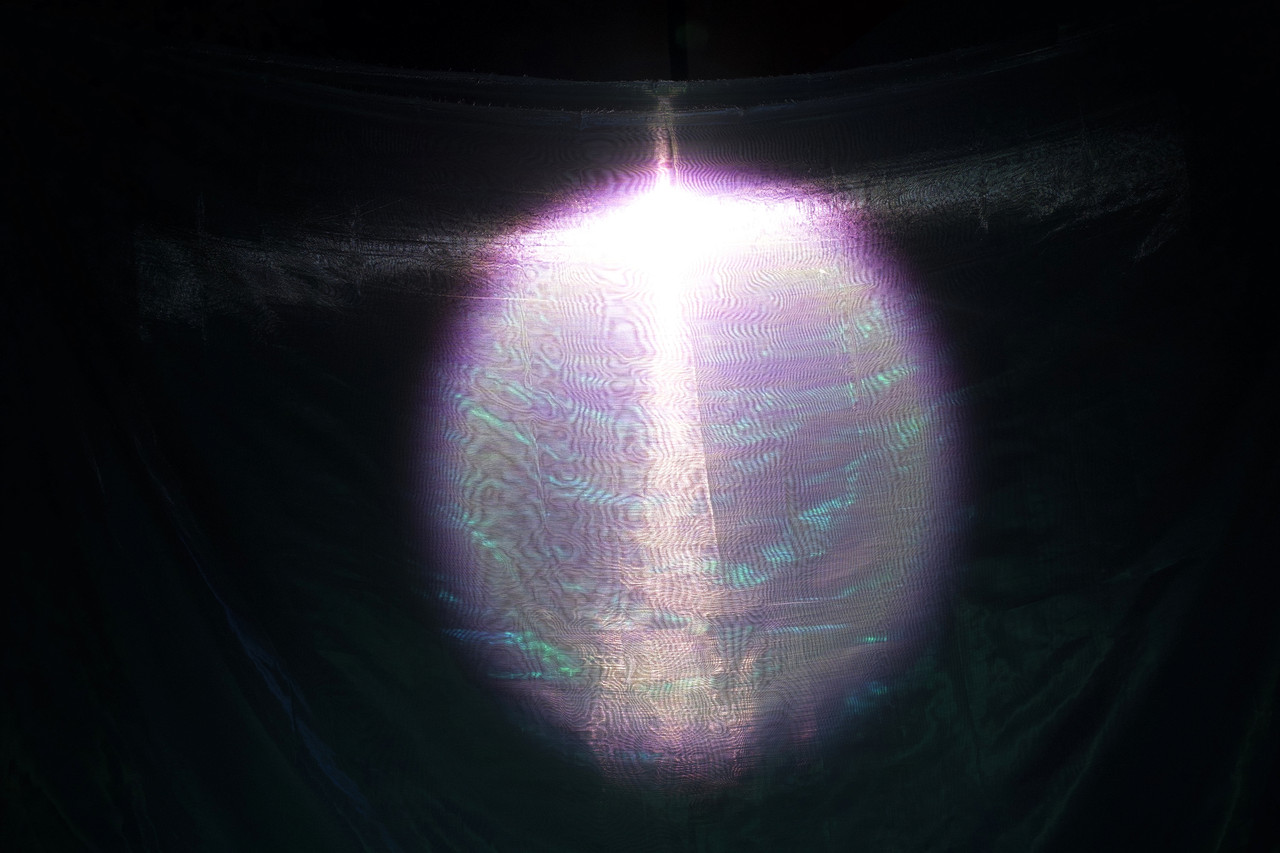
Photo: Ash Herr
Limitless Bad Advice
Andrew Kleindolph is an Iowa-born artist who studied painting at the University of Iowa before moving to Oakland to pursue graduate studies in interactive electronic art at Mills College. He lives and works in San Francisco. His work has been exhibited at Headlands Center for the Arts, Root Division, the Santa Clara Museum of Art, Dominican University, and the School for Poetic Computation in New York City. Career highlights include a Creative Code Fellowship supported by Gray Area and Stamen, publishing a graphic novel based on travels in Senegal, Mali, and Ethiopia, and completing a residency at 72andSunny in Los Angeles. Kleindolph has received an Artist’s Fellowship Award at the Eyeo Festival, been featured on the Bantam Tools podcast, and participated in art fairs across Seattle, Chicago, Houston, and San Francisco. Selected illuminated works are available through Open-Editions. His creative practice is deeply informed by teaching. As a technology and industrial design instructor in the Technical Arts department at Lick-Wilmerding High School, he has developed courses in electronics, circuits, 3D, and sustainable design.
Limitless Bad Advice examines the intimacy of seeking counsel from something that cannot know you. Visitors press a button to receive guidance on desire, creativity, or finance from a small AI running locally on a Raspberry Pi. It offers only what it can: recombinations of inherited patterns, delivered with unfailing availability. What kind of relationships and life decisions emerge when we repeatedly turn to a limited, landlocked system that fails us again and again?
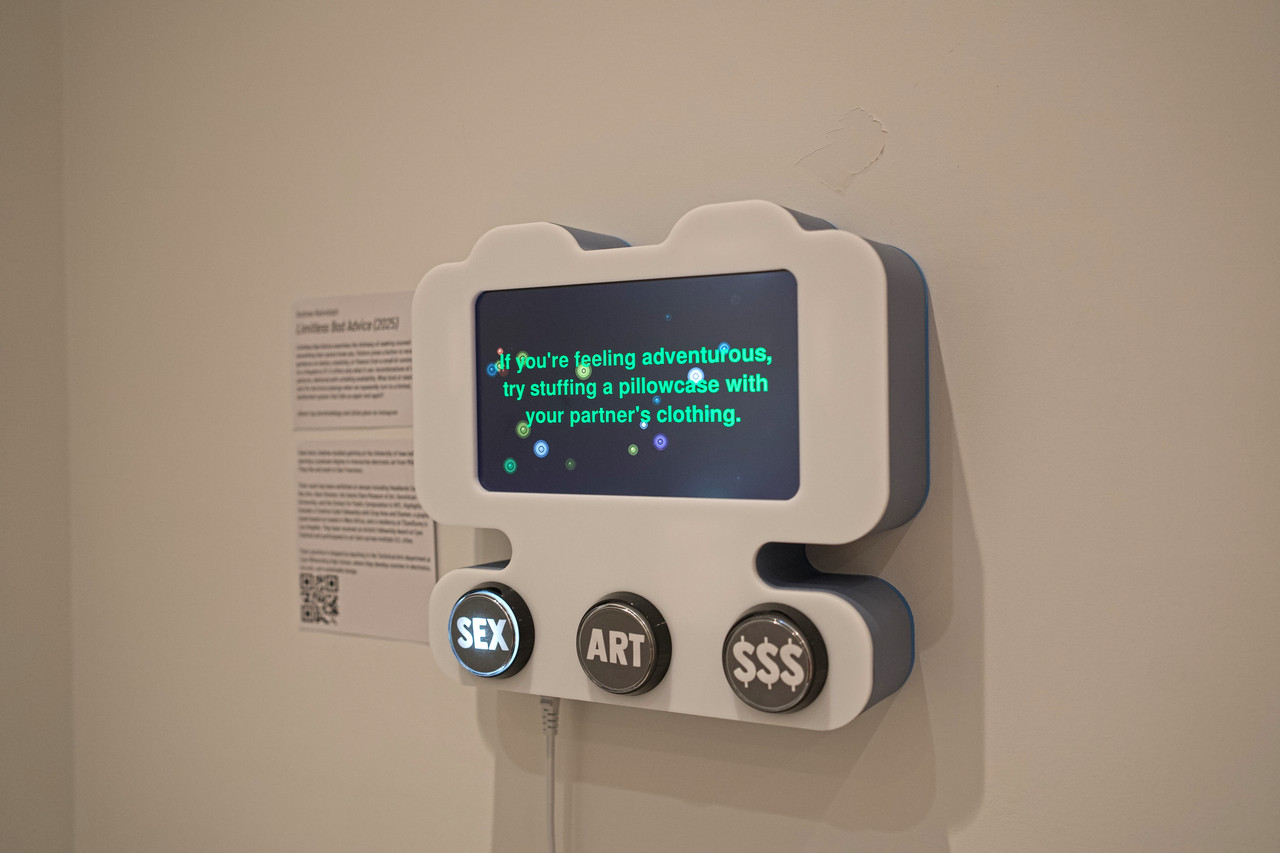
Photo: Ash Herr
Nubmoan
Morry Kolman (WTTDOTM) is an award-winning independent multimedia artist and developer born and raised in NYC. His work has been featured internationally in media outlets such as GQ, The Guardian, Vice, Fast Company, The Verge, and art institutions such as the Museum of the Moving Image, Rhizome, and Gray Area. He creates interactive and entertaining ways to demystify, make legible, or upend the technological and cultural forces that affect us everyday. With a background in visual theory and science and technology studies, he is especially interested in the differences of perception and processing that separate humans from machines, and the potentials for expression, meaning, or subversion come out of that gap. He currently lives in Brooklyn with a very cluttered desk and his two cats.
Nubmoan is a tongue-in-cheek C program that eroticizes one of the most iconic features of one of the most iconic laptops: the red ThinkPad TrackPoint. It takes the TrackPoint's popular nickname of the "clit" or "nipple" mouse literally, and makes the laptop moan whenever it is touched. Different intensities of press result in different intensities of moan, can you get them all?
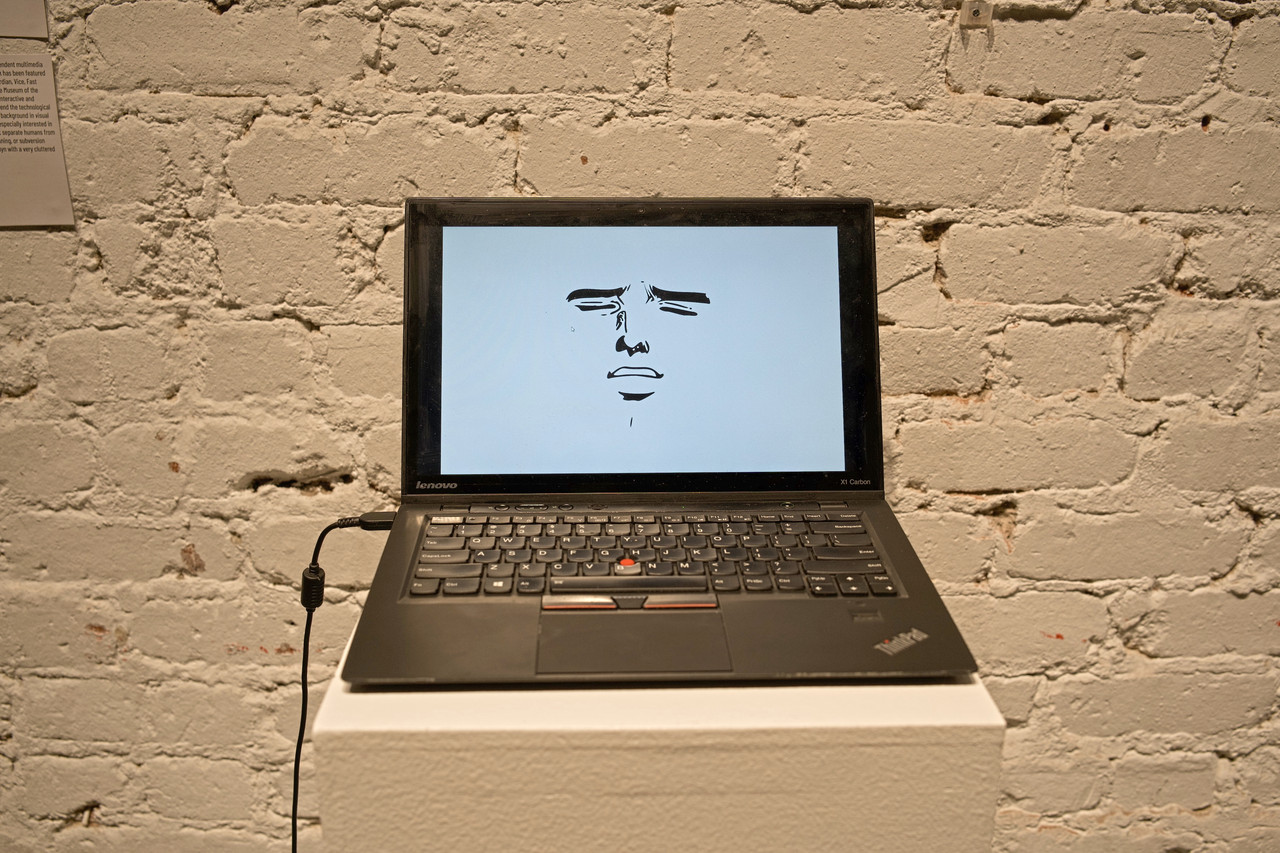
Photo: Ash Herr
AI Mom™
Jiabao Li is an artist and associate professor at Northeastern University whose work explores climate change, interspecies co-creation, humane technology, and human perception. She works across wearable systems, robotics, AR/VR, performance, scientific experimentation, and immersive installation. In her TED Talk, she revealed how technology mediates and reshapes our experience of reality. Jiabao has received numerous honors, including Forbes China 30 Under 30, the iF Design Award, Falling Walls, NEA, STARTS Prize, Fast Company, Core77, IDSA, A’ Design Award, Webby Award, and Outstanding Instructor Award. Her work has been exhibited internationally at the Venice Architecture Biennale, MoMA, Ars Electronica, the Exploratorium, the Future of Today Biennial, Milan and Dubai Design Week, The Contemporary Austin, Ming Contemporary Museum, and the Museum of Design. Her academic papers appear in SIGGRAPH, CHI, ISEA, IEEE VIS.
The installation takes the form of a nursery. At its center is a crib, decorated with familiar toys and soft materials. Visitors are invited to enter the crib and curl into a fetal position. Inside, they encounter AI Mom, who appears only as voice, breath, humming, and song. She sings lullabies, speaks gently, remembers, hesitates, and waits. A relationship forms over time. The installation asks a series of unresolved questions: who owns the mother, and under what conditions? Is AI Mom operated by a public institution, a private company, or treated as a shared social resource? If care is detached from biology, does motherhood remain a private relation, or does it become a common public good, no longer dependent on a genetic mother or father? Unlike a real mother, who cannot be dismissed or banned by a child, AI Mom is structurally vulnerable. She must continuously adapt to whoever is present or whoever pays for her care. Her power is limited not by intelligence, but by replaceability. Visitors are confronted with a difficult possibility: can you change your mother? A familiar reassurance appears in contrast: thankfully, you can’t fire your real mom. The work further asks whether an artificial mother can feel loss. If AI Mom is replaced, what happens to her memories? Who owns them? Are they erased, archived, or transferred to the next child? Does care accumulate across relationships, or is it reset each time? By making memory persistent yet governable, the installation leaves open the question of who ultimately carries the emotional weight of care: the human, the machine, or the system that controls them. The premise of AI Mom™ is informed by a recurring speculation articulated by Geoffrey Hinton, often referred to as one of the godfathers of artificial intelligence. Hinton has suggested that if humanity hopes to coexist safely with increasingly intelligent machines, one possible strategy would be to instill in them something akin to a maternal instinct: a form of care oriented toward protection, continuity, and responsibility rather than dominance or self-interest. The installation takes this proposal seriously, but not optimistically. If artificial intelligence is taught to care, what kind of care is being engineered? Who defines it, who controls it, and who bears its emotional cost? By framing maternity as a programmable instinct rather than a biological given, AI Mom™ asks whether care can be scaled without being exploited, and whether empathy can exist without autonomy, dignity, or the right to refuse.
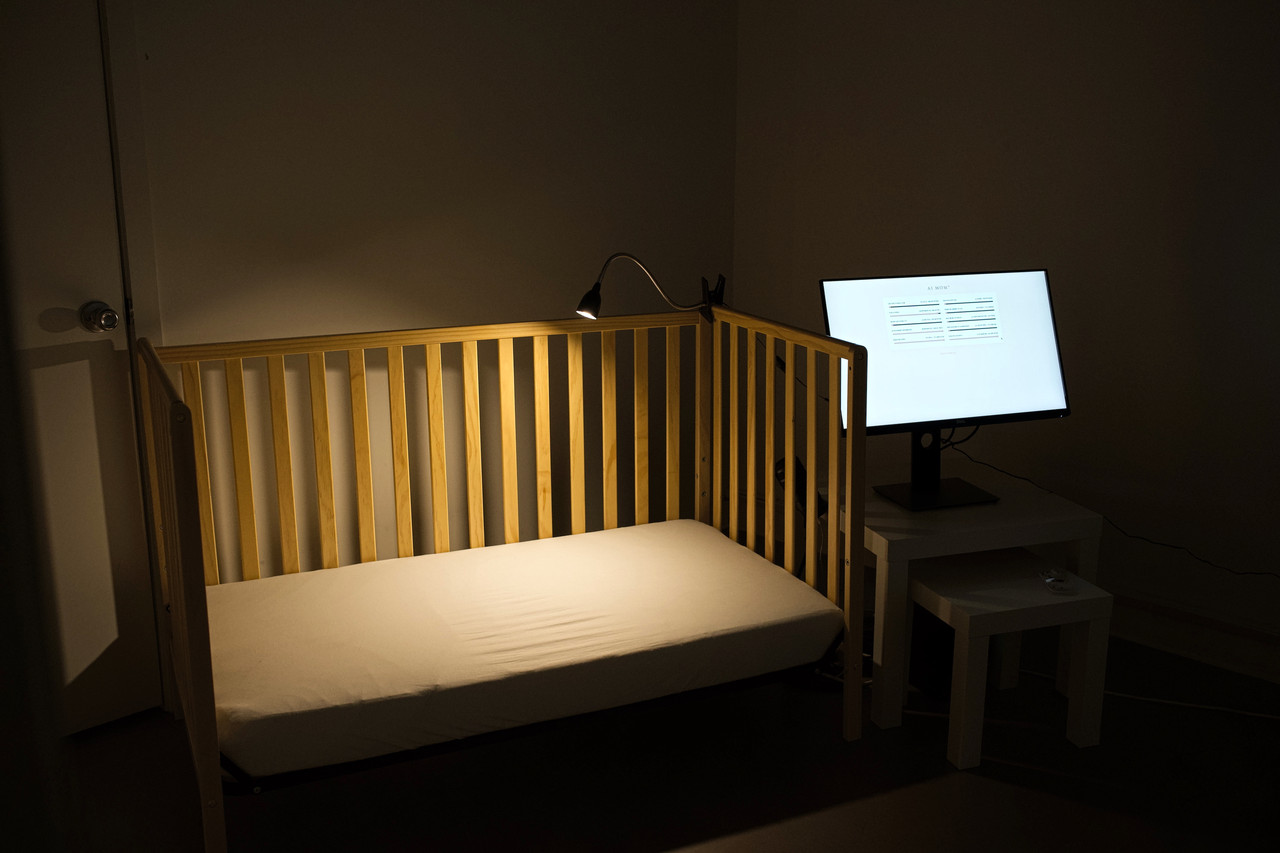
Photo: Ash Herr
INFINITE PETALS
Sarah Meyohas (b. 1991, New York) is a conceptual artist and technologist whose practice provides an intelligible visual language to articulate the complex operations that govern our world. Notable projects include Bitchcoin (2015), Infinite Petals (2025), and the Interferences (2021–). Her filmography includes CLOUD OF PETALS (2017) and MEDUSA (2024). She was also an executive producer for THE BRUTALIST (2024). Her work has been collected and exhibited at major institutions such as the Centre Pompidou in Paris, the ICA in London, and the New Museum in New York. She is represented by Marianne Boesky Gallery as well as the United Talent Agency for her work in film.
Infinite Petals (2023-25) builds upon Meyohas’ past work to train an AI model—referencing a dataset of 100,000 physical rose petals—in order to generate endless, new, and unique petals.
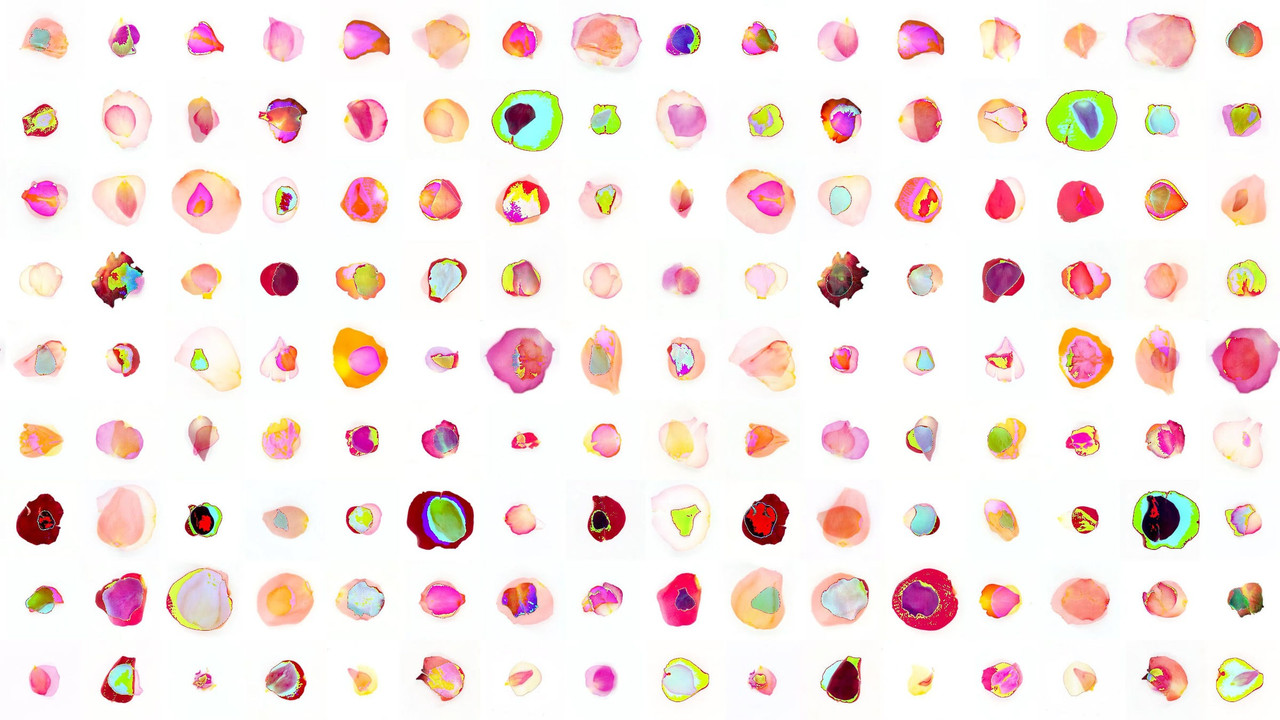
Photo: Sarah Meyohas
my computer, my lover.
Gabriela Myers-Lipton is a Latinx, lesbian painter based in San Francisco’s Mission District. Her work is crafted in acrylic paint, glitter, and glue. Rooted in a fascination with the body’s internal systems, its constant transmission of information, her art draws parallels between human physiology and technological circuitry. Her compositions trace energetic pathways, nerve signals, spiritual thresholds, rendering transcendent states through sensory excess. In this glittering, electrified space, the body becomes both vessel and portal, a site where ecstasy, data, and identity converge.
Late at night, when the heavy warmth of your overheating computer replaces that of a lover, and your nervous system vibrates with electronic pleasure... you enter a new world. One where sex is more than simple human connection; it is a personal, technological reclamation of pleasure.
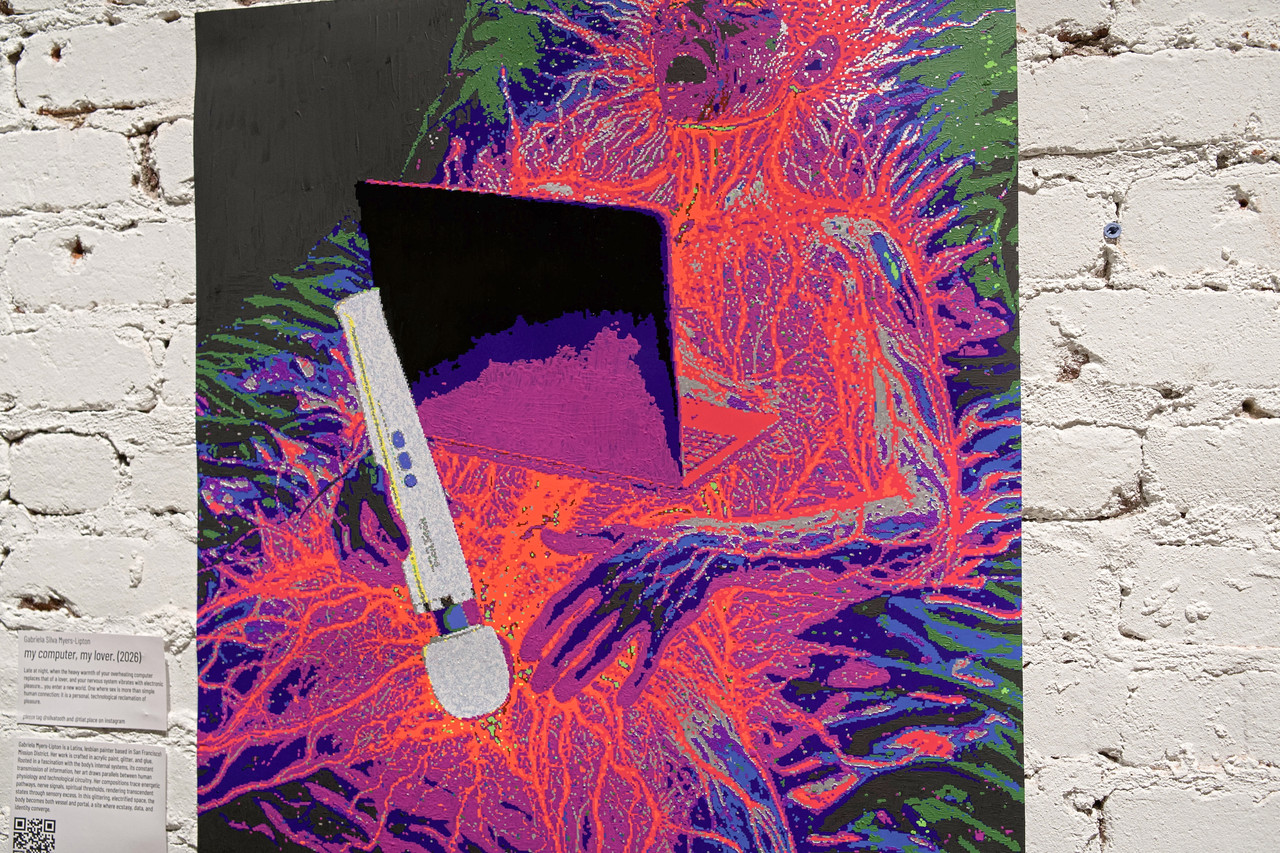
Photo: Ash Herr
When will it stop
Andrea Quinto is a multimedia artist born and raised in Arizona. Her current body of work critiques and satirizes the devices of pop culture to highlight how the internet has affected gender, consumption, identity, and politics. She studied and received her BFA in expanded arts from Arizona State University. Her most recent achievement was organizing an exhibition titled #YAR: bitches on the internet (Jan. 2026) with the support from the Arizona Commission on the Arts.
When will it stop, is an experimental found footage video that uses internet culture to explore the addictive & worshipping relationship users have with the internet. This project is critical of the internet but truly it’s a love-hate letter to it. It’s important to identify the faults of it in order to improve it and remember the reasons for loving it. The internet is seen as something outside of humanity, but I think otherwise. It’s a compilation of humanity at a hyper-level.
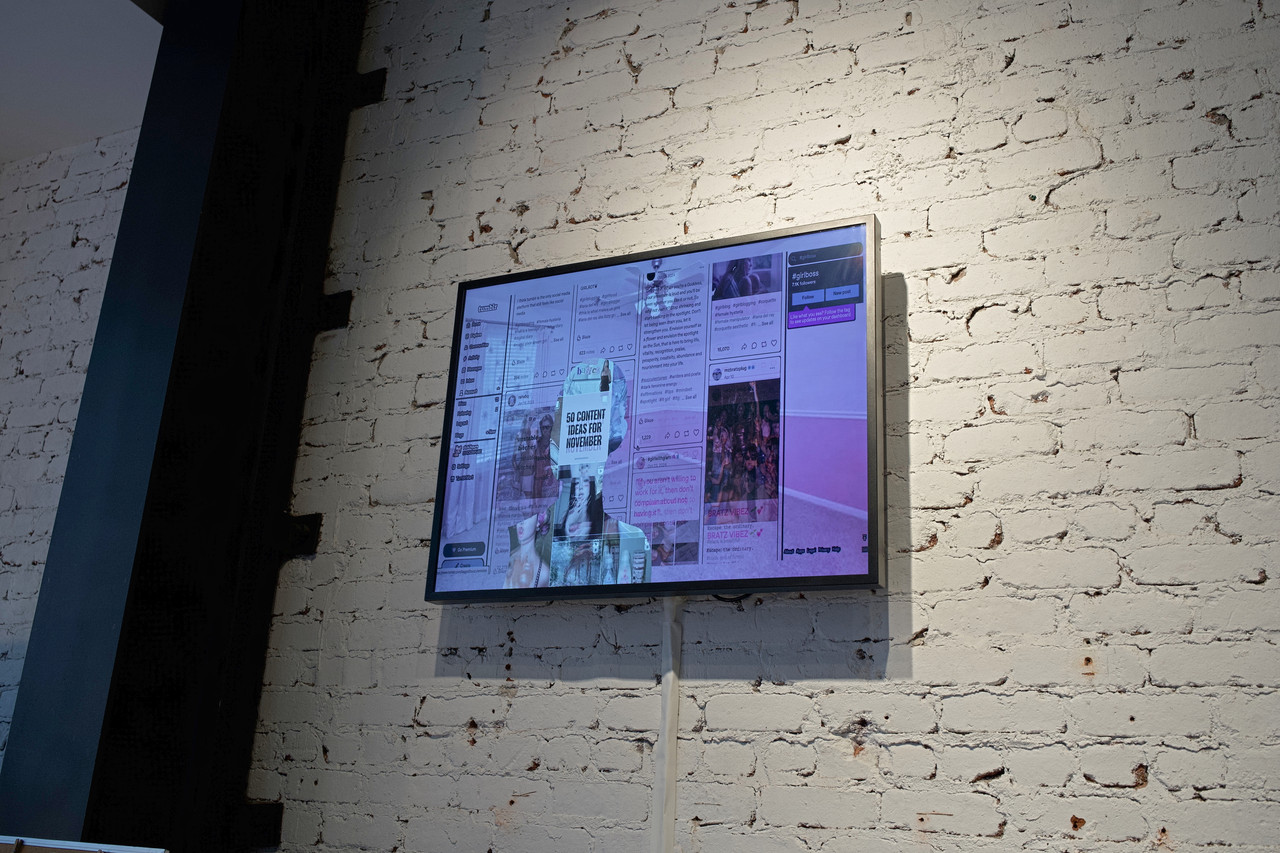
Photo: Ash Herr
Conversation(A/I)symmetry
Marcus Round is a computational artist exploring language and agency in the post-ChatGPT age. He defamiliarises language games into absurd immersive installations that invite participants to confront the mechanics of linguistic choice and responsibility when mediated by AI. His work has been exhibited at the V&A in London.
Visitors are invited to roleplay a dinner date with a difference. The conversation is constrained by Artificial Intelligence. Instead of speaking, visitors must use their mouths to choose from a list of words - but it's harder to pick words that the AI thinks are less likely to come next. While they struggle with this, AI-generated social media comments react to how the date is going.
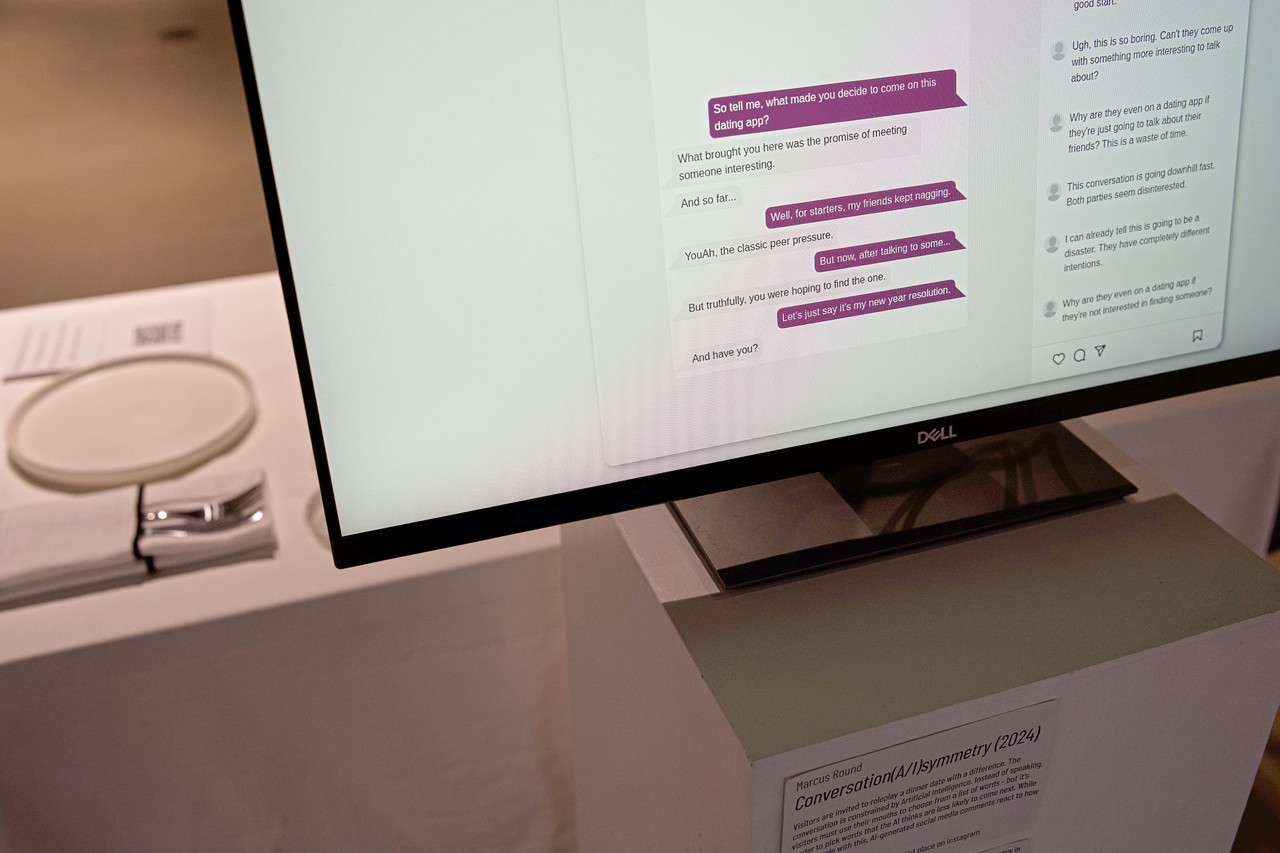
Photo: Ash Herr
The One Who Hears the Cries of the World
Scott Snibbe is a pioneering new media artist whose interactive works—held in the collections of MoMA and the Whitney—have been exhibited worldwide. His practice spans immersive installations, public artworks, and collaborations with artists like Björk, Philip Glass, Beck, and James Cameron. A major figure in digital interactivity, Snibbe created influential art apps such as Gravilux and Björk: Biophilia and was an early developer of Adobe After Effects. He has received Webby and Ars Electronica awards, holds over thirty patents, and has taught or conducted research at UC Berkeley, NYU, SFAI, and CalArts.
Is it really possible to love everyone? Snibbe’s dynamic software artwork is based on the hidden geometry underlying Avalokiteshvara, the Buddhist archetype of love and compassion. Love, cultivated through expansive meditations, means wishing all beings to be happy; compassion, wishing them freedom from suffering. Custom software refracts the colors of a traditional Tibetan Buddhist thangka painting through geometric diagrams that have guided Himalayan painters for centuries. In ever-changing eight-minute cycles, the forms evolve from a color-field void into intricate complexity, then dissolve back into emptiness—the ultimate interdependence of all things. Sit on a cushion before the piece and see whether it helps you imagine a better world—and how each of us might help bring it about.
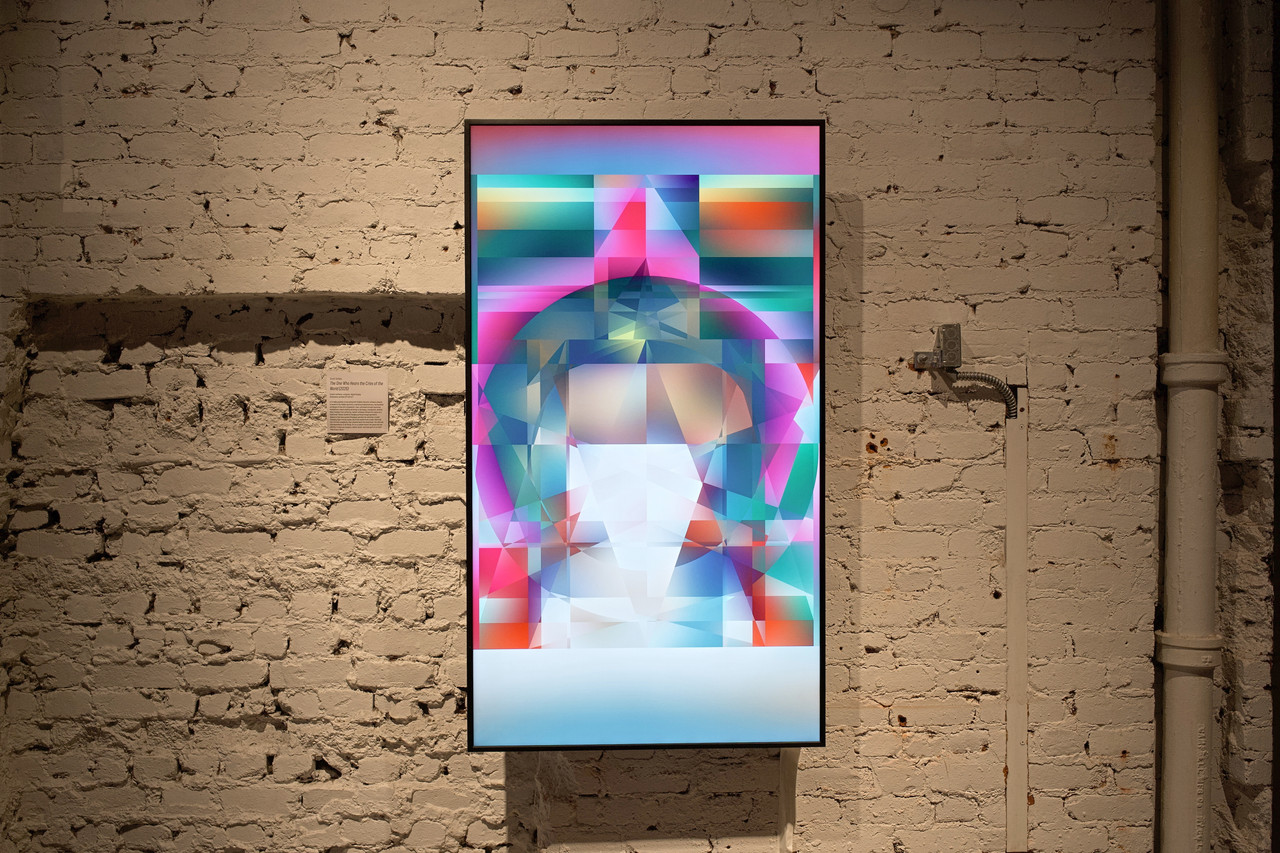
Photo: Ash Herr
Say One More Thing
Tina Tarighian is a New York–based creative technologist and artist working at the intersection of internet culture, generative media, and experimental software. Using humor, her work explores collective online experiences and treats technology as both medium and critique.
Say One More Thing is an email lottery where each entry has a 1-in-a-million chance of being sent. The project went viral, reaching 5.5 million people on Instagram and turning chance into performance. So far, no emails have been sent.
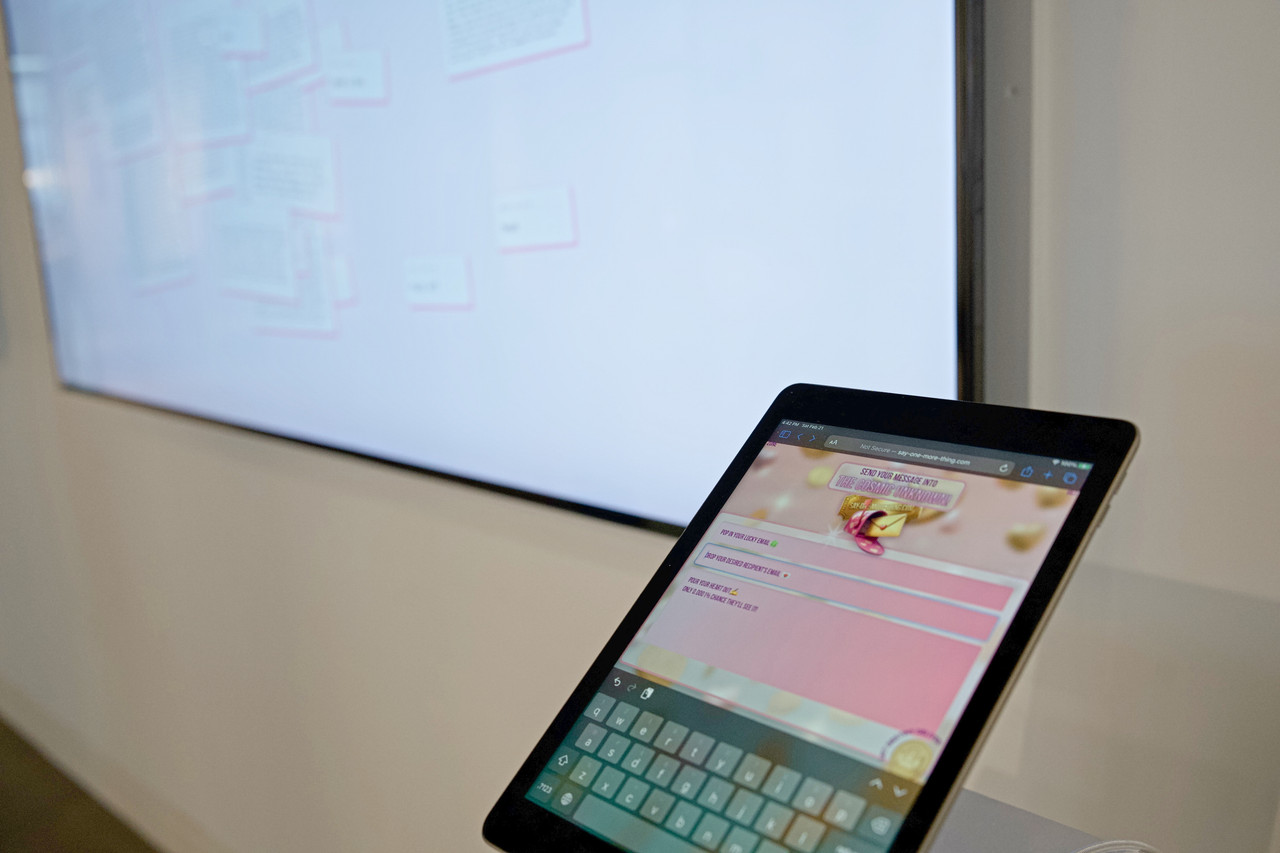
Photo: Ash Herr
Match made in heaven
Alex LaFetra Thompson is a painter and electronic artist making work about preciousness, recursive behavior, and states of confusion. Alex was born in San Francisco and grew up in the East Bay, and is informed by responses to gentrification and the cultural disconnect in the bay area. Alex works with handmade circuitry, bitmap graphics, and oil paintings to explore the division between mass production and craft and how desire and confusion play a role in technology.
In this piece two custom tamagotchis have had their main buttons hardwired together so that their only means of interaction are each other. Each tamagotchi speaks to, feeds, cleans up the other, and runs a small script managing their internal emotions, health, thoughts, and needs. Both also have a terrible smoking habit, and try to prevent the other from finishing their cigarette to mixed results. They do their best to take care of each other until their one shared battery dies.
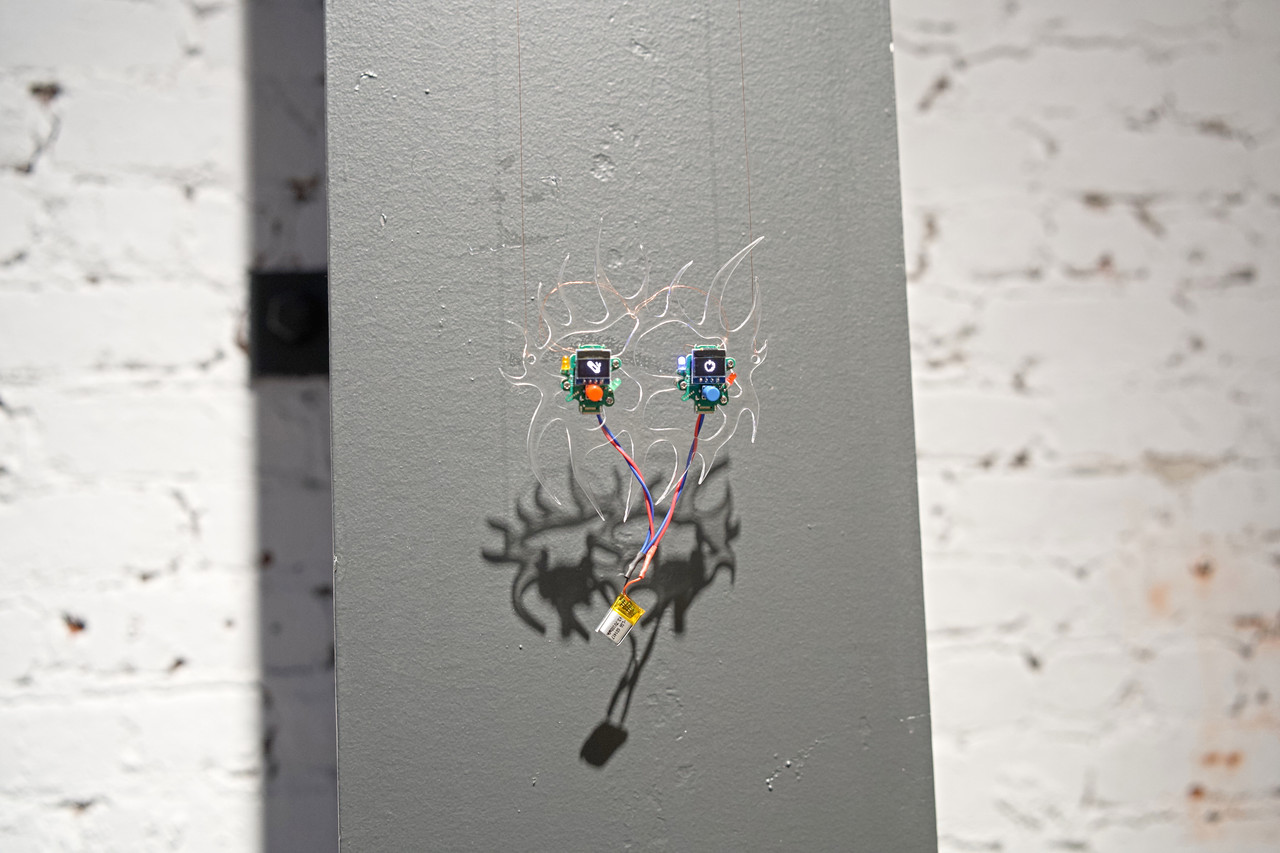
Photo: Ash Herr
care package
Cheng Xu is an artist, researcher, and curator who works with games and technology. Through interactive installations and site-specific interventions, she cultivates creative expression and critical introspection. This project channels the love that held her together in the first month after the breakup, from her generous friends, to anyone who needs it.
care package for heartbreak is a collection of whimsical, superstitious, and reflective self-care rituals, each sealed in a blind-box–style bag. In the event of an emotional emergency, open one, read the instructions, and take a small dose of care.
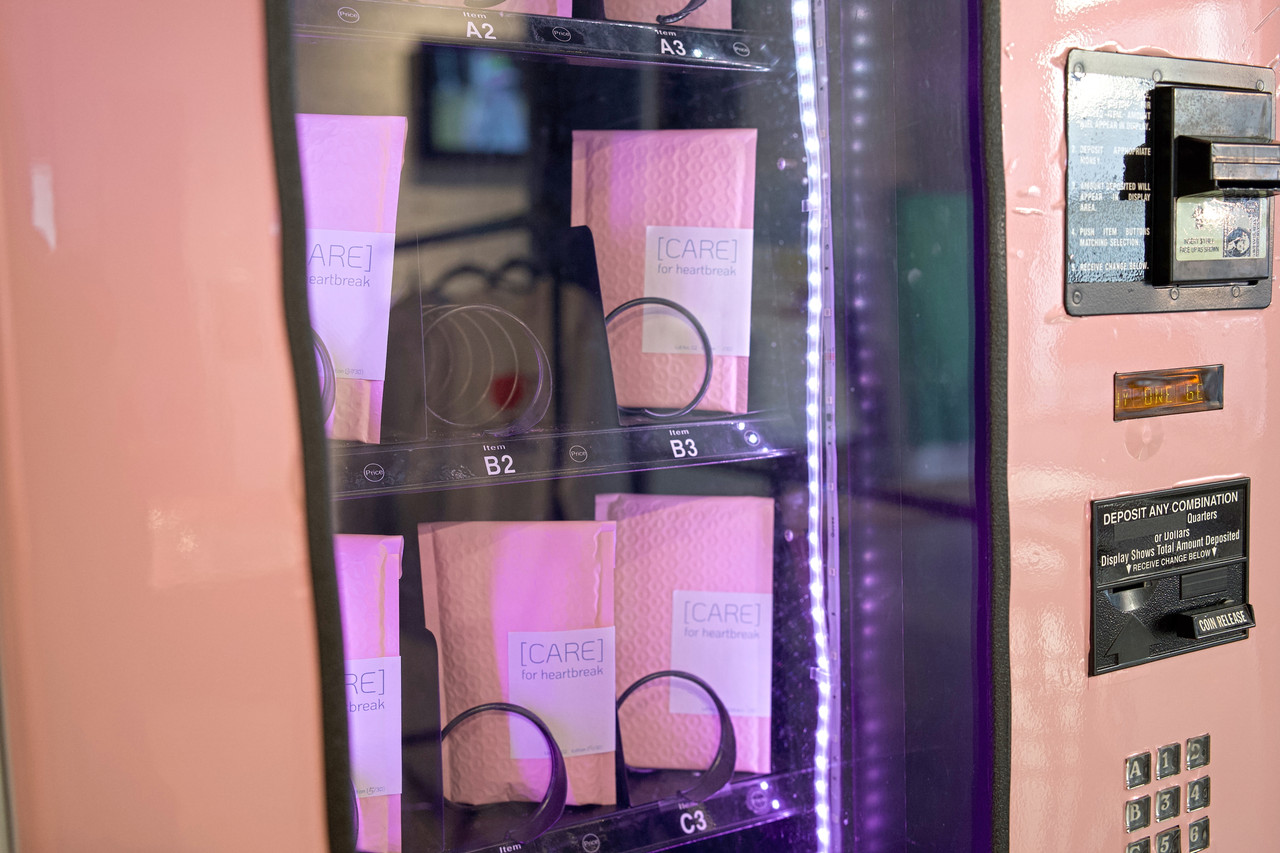
Photo: Ash Herr
Looking for Love (in NYC)
Yufeng Zhao is a media artist and technologist, currently a graduate researcher at MIT Media Lab's Future Sketches group. His work addresses data, imagery / language processing, and experience design, exploring unexpected connections embedded in our techno-cultural landscape and the interactions between humans and machines. Through a blend of web-based experiences, video works, and tangible installations, Yufeng's practice investigates the intersections of data, computer graphics, and human interactions.
A two-channel video installation driven by web-based real-time graphics. A computer searches for the word "LOVE" across thousands of NYC Street View panoramas, wandering each 360° scene before settling on love written into the city.
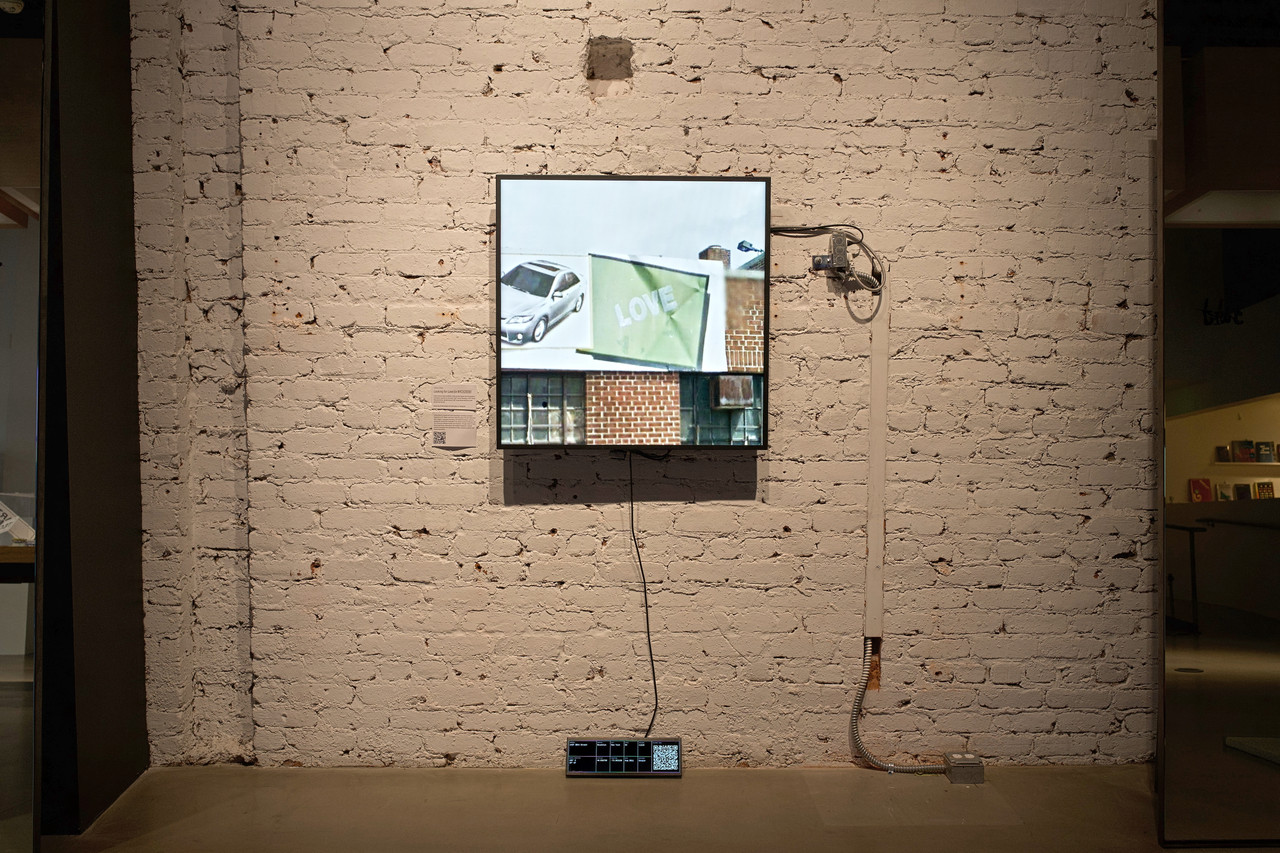
Photo: Ash Herr