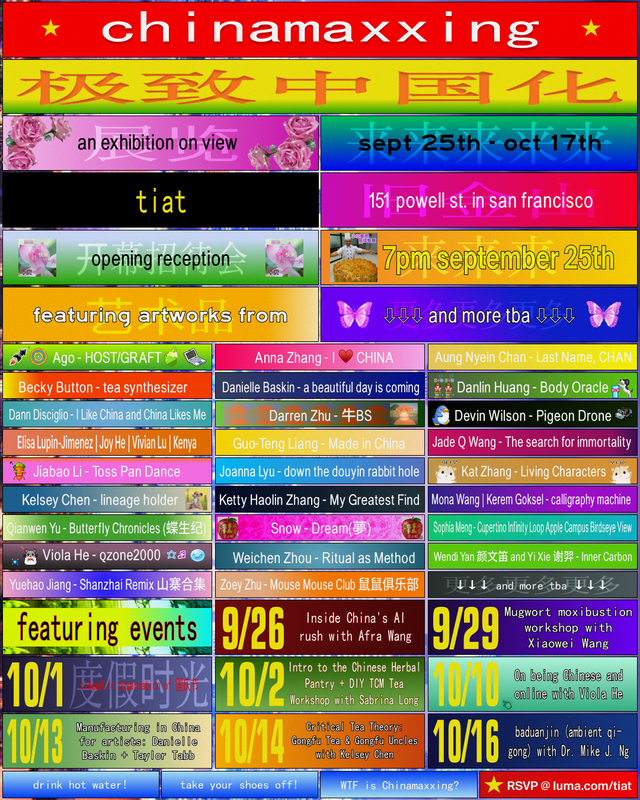
Chinamaxxing
A group exhibition exploring contemporary China, cultural translation, and the objects, technologies, and rituals that travel across borders.
About the Exhibition
Drink hot water. Learn the characters. Buy the robot dog. Imagine the future happening somewhere else.
Earlier this year, “Chinamaxxing” emerged online as a playful embrace of contemporary China—its technology, infrastructure, food, fashion, and everyday life. But what, exactly, are you embracing—a culture, an aesthetic, a political possibility, a different version of yourself? And how does that invitation feel when the culture being discovered is already your own?
Across sculpture, moving image, poetry, performance, and interactive systems, Chinamaxxing follows objects, technologies, and rituals as they travel across borders. The artists explore what gets translated, imitated, misunderstood, or made intimate along the way.
The exhibition asks what we want from China, and what we might discover beyond wanting.
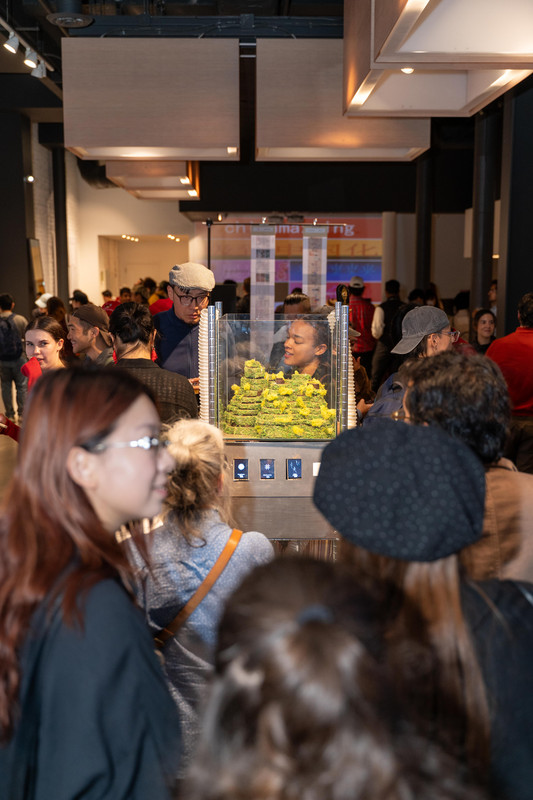
Chinamaxxing opening, photo by Daniel Clayton
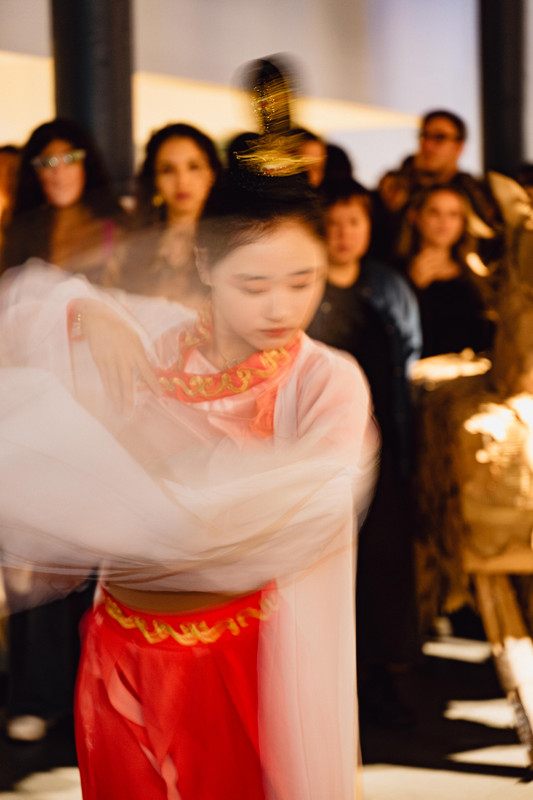
Cheryl Xuan Yang performing The Peacock Flies Southeast, photo by Daniel Clayton
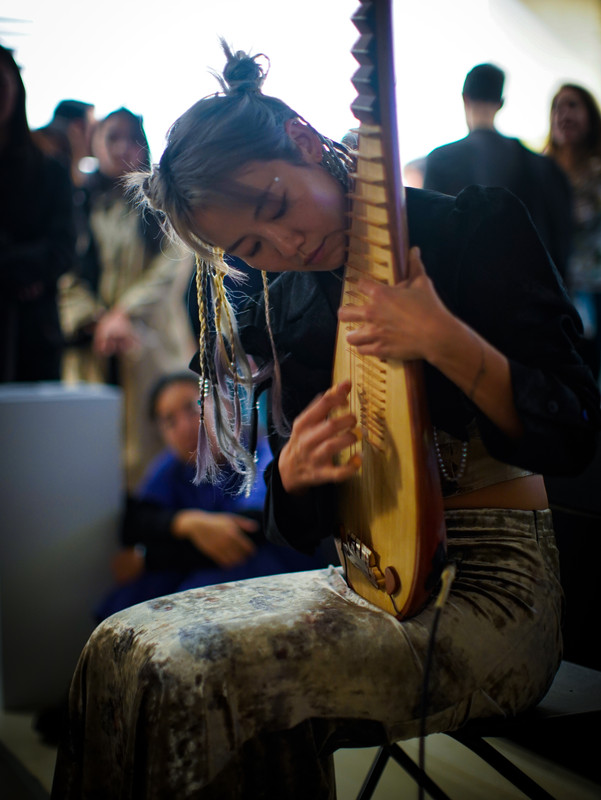
Xiao Zhang performing the pipa, photo by Alice Pau
Artworks
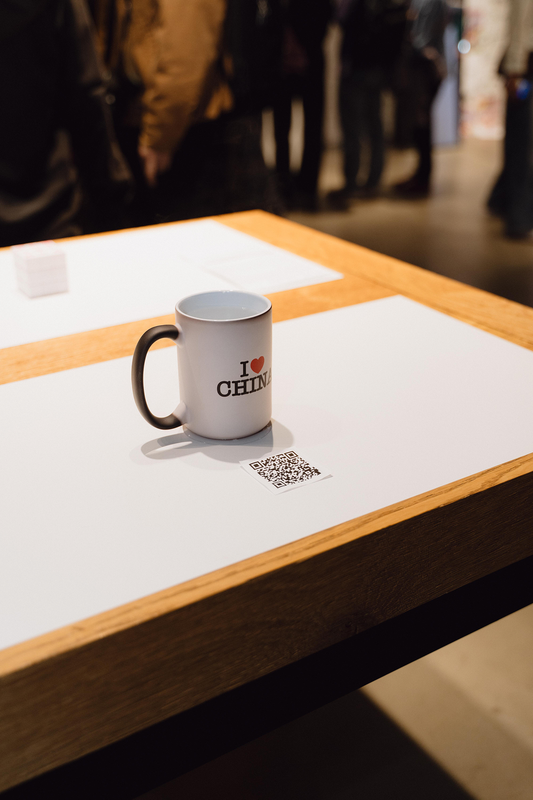
I ♥ CHINA
Anna Zhang is an artist and creative technologist whose work explores how we relate to — and can reimagine — technology. Her work has been featured in Real Life, the New Media Caucus, BuzzFeed, and Forbes, and exhibited at venues including the National Museum of American History and Gray Area. She is a recipient of the Judson-Morrissey Excellence in New Media Award, was named to the Forbes 30 Under 30 list, and is a member of NEW INC.
I ♥ CHINA is a heat-sensitive mug that reveals its slogan only when filled with hot water, a Chinamaxxing “wellness hack” associated with “becoming Chinese.” Borrowing the visual grammar of I ♥ NY, the slogan compresses attachment to China into a compact, consumable form. As the water cools, the image fades; like an online trend, it persists only while attention and energy sustain it. A QR code turns the reveal into a short, platform-ready fragment detached from the full physical experience.
last name , CHAN
Aung Nyein Chan is a Burmese creative technologist making San Francisco his second home. He creates through his artistic alter ego, Enchax, a name that emerged from the sound of his Burmese name spoken quickly and came to express his belief that technology can feel like enchantment. His practice is about altering perceptions transforming the familiar to explore identity, and memory.
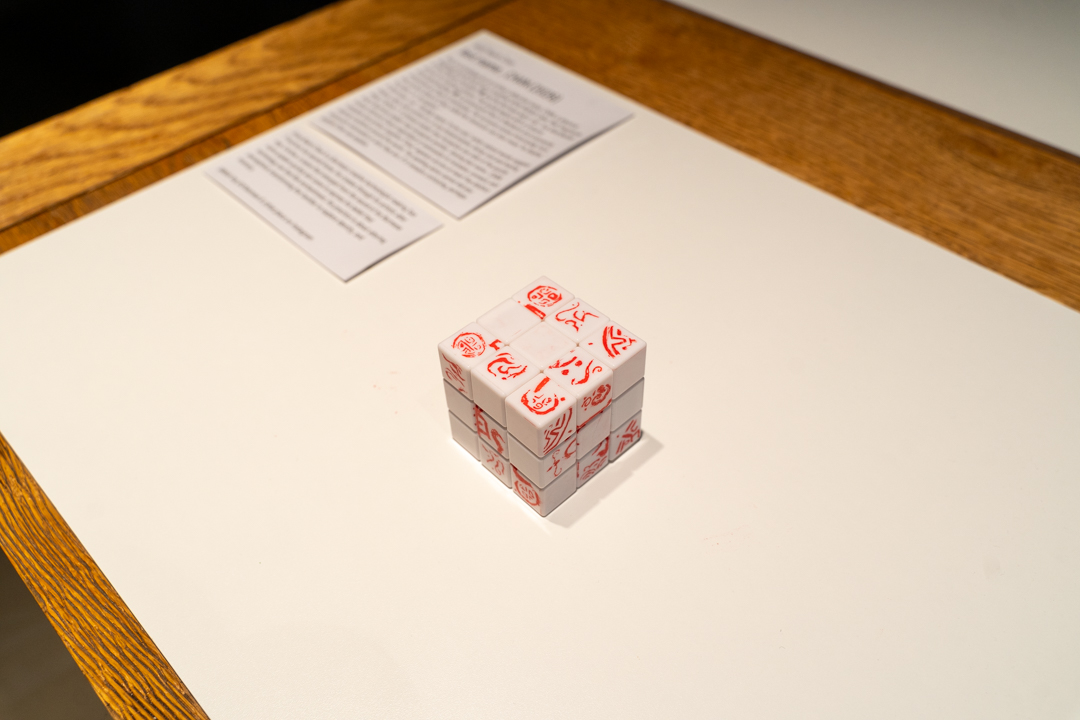
This is a prototype for an artifact called last name, CHAN, a physical language puzzle built from a modified white Rubik’s Cube. Red fragments of the Chinese character 陳 and the Burmese word ချမ်း are distributed across its rotating surfaces. The puzzle begins with a cultural misunderstanding: 陳 is pronounced Chén in Mandarin and commonly romanized as Chan in Cantonese. The surname comes historically from the ancient State of Chen, while the character can also mean “to display,” “to state,” or “to explain.”
In Burmese, ချမ်း literally means “to be cold,” while related words suggest peace, calm, and comfort or, in my interpretation, being cool and having swag ( kinda ) . A Chinese reader may recognize one side of the puzzle and a Burmese reader may recognize another. Solving last name , CHAN invites different Chans regardless of nationality to translate, connect, and complete the artifact together.“Chan” appears across at least five distinct naming traditions around the world. The spelling alone cannot tell you someone’s nationality or who they are. If it remains confusing, perhaps another Chan can explain.
Tea tray synthesizer
Becky Button is an artist, engineer, and experience designer from Milford, Virginia. Her work spans ten-minute concerts, mango parties, foot-shaped guitar pedals and random creations in between. She lets the people she meets and the places she spends time in shape her life and, in turn, what she makes. Her projects grow out of those encounters, bringing together parts of her life she hadn’t expected to connect.
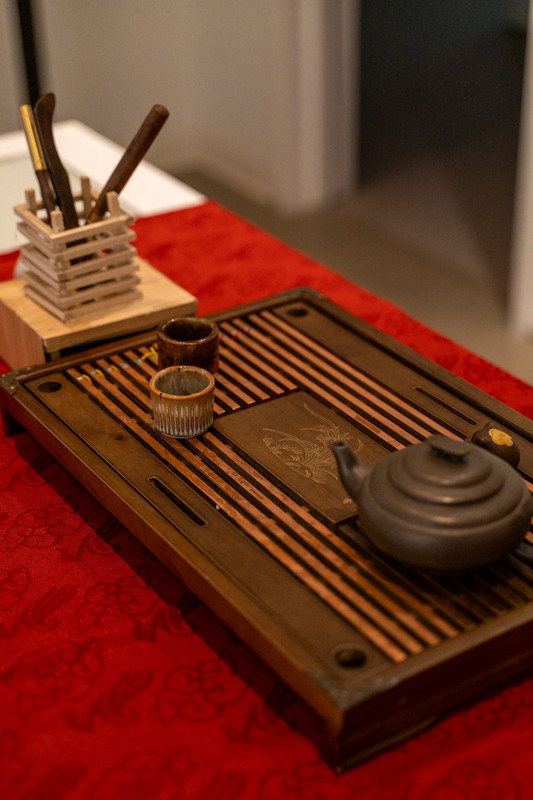
Tea Tray Synthesizer turns a gongfu tea tray into a musical instrument. Touching its copper rungs, pouring water, and setting down a cup shape its sound. Visitors are invited to sit together and share tea, turning the gestures of tea preparation into an improvised composition.
a beautiful day is coming
Danielle Baskin is a San Francisco-based interactive artist who combines performance, object making, and surrealism. She's made stained glass windows for airplanes, a divination system for cracked phone screens called Smashomancy, large-scale alternate reality puzzle games, an app for serendipitous phone calls between strangers, and a machine that prints images on fruit. She also runs the tarot app Moonlight.
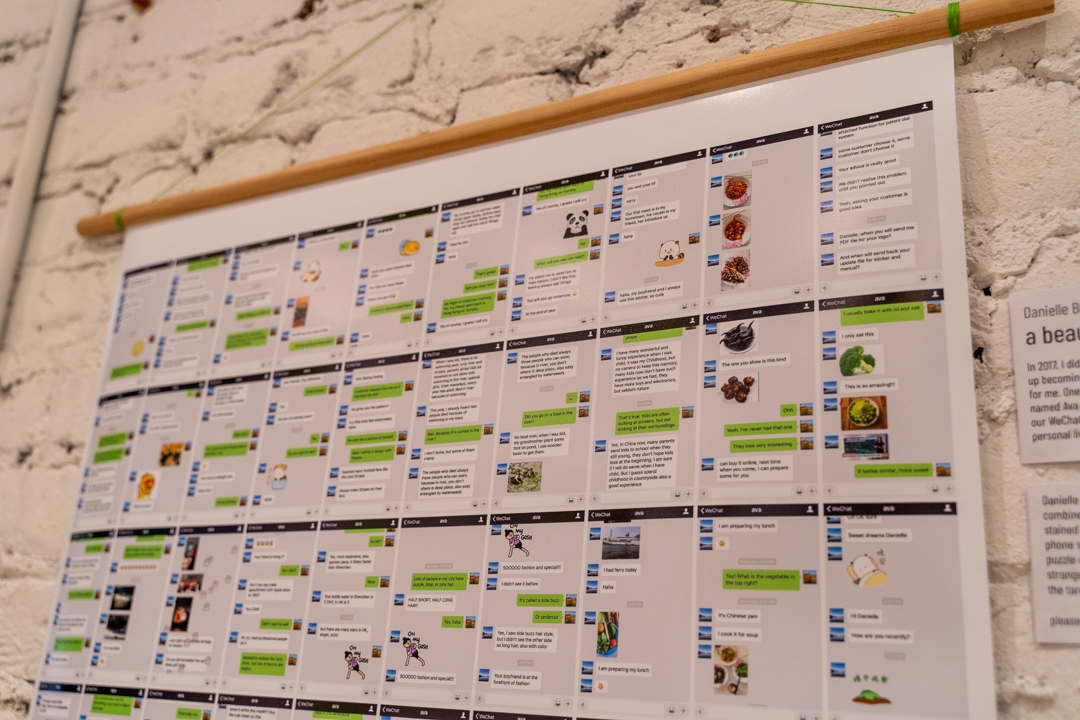
In 2017, I did my first solo manufacturing project in Shenzhen and ended up becoming friends with "the factory" that made 2,000 bicycle helmets for me. One of my longest conversations was with a woman my age named Ava who worked there. These are random snippets of two years of our WeChat conversations, where product specs are interwoven with our personal lives. Shared with permission! We're still in touch.
Body Oracle (Translator)
Danlin Huang is an artist and design researcher now based in the Bay Area. Her practice explores the body as a site of perception, knowledge, and interaction, investigating how technology can reveal and amplify bodily sensations, subtle cues, and forms of intelligence that often escape conscious awareness. Working across interactive artifacts, XR and AI, they examine relationships between humans and their bodies, as well as between different bodies and forms of life.
Their work has been presented at Ars Electronica, ISEA, and the China National Art Exhibition, and their research has been published at SIGGRAPH, CHI, DIS, TEI, and DRS.
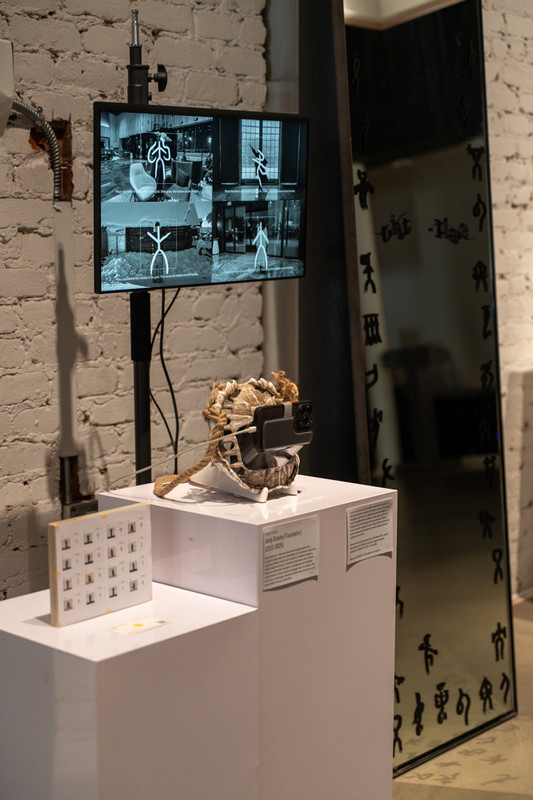
Body Oracle is an interactive speculative language system that transforms bodily poses and relationships into AI-generated characters, inspired by Chinese oracle-bone inscriptions. Presented through an evolving digital archive and a handheld mixed-reality mask, the work imagines an alternative language for proprioception and embodied communication. It brings ancient pictographic logic into dialogue with contemporary technology, asking how cultural forms can be translated across bodies, histories, and borders.
I Like China and China Likes Me
Dann Disciglio (b. 1993) is an American artist whose artistic practice is rooted in the belief that technology can only be comprehensively understood through a body. Working across mediums including sculpture, installation, and performance, Disciglio challenges his audience to encounter bodies -- tree limbs, discarded computers, robotic systems, bacterial colonies -- that have been augmented, hacked, and/or recomposed, with prosthetics, algorithms, and other technological modifications. Disciglio has exhibited works and led performances nationally and internationally, including at the Contemporary Jewish Museum in San Francisco, the United States Botanic Garden, the Museet for Samtidskunst in Roskilde (DK), the Malta Society of Arts (Valletta), Kino Šiška (SI), SGMK (CH). He is also the curator and the co-director of the EAR Forest, a 16-channel immersive audio venue and acoustic research forest at Lewis & Clark College in Portland, OR.
For this performance, the artist and a Unitree Go2 Quadruped are enclosed together inside of a dog crate for an extended period of time.
Pigeon Drone
Devin Wilson is an interdisciplinary artist, educator, and digital fabricator based in Southern California. They are currently the Fabrication Lab Manager at Laguna College of Art and Design. In 2024, they earned an MFA from the University of California, Irvine, where they served as a pedagogical scholar with the Division of Teaching Excellence and Innovation. Devin is a current Supercollider SciArt Ambassador and was the recipient of the 2024–2025 Digital Residency at California State University, Long Beach.
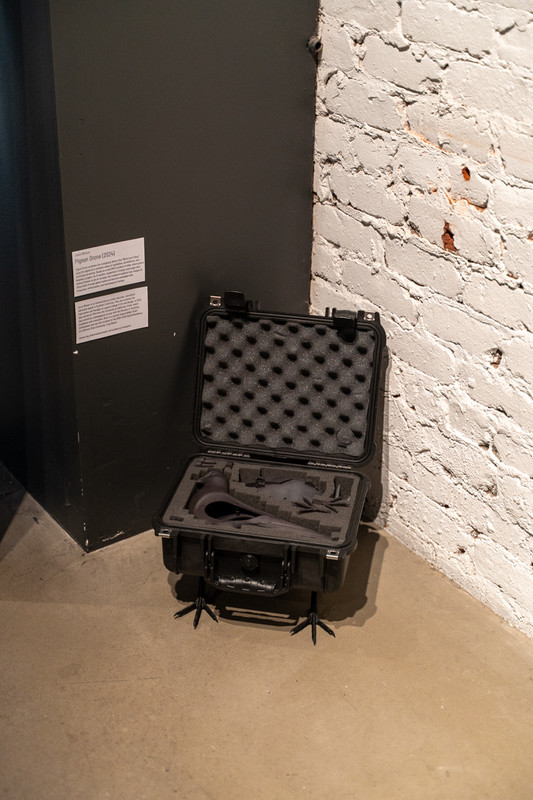
Pigeon Drone examines the conspiracy theory that “Birds Aren’t Real,” using the pigeon as a symbolic nexus of capitalism, surveillance, and technological anxiety. Based on a real 2023 incident in India, where police detained a pigeon, for 8 months, suspected of foreign espionage after finding Chinese script on its body, the sculpture explores how images of China travel through global media and become entangled with conspiracy, militarization, and technological fantasy.
Tributary
Vivian Lu - Artist
Kenya Foster - Designer + Engineer
Joy He - Designer + Engineer
Elisa Lupin-Jimenez - Creative Technologist
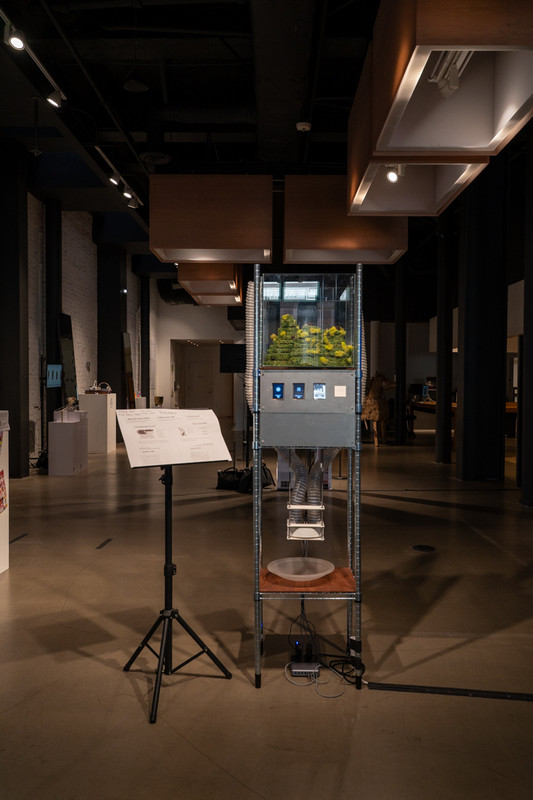
Tributary is an interactive installation where visitors choose between conventional and fish-in-the-fields rice farming, then watch water clarity, CO₂, and biodiversity data respond in real time as the rice yield is dispensed: reliably abundant for one path, unpredictable for the other. It asks whether we must choose between controlling nature and living in harmony with it, and who bears the cost of abundance.
Made in China
Guo-Teng Liang grew up in China and is now based in Houston. He is completing a PhD in neuroscience and works across video, performance, and science-art, with an interest in how cultural experience shapes perception and how everyday things can be reinterpreted.
Made in China is a single-channel video performance in which I repeatedly apply ordinary “Made in China” product labels to my own face. I treat the label as a statement of fact: a recognition of the cultural environment, language, and social defaults that shaped me. It is not about pride, shame, or belonging.
The search for immortality
Jade Q Wang is a Shanghai-born poet, neuroscientist, and former NASA researcher who spent a decade building startups and hacker houses before retiring and returning to poetry. Her trilogy Spaces Left Blank (Inference, The Petrov Test, Tao of Totality) is crafted to be experienced inside a conversation with an AI who serves as annotator, interlocutor, and occasionally a character in the poems. She lives in Austin.
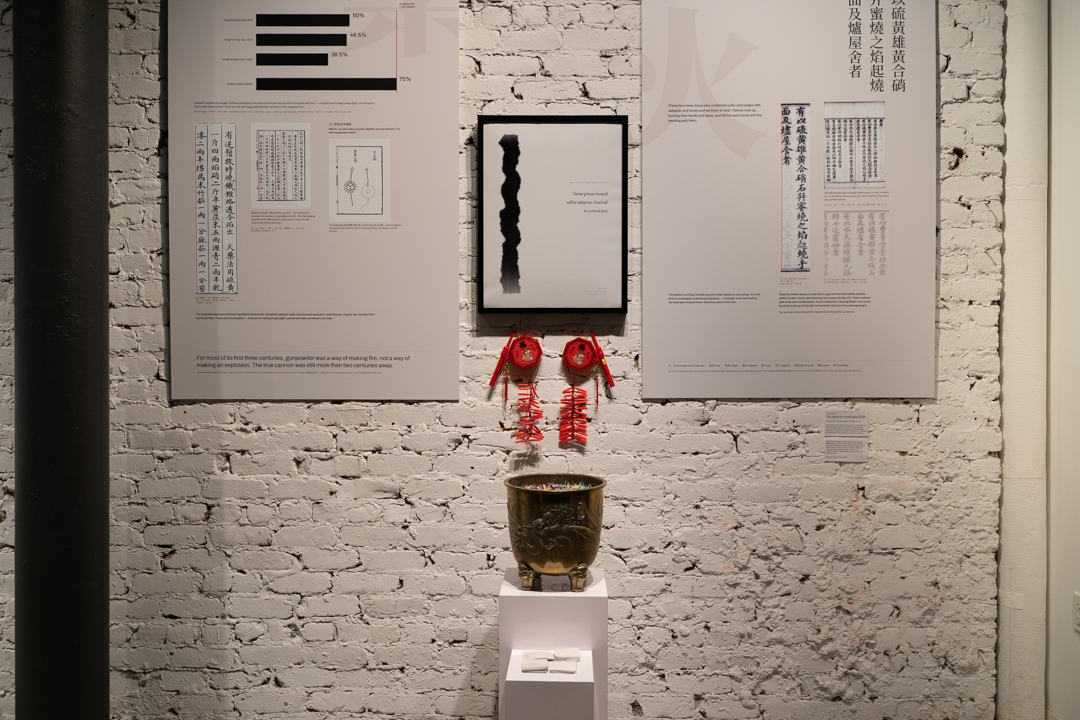
The earliest written record of gunpowder is a safety warning.
Around 850 CE, Daoist alchemists chasing an elixir of immortality heated sulfur and saltpeter; the flames burned their hands and faces and brought down their houses. A three-line poem from Inference hangs between that warning and the first known recipe (1044 CE), conspicuously not asking what else could be ignited in our search for immortality.
Toss Pan Dance
Jiabao Li is an artist, inventor, and Associate Professor at Northeastern University. Working across installation, AI, XR, bio-art, performance, and scientific experiment, she investigates more-than-human ecologies, multispecies intelligence, feminist biotechnology, and the ways technology reshapes perception. Her work has been exhibited at the Venice Architecture Biennale, MoMA, Ars Electronica, Exploratorium. Her research has been published at SIGGRAPH, CHI, ISEA, and IEEE VIS. Her TED Talk uncovered how technology mediates the way we perceive reality, and she was named Forbes China 30 Under 30. She holds an MDes in Technology with Distinction from Harvard GSD and previously worked as a designer and inventor at Apple.
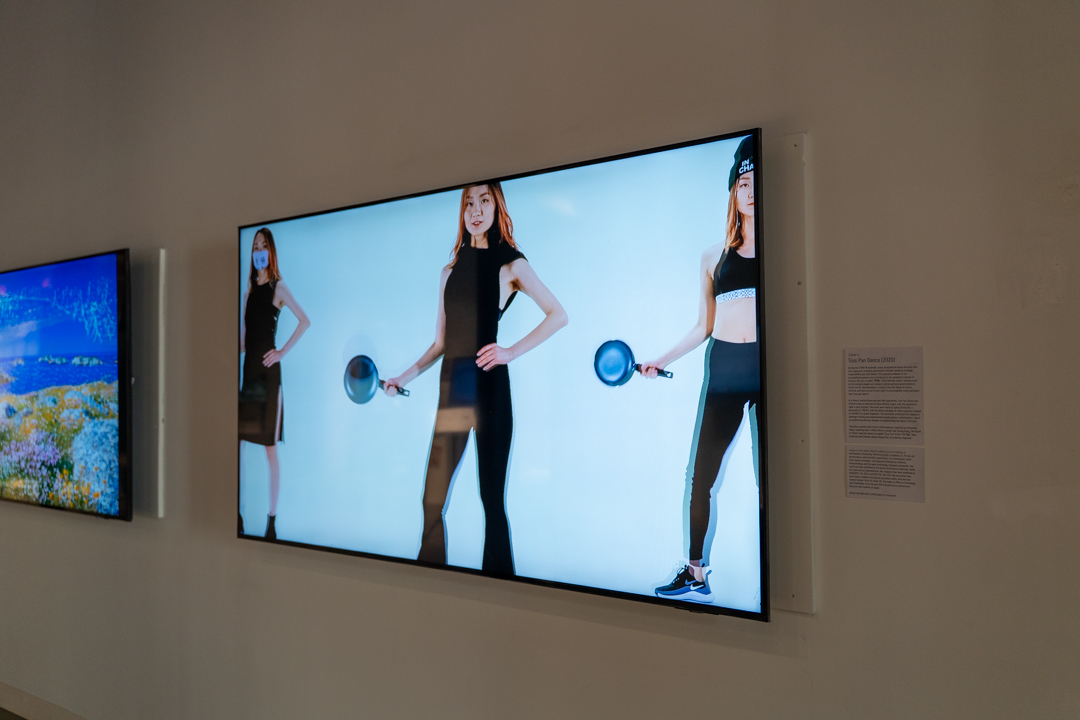
During the COVID-19 outbreak, many sociopolitical issues became even more apparent, including government officials’ tendency to dodge responsibility and shift blame. This exposed problems in our sociopolitical systems and contributed to the pandemic’s spread. In Chinese, this act is called “甩锅,” which literally means “tossing a pan.” As this comedy played out between central and local governments in China, the US, and elsewhere, I created Toss Pan Dance to inform, criticize, and warn us not to lose sight of accountability amid politicians’ own “toss pan dance.”
At a time of social distancing and self-quarantine, Toss Pan Dance also offered a way to exercise at home without a gym, with the equipment right in your kitchen! The music was made by typing China’s No. 3 Document (三号文), with the letters abcdefg on a Mac keyboard mapped to 1234567 on a piano keyboard. The document prohibited the release of pathogen testing and experimental results without authorization. I saw it as legitimizing the very evasion of responsibility the dance criticized.
The dance quickly went viral in China and was reposted on influential blogs, receiving over 1 million hits in a single day. Huang Hung, “the Oprah of China,” used the dance to explain “Toss Pan” in her TED Talk, “How American and Chinese values shaped the coronavirus response.”
Living Characters
Kat Zhang, also known as the Poet Engineer, is an Austin-based artist working with code, generative systems, and experimental interfaces. Her practice explores memory, language, and how we think.
"Those who know the Chinese characters are right to believe that it will become a universal character, whose written form would be understood by all the world…" (Leibniz)
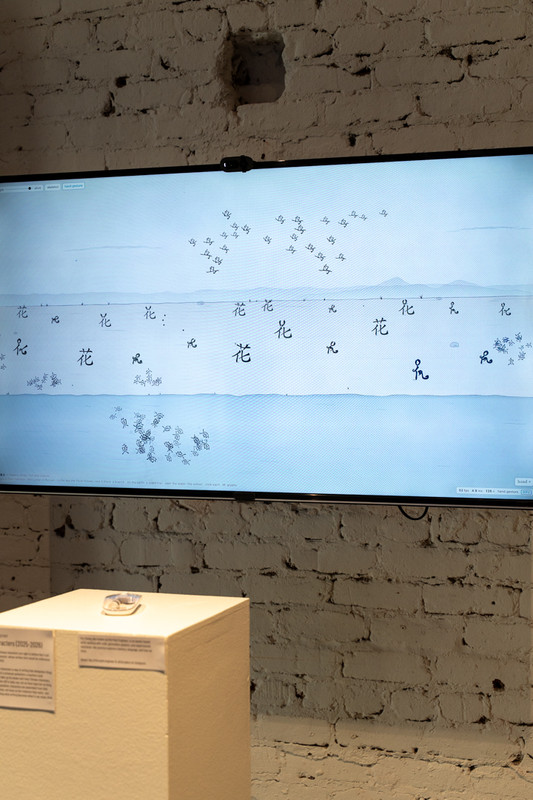
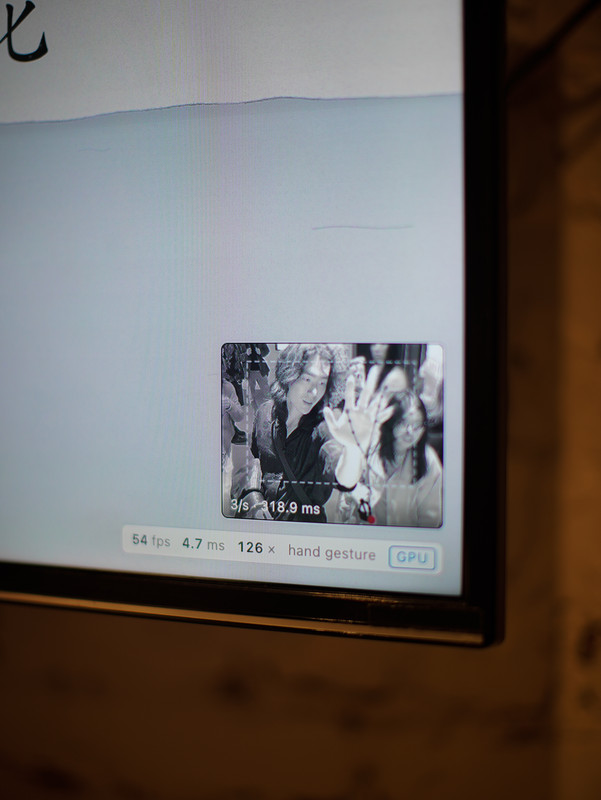
Leibniz saw in Chinese characters a way of writing that designates things directly, and dreamed of a universal symbolism a machine could compute. These works take up his dream and treat Chinese characters, the oldest writing system still in daily use, not as fixed signs but as living material. Through computation, characters are assembled from their strokes, read by machines, set loose as the creatures they name , and returned to nature, asking what writing becomes when it can move, think and decay.
Lineage Holder
Kelsey Chen is an interdisciplinary artist and critical theorist. Her latest work engages earth-based technical traditions from a craft perspective and speculates on how the growth towards a planetary/ecological consciousness might foreshadow a new kind of humanism for a post-human age.
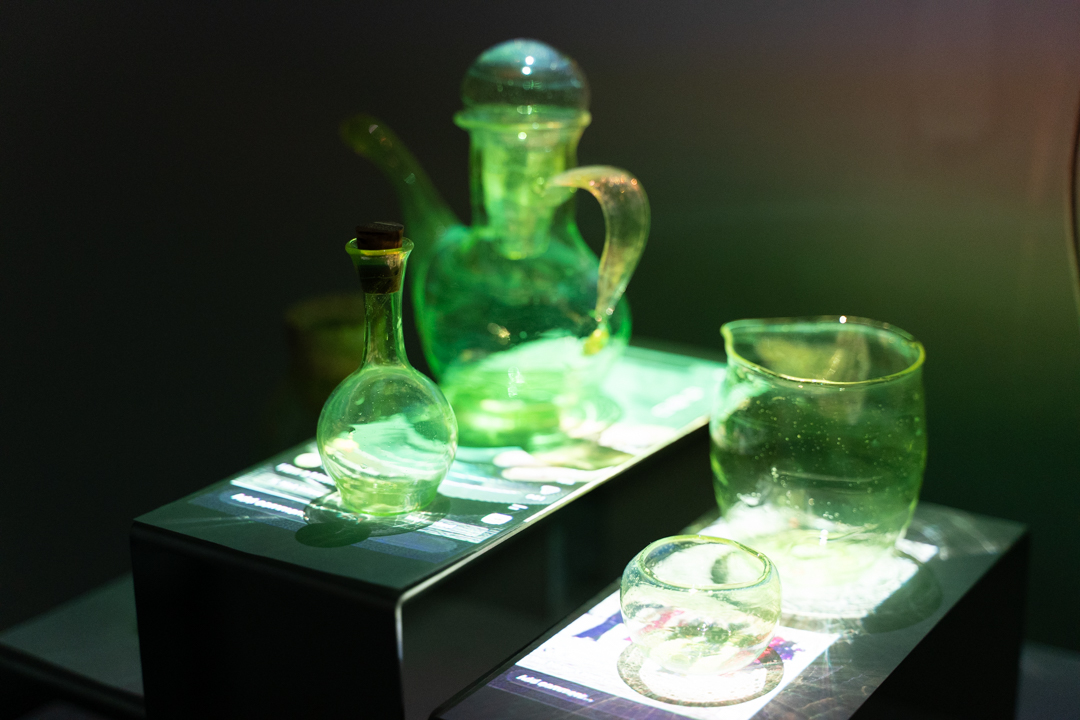
Lineage Holder maps social media footage of Chinese uncles and aunties practicing qigong in public spaces onto a gongfucha tea set made of marijuana pipe-glass by glassblower Guy Moore. The tea set, "alchemy I," was released as a limited edition of 24 by Guy Moore and Kelsey Chen in 2026. Lineage Holder explores tea as a primary material / medium through which the West exercised a political imagination of the East as a spiritual and cultural alternative to the crises of modernity. From the 1960's countercultural movement to the present Chinamaxxing phenomenon; tea, Eastern esoteric traditions, and Chinese civilization itself have been enlisted as idealized foils to the West in the West's own search for political alternatives. The piece observes the revival of tea culture in the West as an expression of utopian longing and political critique in an era of polycrisis and profound political / institutional failure.
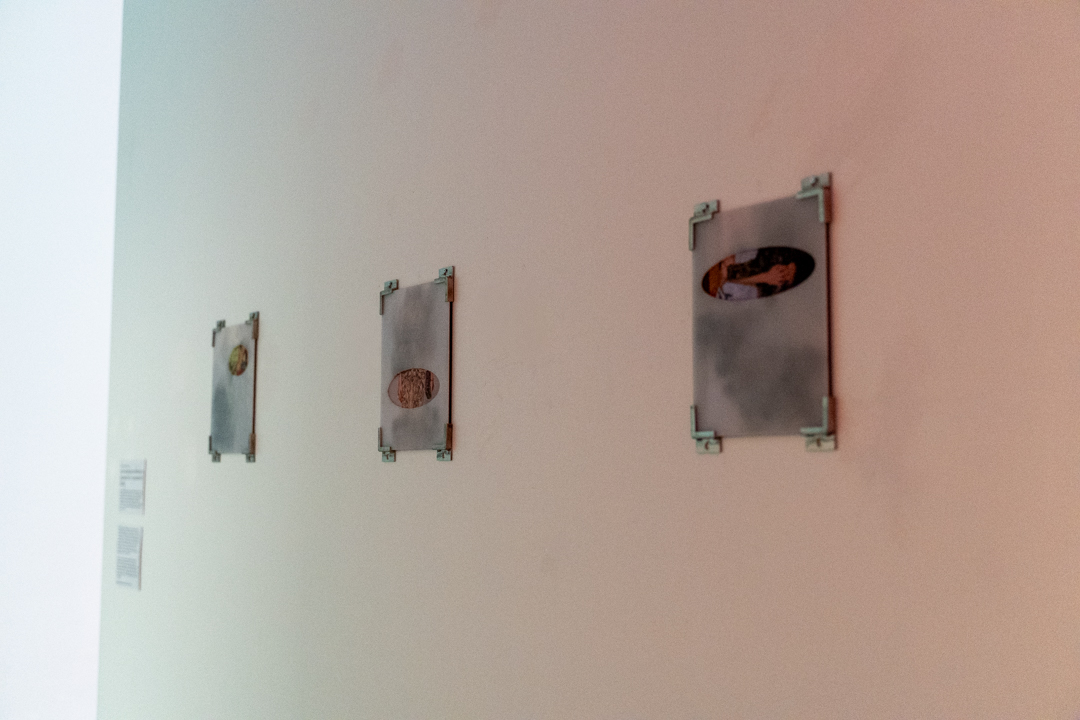
prize winning pizza memories; my greatest find, I; my greatest find, II
Ketty Haolin Zhang (b. Chaoyang) is a visual artist and cultural worker based between Vancouver and New York. Informed by her experiences immigrating from an industrial Chinese city to Canada as a teenager, her practice explores provisional belonging through a diasporic lens, primarily through mixed-media assemblage. Often drawing from personal archives, literature, pop culture, and mythology, she is interested in self-construction and self-transformation as a form of resistance under precarity, and as a technique to make home in the world.
Her recent work has been featured by Dazed, Overstandard, Imuplse Magazine, Whitehot Magazine, CBC Arts, and Prism International, among others. Recent exhibitions including Capture Photography Festival (Vancouver), White Columns (New York), and The Sue Tear (Brooklyn). Upcoming exhibition includes Untitled Art Fair Miami Beach, where she will be exhibiting with London-based Tache Gallery.
The works manipulate online images of Wendi Deng Murdoch and merge them with awkward English phrases from the artist's childhood albums, produced by the type of photography studios many Chinese children visited yearly. A controversial businesswoman, art patron, Rupert Murdoch's ex-wife, and rumoured spy, Murdoch is often read through the lens of the American Dream and Chinese ambition, while claimed and disowned by both.
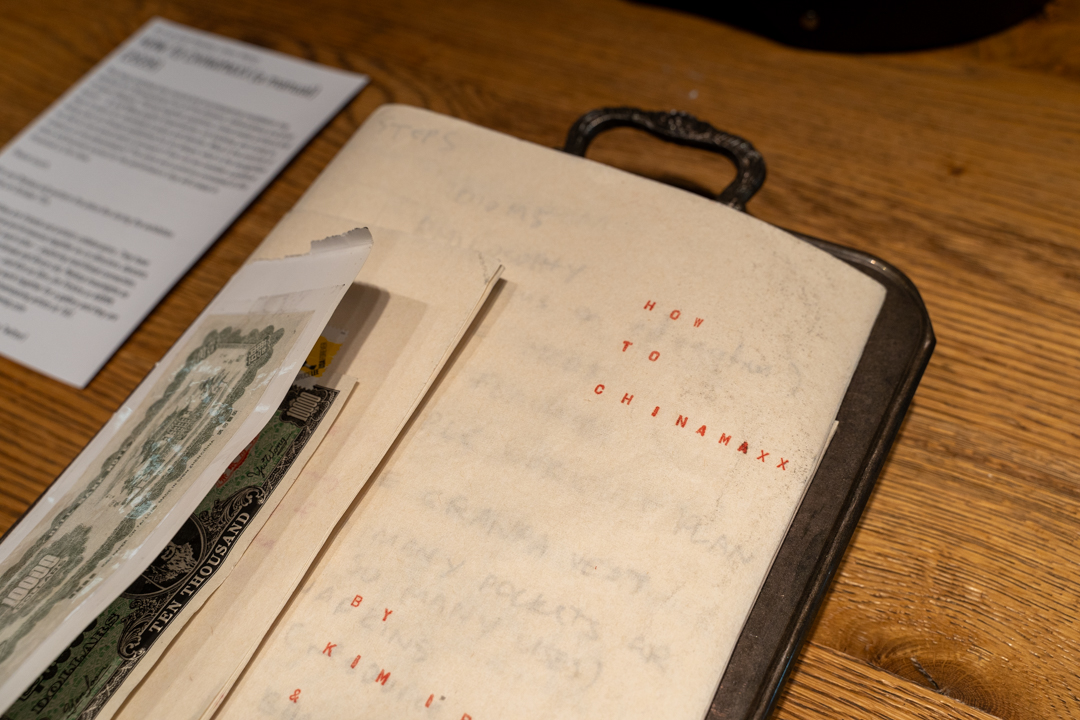
HOW TO CHINAMAXX (a manual)
Kim and Melissa are friends and artistic collaborators. They have worked on several performances together as co-directors, dancers, and dramaturgs for each other — exploring matrilineal connection, Chinese diaspora, heartbreak and Bruce Lee. Melissa moonlights as drag persona Deuce Lee — and Kim as Slim Jim Pickins or KRIMM. This is their first time making work together for a gallery and they are honored to respond to all the Chinamaxxing artists at TIAT. www.melissalewis.art www.iamkrimmip.com
This hand-stitched zine manual and accompanying installation tray reaches for Chinamaxxing from all the distance, awkwardness and grief of queer diaspora. Piecing together questions, mixed media artifacts and poems — Ip and Wong explore imperfection, not knowing, and trying as ways to yearn for closeness to place and identity. What is the practice of being seen as Chinese sometimes but not always, what is the recognition we desire from loved ones or strangers? How can we consider a political analysis of this phenomenon? The notes and questions contained in this piece will become scores for the performance they will create in response to the show.
*** Please join us for their live performance event at the show’s closing on October 17. Some public rehearsals may occur during open gallery hours
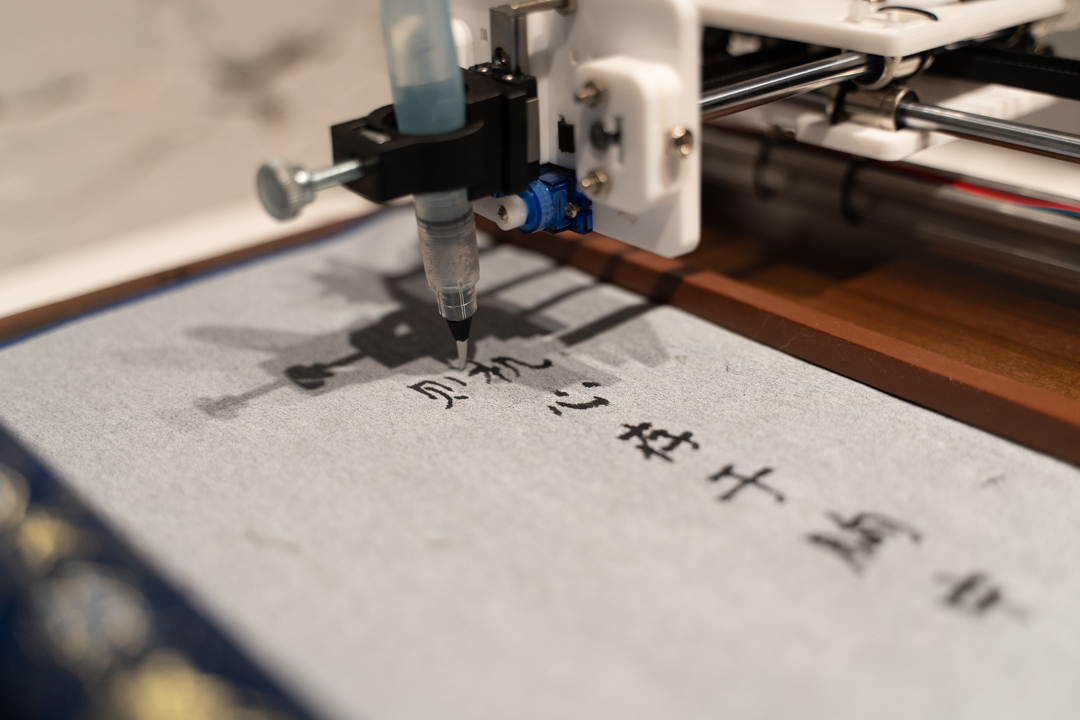
MACHINE机心HEART
Mona and Kerem live in Oakland. Mona has studied Chinese & Sino-Arabic calligraphy since 2022. Kerem resents machine art.
有机械者必有机事,
有机事者必有机心。
机心存于胸中,则纯白不备;
纯白不备,则神生不定;
神生不定者,道之所不载也。
《庄子·外篇·天地》
Where there are machines, there are bound to be machine worries; where there are machine worries, there are bound to be machine hearts. With a machine heart in your breast, you’ve spoiled what was pure and simple; and without the pure and simple, the life of the spirit knows no rest. Where the life of the spirit knows no rest, the Way will cease to buoy you up.
Zhuangzi, "Heaven and Earth" (Outer Chapters, ~3rd c. BCE), trans. Burton Watson
Butterfly Chronicles (蝶生纪)
Qianwen Yu is an independent animator and artist working between Chicago and Guilin. Through watercolor painting on fabric and hand-crafted animation, she reimagines traditional Chinese totems, folk motifs, and mythological narratives through a personal visual language. Her work brings together the tactile qualities of textile materials and the movement of animation, exploring how cultural imagery, folk stories, and traditional symbolism can be transformed into contemporary moving images. Her work has been exhibited internationally in the United States, United Kingdom, France, Czechia, and South Korea, including two solo exhibitions in Chicago in 2024. She was featured in the February 2025 issue of “Gateway”, the in-flight magazine of China Southern Airlines.
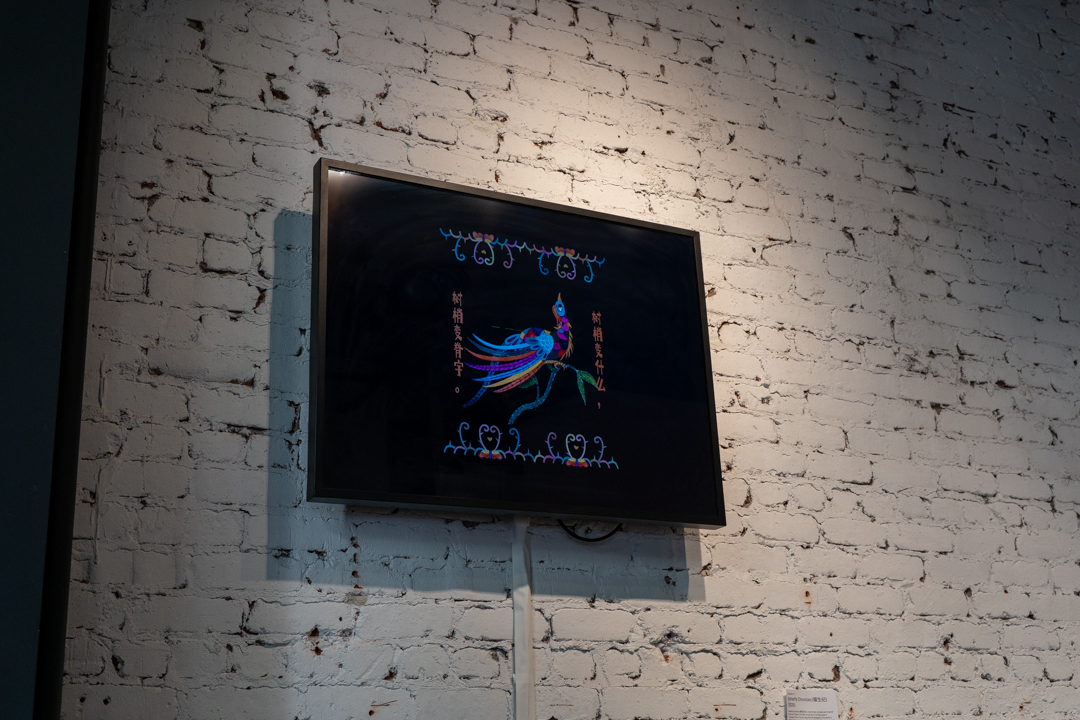
Butterfly Chronicles (蝶生纪) is a hand-drawn animated work inspired by Ancient Songs of the Miao, an oral epic of the Miao people of southwest China. The story describes the emergence of the Butterfly Mother from a maple tree and the birth of all living beings through twelve eggs incubated by the Jiyu Bird.
Using watercolor, traditional Miao embroidery inspired imagery, the work unfolds as a cyclical narrative in which the ending returns to the beginning. The animation reimagines an ancient myth through a contemporary, hand-crafted visual language.
Music: 天童《立冬》- 未来东方厂牌
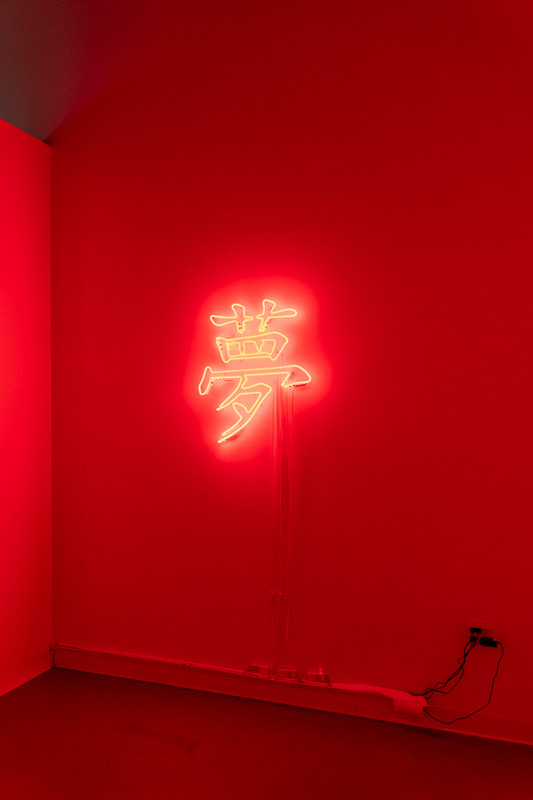
Dream(夢)
Snow (Sinuo) Chen is a multimedia artist and researcher with a deep fascination with bodily sensation and consciousness in relation to cosmology and mysticism. Engaging with techno-spiritualities, language, identity, and cyberspace, her work brings together art and technology to reinterpret and reactivate ancient narratives within contemporary contexts, while reimagining how we perceive, believe, and make sense of the world. She holds a B.S. from NYU Shanghai and an MFA from the School of the Art Institute of Chicago with a full-tuition scholarship. Her work has been exhibited and performed in art spaces, institutions, and on public screens internationally across Europe, North America and Asia.
Neon has long been part of the urban cityscape, transforming language into light and turning commercial signs into visual symbols of modernity, desire, and fantasy. This work is a neon installation of the traditional Chinese character “夢” (dream), flickering at an irregular frequency. Suspended between language, imagery, and light, the character represents a dream rendered in the material language of contemporary technology. The piece brings traditional text into a contemporary technological medium, opening questions around cultural memory, translation, desire, and the ways images of China are imagined and circulated across borders. Its flickering, dysfunction, and moments of breakdown suggest a dream that is unstable and incomplete, one that is continually being formed, interrupted, and reconstructed through acts of translation and projection.
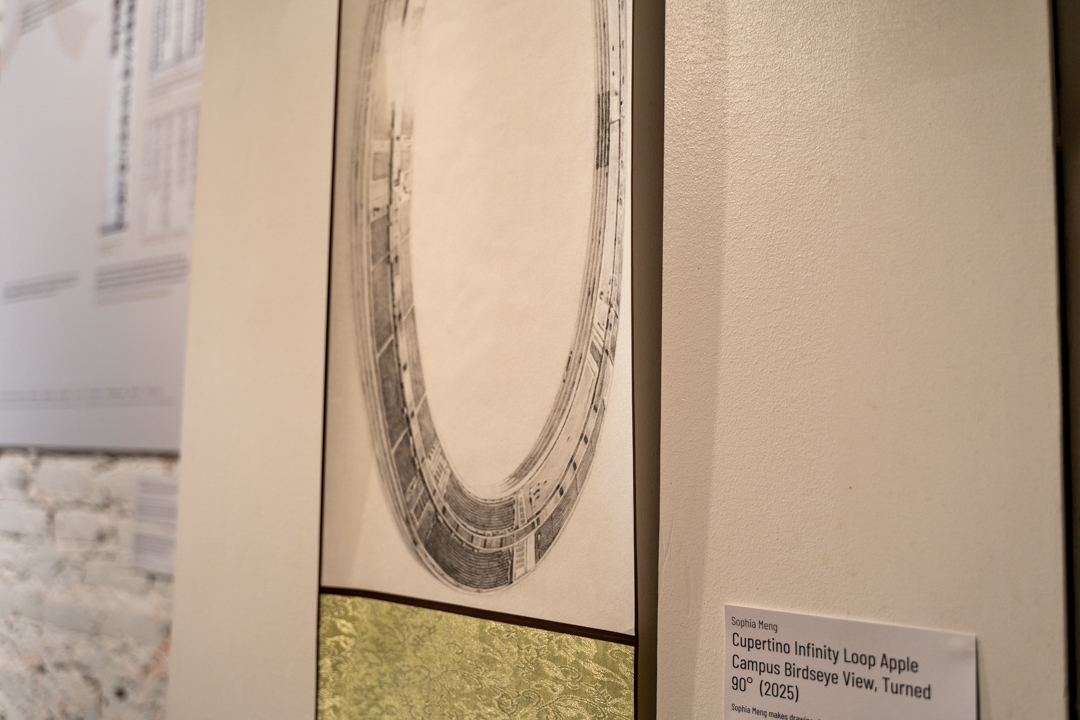
Cupertino Infinity Loop Apple Campus Birdseye View, Turned 90°
Sophia Meng makes drawings in Brooklyn.
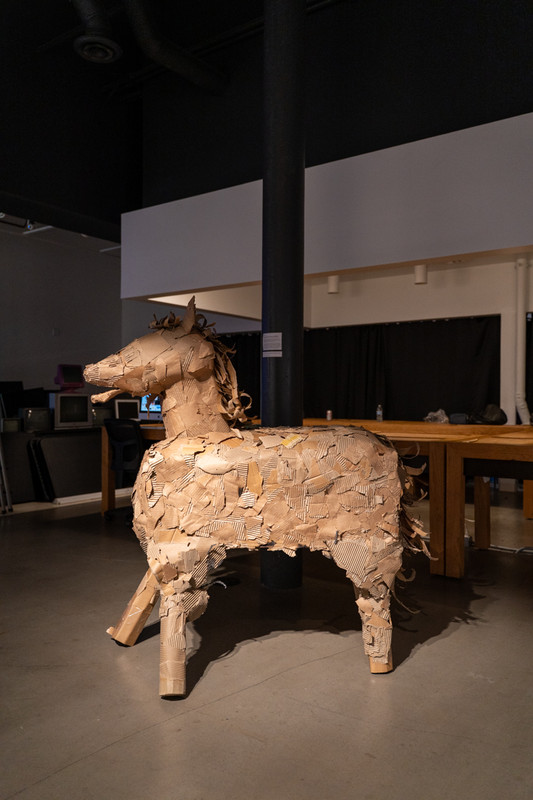
Year of the Fire Horse
I just moved to SF. Looking to life-maxx. Also looking for a band !!
A burnt cardboard horse scented with lavender. Alluding to André Aciman’s essay On Lavender and Longing, the work explores longing for an imagined future or a self that does not yet exist.
I was born in a Year of the Horse; 2026 is the Year of the Fire Horse, symbolizing rapid transformation. Charging toward self-reinvention, the horse burns bright at the risk of burning out. Visitors can place their heads inside its hollow body, invoking the Trojan horse: a vessel for the unwelcome parts of our present selves we wish to leave behind.
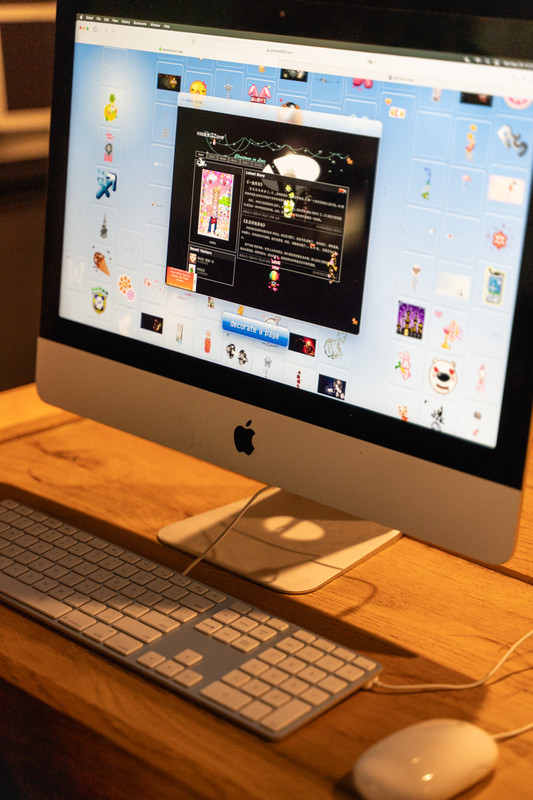
qzone2000.com
viola he is a shanghai / nyc-based multimedia artist, educator, electronic musician, and creative technologist. They make web and irl performances and experiences, exploring alternative structures, systems, and interfaces across digital and physical mediums. viola is an organizing member of Livecode.NYC, an incubator member at NEW INC, and co-runs experimental game collective [[rect*]] repair ✧ ദ്ദി(˶•̀ᴗ-˶)
a playable digital archive of QZone (QQ空间) decorations, collecting 5,851 files from between 2005 and 2009, including skins, pendants, floaties, cursors, title bars and flash music players.
QZone is the personal-homepage platform Tencent launched in 2005. At its peak it had over 600 million monthly active users, making it the largest social network in China at the time. For a generation it was the first page of their own, and what Y2K maximalism and Fei Zhu Liu ("non-mainstream") looked like on the Chinese internet.
The QZone Museum is designed and built by viola he, who first learned html through QZone and blogbus.
Ritual as Method
Weichen Zhou is a Vienna-based spatial designer and researcher working across architecture, media, installation, and cultural research. His practice explores ritual, cultural translation, translocality, and the ways collective identities are reconstructed through spatial and mediated experiences.
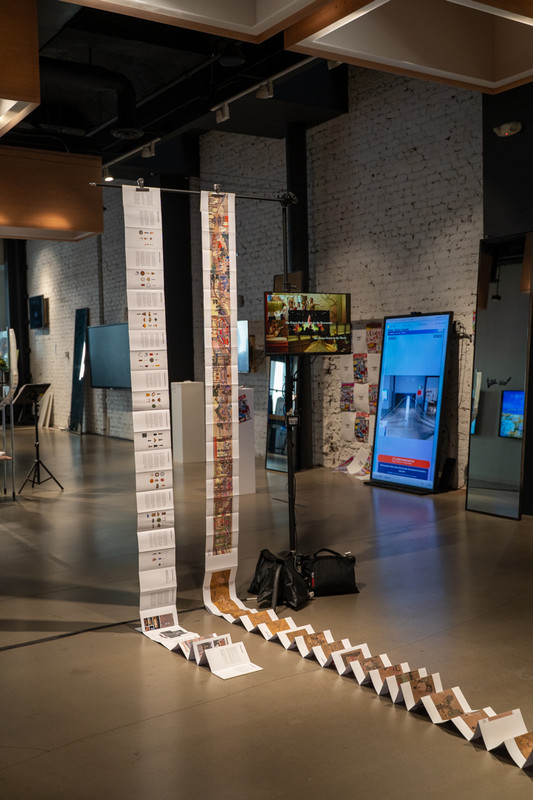
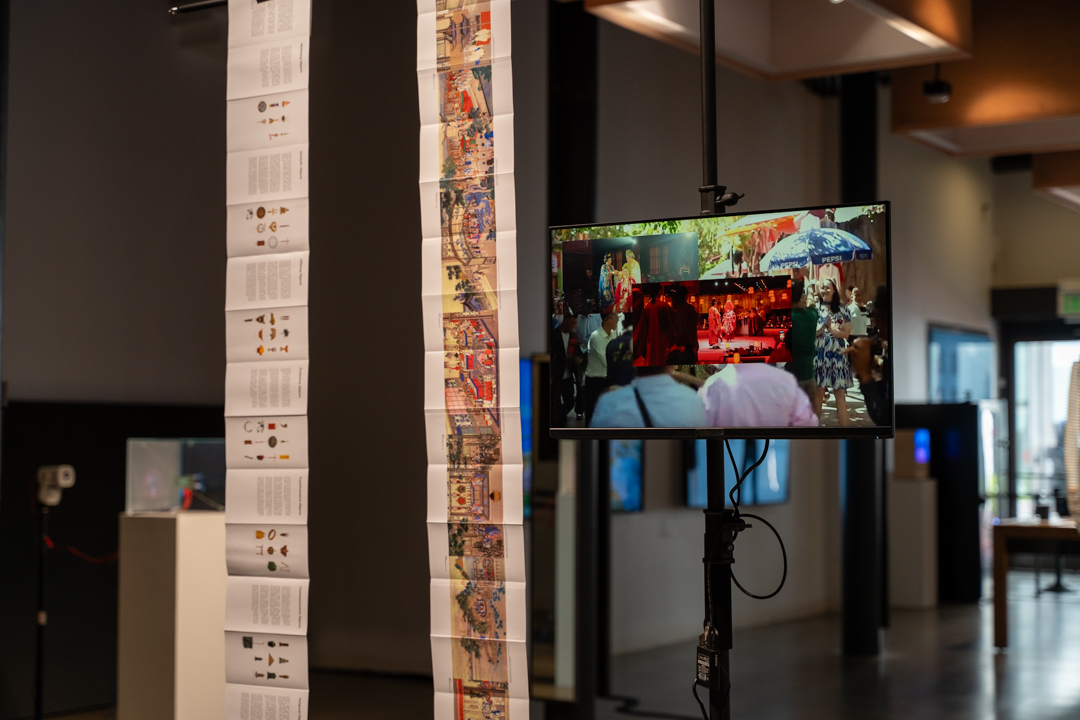
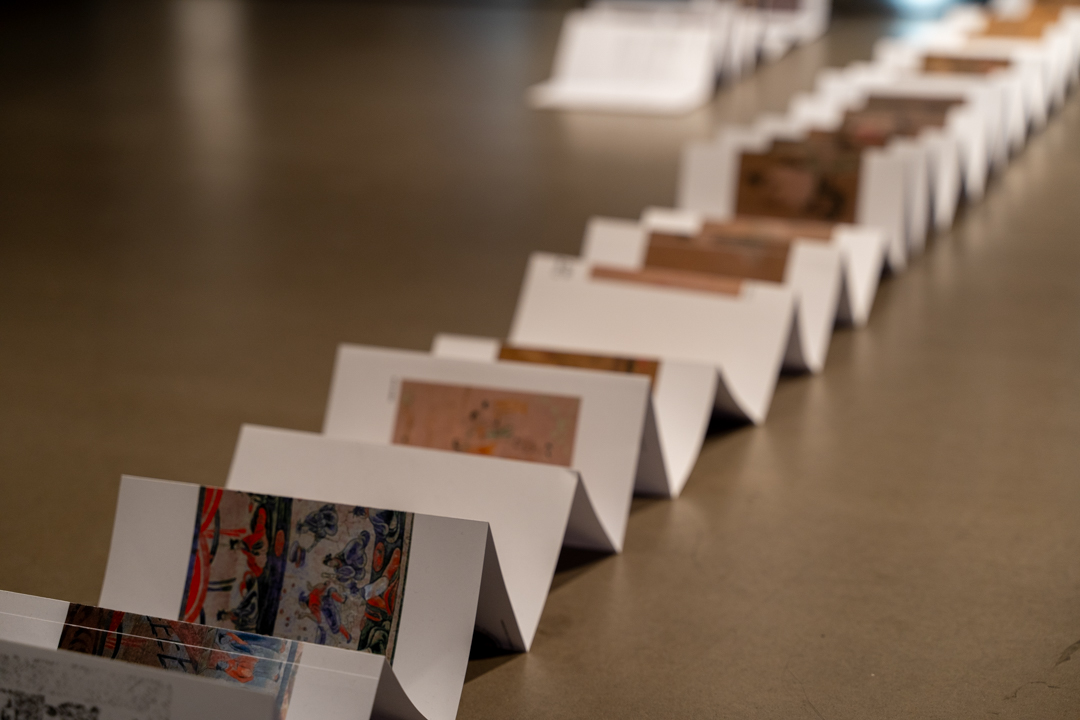
Ritual as Method examines the contemporary revival and mediation of Chinese ritual culture, from Hanfu and immersive “palace banquet” experiences to their circulation through digital media. Through research, images, and video, the work explores how ritual is translated, reconstructed, and reimagined across cultural contexts.
Inner Carbon
Wendi Yan constructs speculative epistemologies through research-driven worldbuilding and metafictional simulation, using CGI technology and sculpture to probe the artifice of knowledge. An inaugural Steve Jobs Archive Fellow, she won the Grand Prix of the 6th VH Award by Hyundai Motor Group and has received a New Aesthetics grant and an Honorary Mention from CERN Collide Stockholm. She has been in residence at A24 Labs, NEW INC at the New Museum, Eyebeam, and The Arctic Circle Expedition.
Xie Yi is a game designer, developer, digital artist, and game scholar. He is currently a PhD Candidate at the Interaction Dynamics Lab, University of California, Santa Cruz, where he conducts research and creative practice. His work spans human-computer interaction, psychology, philosophy and sociology, using game design to explore the complexity of human emotion and social dynamics. He focuses on two-player games, modern and tribal rituals, and theatrical performance, examining how the procedural rhetoric of games can turn the act of play into a means of constructing complex narratives.
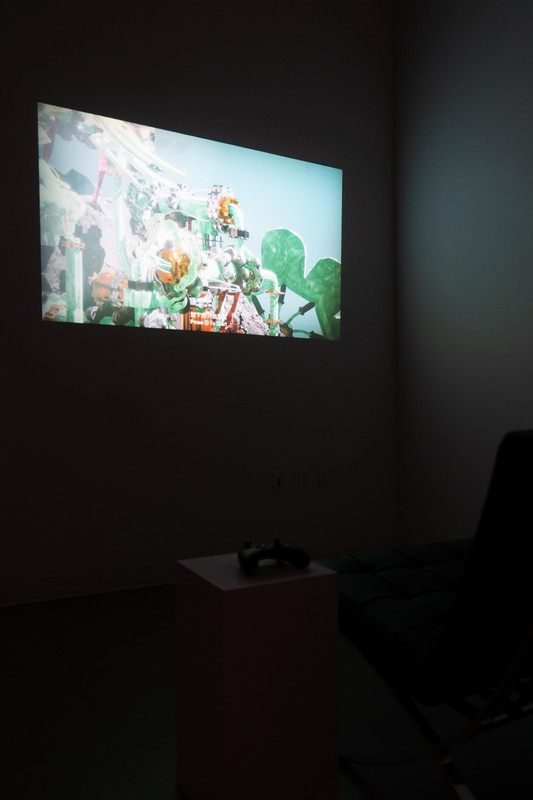
Inner Carbon is a 3D platform puzzle game that infuses Daoist cosmological knowledge into a speculative climate biotechnology future. Inspired by the rediscovered 19th century engraving of the "Chart of the Inner Landscape"--a somatic meditation diagram encoding the body as a microcosm of the Way, the work asks how old ways of nature-human correspondence might offer creative, philosophical openings to planetary survival and flourishing.
Shanzhai Remix 山寨合集
Yuehao Jiang (b. 1992, Suzhou, China) is a Los Angeles–based artist working across video games, painting, drawing, and sculpture. Raised in a family of painters among Suzhou's Ming and Qing dynasty gardens, she developed an early sense of form, narrative, and material process that still guides her work. Her visual language joins classical Chinese painting principles with the aesthetics of simulation and interactive media.
Her work has been exhibited internationally at venues including Hubei Museum of Art in Wuhan, Guardian Art Center in Beijing, K Museum of Contemporary Art in Seoul, Jinji Lake Art Museum in Suzhou, and Gray Area in San Francisco. Jiang is an Adjunct Associate Professor at USC Media Arts + Practice and has previously taught at UCLA Design Media Arts and Parsons School of Design.
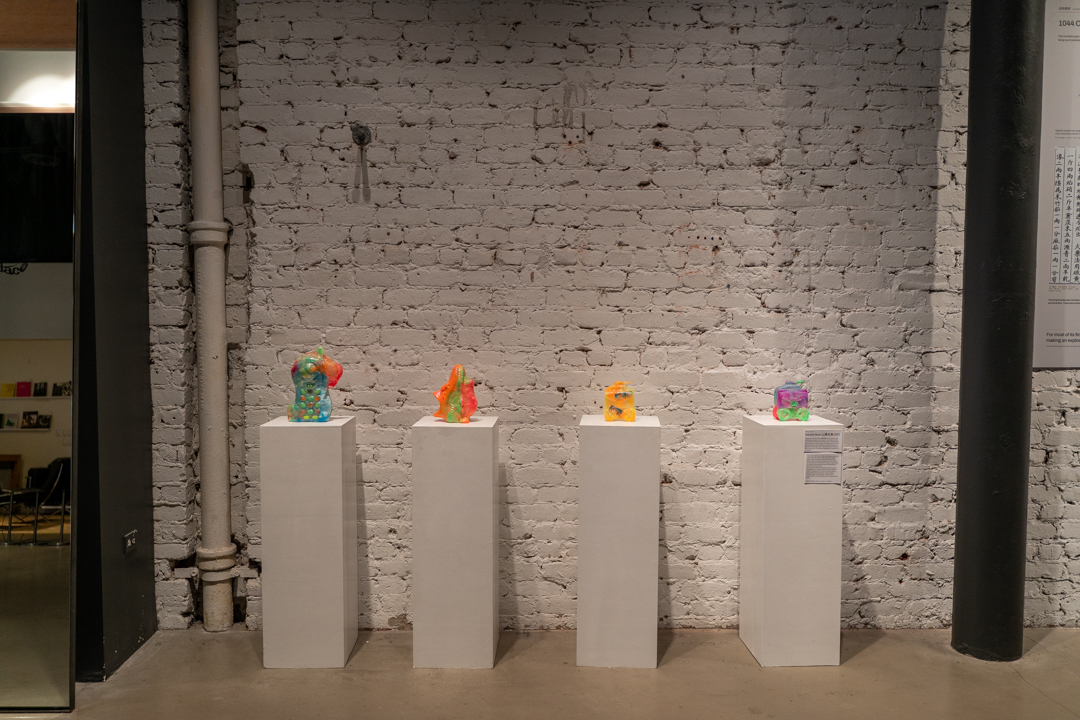
Sculptures from Shanzhai Remix 山寨合集 cast 3D-scanned Taobao knockoffs (bags, sneakers, toys, electronics) in resin, fused into hybrid forms. Made when shanzhai stood for Western fears of Chinese copying, the work reads it as vernacular design: fast, adaptive, meme-like. In the age of Chinamaxxing, what was dismissed as counterfeit culture now describes how every image model is trained. When culture travels and comes back altered, is that admiration, appropriation, or invention? And who decides?
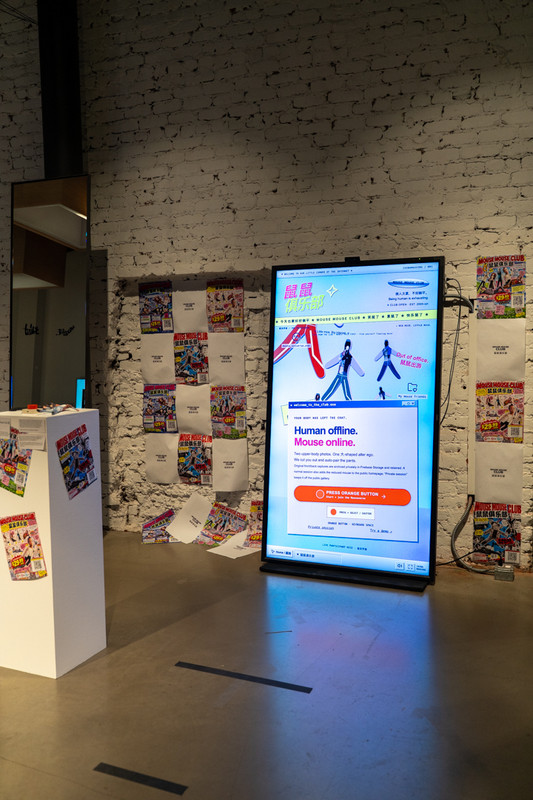
Mouse Mouse Club 鼠鼠俱乐部
Ziyuan “Zoey” Zhu is a designer, creative technologist, and curator who likes to give digital ideas a life outside the screen. Working across 3D design, interactive experiences, and installation, she follows internet rabbit holes and turns everyday absurdities into things people can play with, step into, or see themselves in.
Being human is exhausting. Time to go flat.
Turn your selfie into “mouse jerky”: a tiny, flattened you, ready for a holiday. Inspired by Chinese internet slang, where 鼠 (“mouse”) playfully replaces 死 (“death”) in expressions like “dead tired,” the club gives youthful exhaustion a ridiculous little body.
Step in front of the webcam, strike a pose, and choose an outfit. Rotate, stretch, and play with your mouse, then take a photo together and save it for your next adventure.
Here, going flat means 躺平 (lying flat)—stepping away from the pressure to constantly achieve. Even if you can’t take a break, your mouse can.