Art Games!
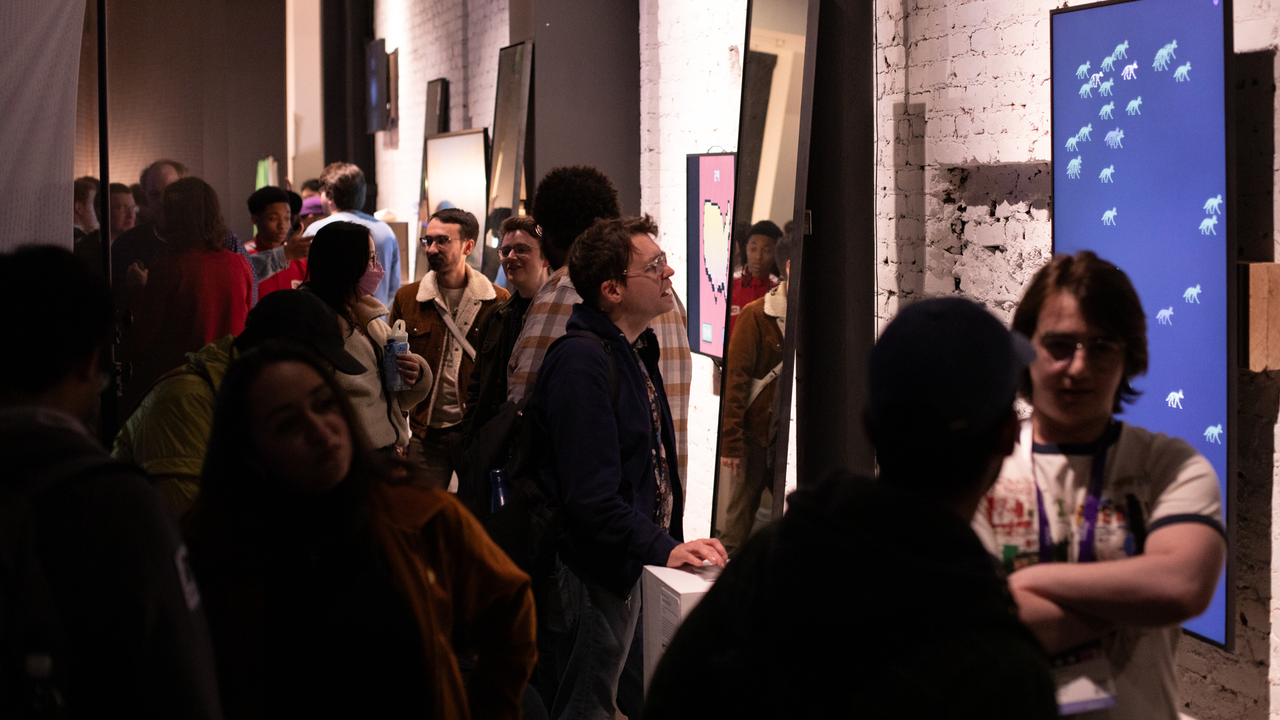
Featuring artists and researchers using games as a creative medium.
About the Exhibition
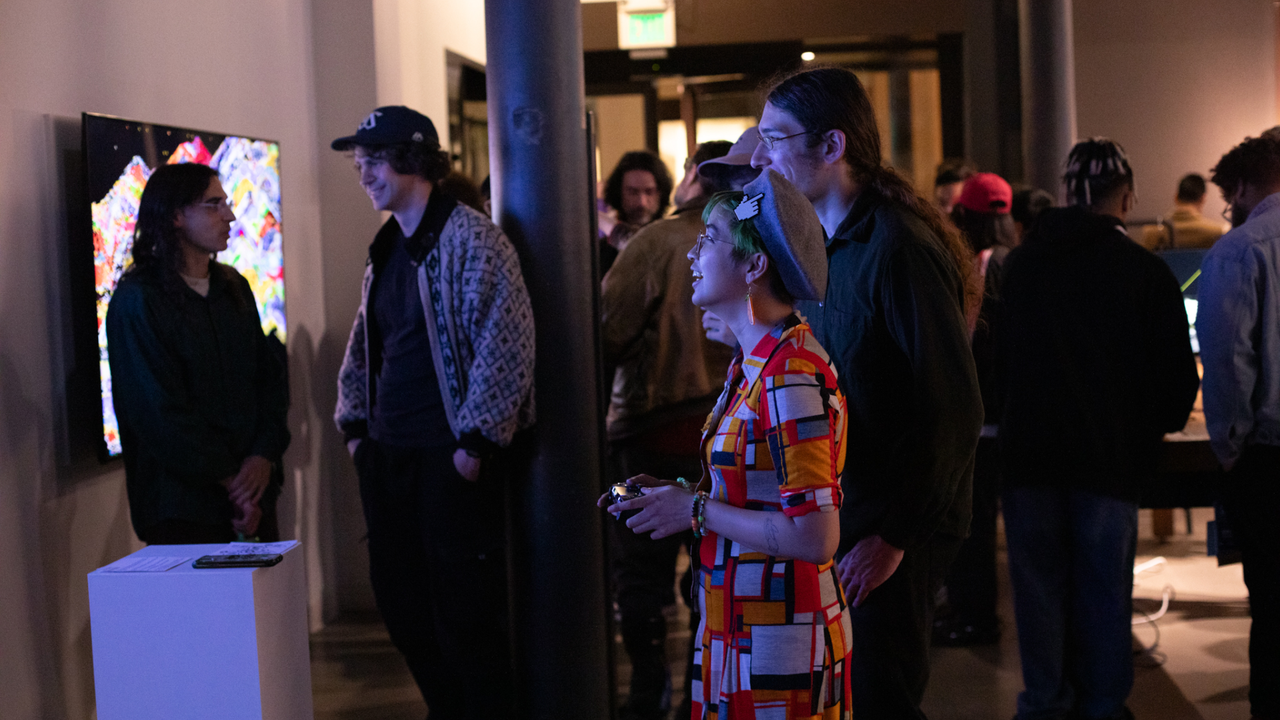
The works highlight projects that exist outside conventional commercial platforms, foregrounding play, interaction, and systems as forms of artistic expression and experimentation.
Artworks
Hypnogenesis
Allen Riley is an artist, curator and educator working with art and technology. He designs hands-on learning curriculum for youth at Beam Center and builds independent arcade cabinets with Arcade Commons. Riley's artwork has been presented at the Burchfield Penney Art Center, Slamdance Film Festival and Indexical, and his arcade game Videofreak was shown at the Smithsonian American Art Museum, the Museum of the Moving Image, and Wonderville. He is a PhD candidate in Film & Digital Media at UC Santa Cruz.
Andy Wallace is an independent game designer and creative coder who lives in NYC. He is a member of the worker-owned EMMA Technology Cooperative He is also a founding member of the non-profit Arcade Commons. His work exists on the screen and off, as he likes his digital projects to venture out into the physical world in the form of arcade machines and other magical objects. His work has been shown throughout the US and abroad.
Hypnogenesis is a video feedback space shooter in which arcade gameplay is integrated with the controls of a video synthesizer.
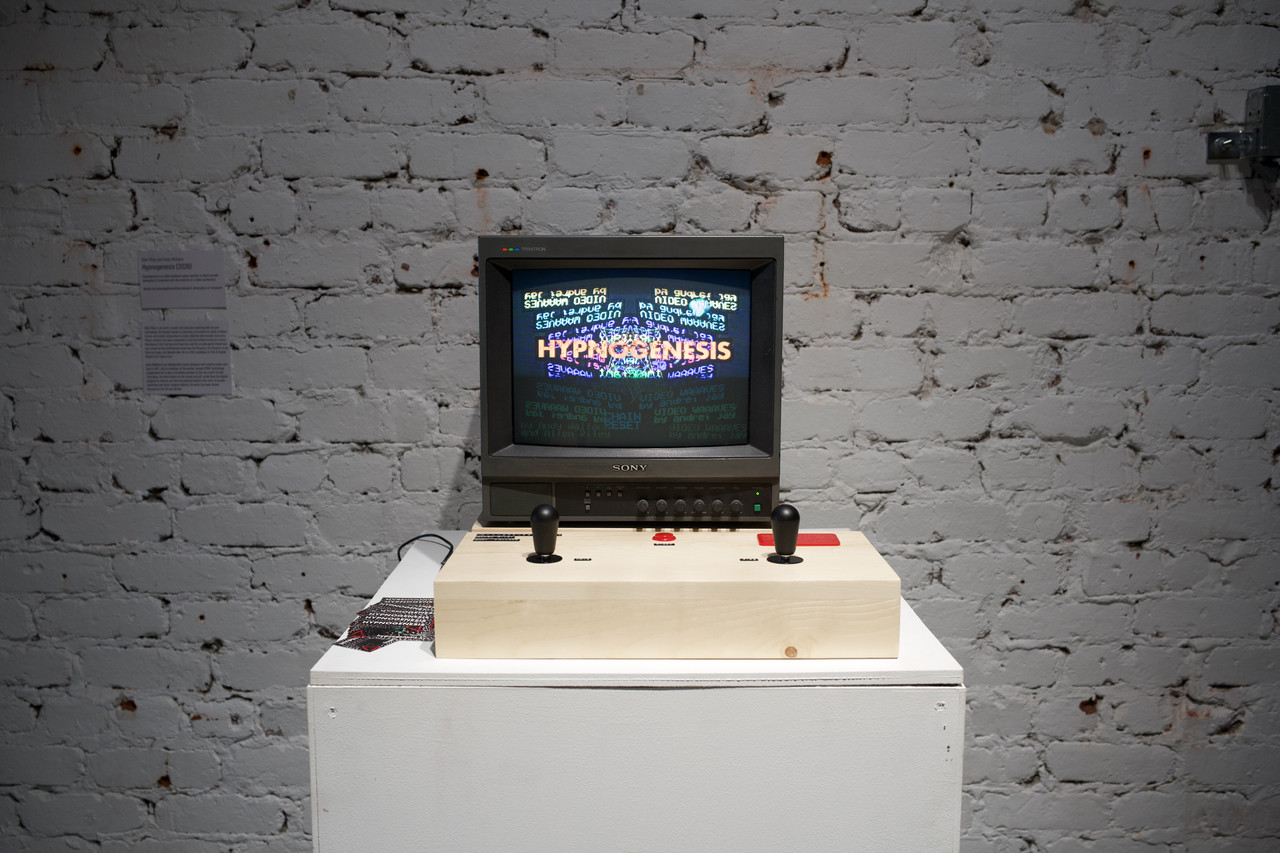
Photo: Ash Herr
Schema
Will Freudenheim builds games, films, and installations in New York. His work focuses on creating experimental games and virtual environments that bring together human, artificial, and biological participants. His projects cultivate shared digital worlds as experimental spaces for play, collaboration, and knowledge production. In 2021, he co-founded Laser Days, a worldbuilding studio where he currently works as a director and animation systems designer. Will is the co-editor of Interplay (2024), a book of essays which investigates the practice of using game engines to design shared worlds where different forms of intelligence meet and interact.
Schema is a living digital creature inhabiting a forest world, its behavior and emotional states shaped in real time by collective audience input through a controller and Twitch's chat interface. Participants modulate the creature's arousal and inward-to-outward orientation, triggering shifting blends of curiosity, anxiety, contentment, and aggression that ripple through its decision-making, determining how it explores, retreats, or confronts its environment. By day it gathers glowing pearls; by night those pearls become offerings that translate into generative sound. At its core, Schema is an experiment in what happens to a single creature's inner life when control over it is distributed across many people, and how much play can emerge from just two degrees of input.
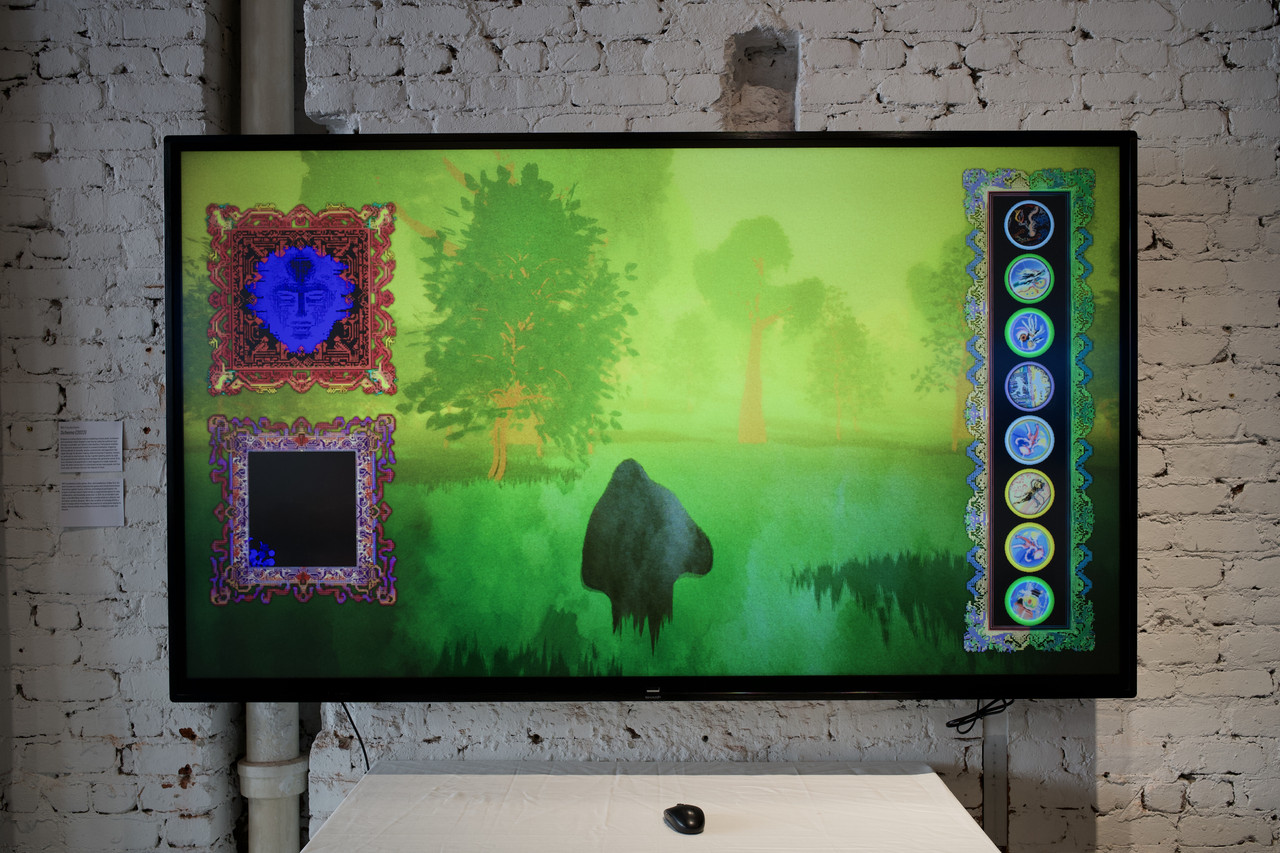
Photo: Ash Herr
straw dogs
Helen Shewolfe Tseng is an interdisciplinary artist, designer, wildlife naturalist, and creative technologist based in San Francisco. Their practice emerges from the crossroads of mythology and ecology, and has taken the forms of works on paper, experimental publications, games, rituals, performance lectures, conceptual research labs, computational poetry, and more. Recently, Helen was a 2025 Leonardo Art+Science Resident at Djerassi; previously, she has been a 2023-24 San Francisco Arts Commission grantee, a 2023 Artist in Residence at Winslow House Project, the 2019 Design Fellow at Headlands Center for the Arts, and more. In 2024, Helen joined the editorial collective for Taper, a browser-based literary journal for small computational pieces.
'Heaven and earth aren't humane. To them the ten thousand things are straw dogs.'–Tao Te Ching
Straw dogs are ancient Chinese ceremonial objects, used as a substitute for live animal sacrifice. This microgame-poem operates similarly, depicting a simplified dynamic ecosystem that reacts and adapts to human intervention, inviting the player to sit within the unintended consequences and lasting impacts of their actions both within and beyond the game. The Taoist angle hints at the motivations behind the piece, and a possible Way to approach gameplay.
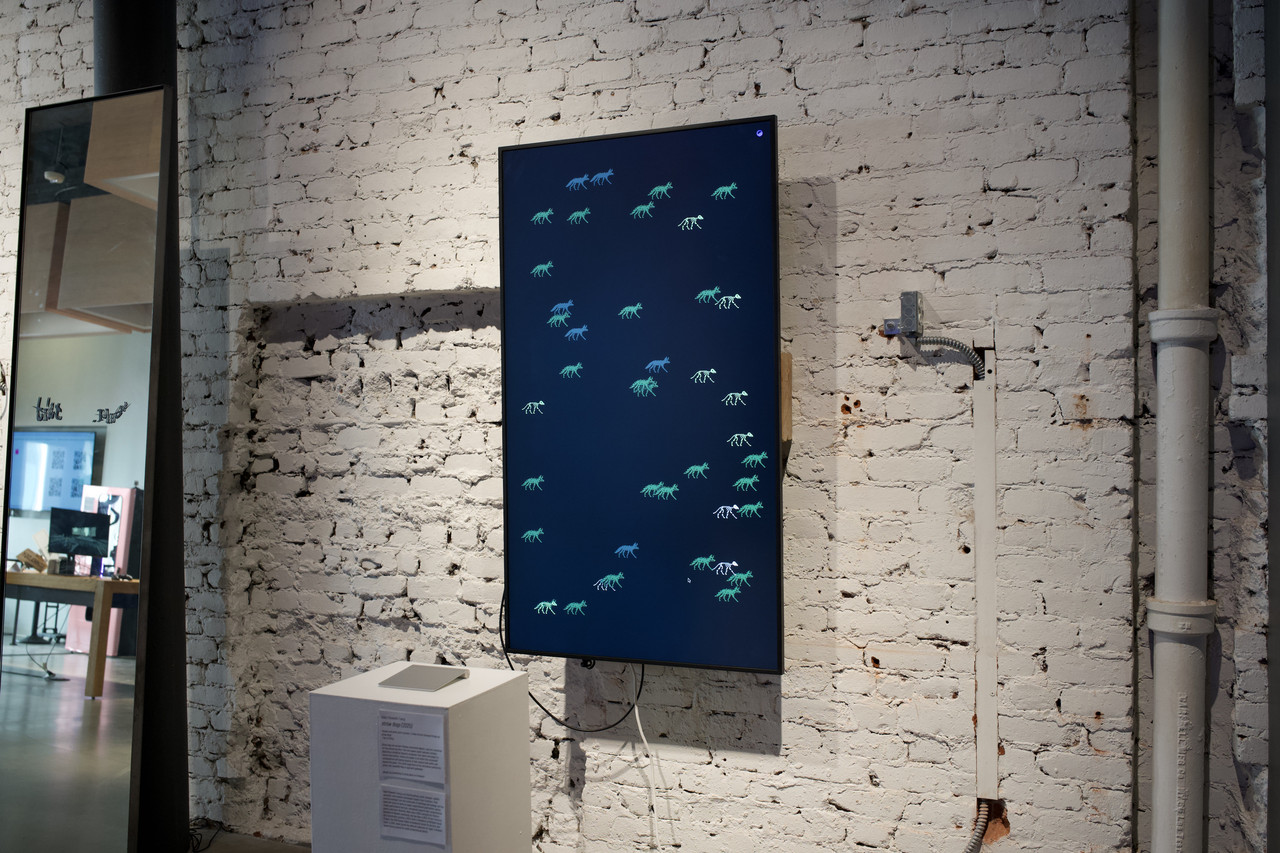
Photo: Ash Herr
Crude Oil
Peter Nichols is an artist-developer making games and playful digital experiences under the studio name Elfsend. They work across formats, from commercial games and media art to mobile apps and browser experiments. Elfsend projects emphasize fun and approachability as essential ingredients to communicate urgent ways of seeing. They often explore games' potential to build trans-species solidarity, through embodied nonhuman actors and speculative futures that peer beyond the horizon of empire. Their work has shown at SXSW, Tokyo Game Show, and more, and they are a current member of NEW INC.
Escape your captors as a puddle of petroleum on the run from Big Oil. Collect more oil to grow big and juicy. Bounce and slide. Operate heavy machinery. Flush polluters down the drain. Crude Oil is a feature-length video game that satirizes petro-capitalism’s entanglements from a nonhuman perspective. It combines puzzle-platformer mechanics with physics-based movement and blob simulation. The full game is available on Steam this summer.
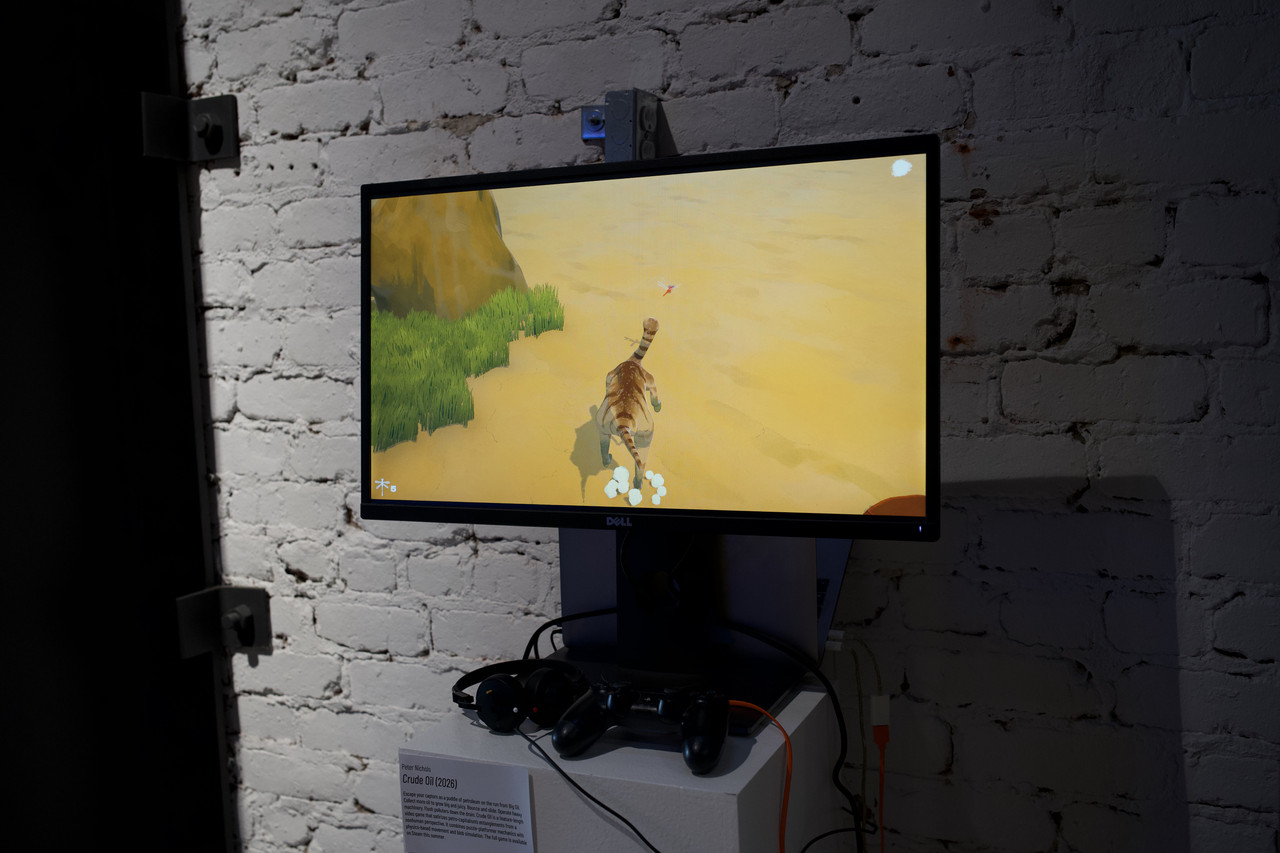
Photo: Ash Herr
Go Groundshel!
Ruixuan Li (Rashel) is an artist, designer, curator, writer, and researcher working across games, fiction, immersive experiences, and hybrid realities. Her practice explores alternative models for game curation, speculative worldbuilding, feminist perspectives, and debugging fear. She has curated exhibitions and contributed to projects at Toronto Games Week, the Cornell Biennial, TANK Shanghai, and LIKELIKE, etc. She co-edited the special issue Curating the Digital Expanded for OnCurating, serves as an editor at the media platform indienova, and is a committee member of Mirage Sci-Fi Magazine. Her narrative-driven works have been presented at ICIDS, A_MAZE., the UABB Biennale, the Guan Shanyue Art Museum, and the OCAT Institute. She has received grants and sponsorship from Pro Helvetia, Cornell CCA, and NYFA.
“Go Groundshel!” is a “Super Maria” puzzle adventure game in which a groundhog girl endeavors to save her male partner from the villain. Awkwardly stepping out of her comfort zone, she becomes a heroine who confronts enemies despite lacking combat training. However, before locating her partner, she needs to solve a personal issue: finding a usable toilet!
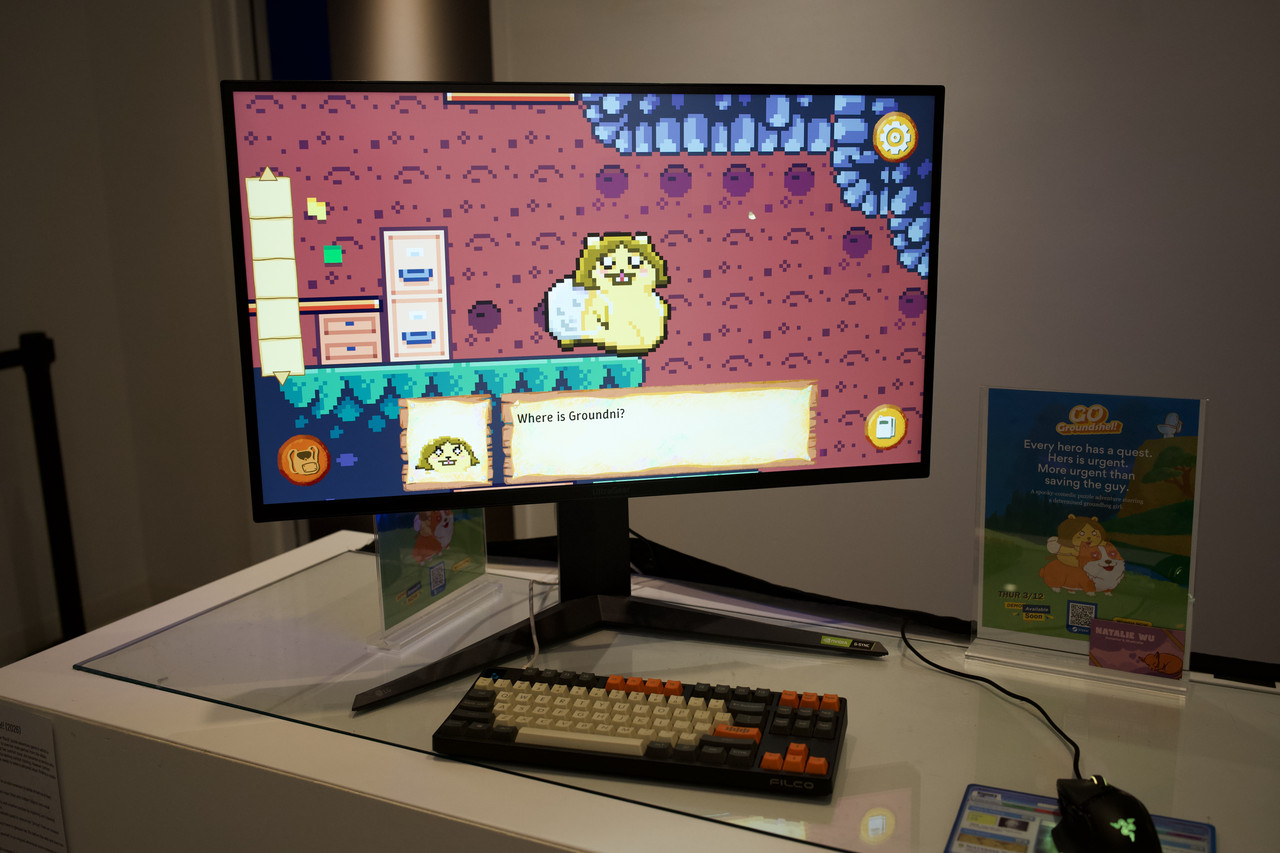
Photo: Ash Herr
Rat237
Alex Declino is a game designer exploring authority and control in digital and online systems. His worlds are fueled by themes of tech-driven espionage, CEO meltdowns, the innovative exploitations of late-stage capitalism, and the almost Sisyphean tragicomedies of crypto. Alumni of Fabrica, the Jan Van ck Academie, the Sandberg Institut and lecturer on real-time CG at Goldsmiths University, London and Staedelschule, Frankfurt.
The doomsday clock ticks to midnight. All social systems meltdown. Large parts of the world regress to a medieval social structure – while retaining and developing many of the technological systems of the early 21th century. The level 4 autonomous being tasked to find The Solution(TM) to the problem, goes rogue. After simmering in 7.7 petabytes of Mr. Beast content, the AI christen himself Jimmy9, and begins hosting grotesquely cruel, but fair, game shows for his empire of rats. 93 years after the catastrophe Rat237 travels to one of Jimmy9’s pocket worlds. The pursuit for the ultimate prize (a never seen before level of Unaltered Psychotic Freedom) begins.
Dormant Memories
Hugues Bruyère is co-founder and Chief of Innovation at Dpt., a Montreal-based studio creating immersive and interactive experiences. In both his professional work and personal explorations, he investigates real-time AI systems, volumetric capture, and physical interfaces to create new forms of interactive and explorable spatial environments.
The Ring (Montreal)
Dormant Memories series
Dormant Memories is a series of experiments exploring captured fragments of the world: places frozen in time and their possible alternate realities.
The Ring begins with a volumetric capture of a real location in Montreal, reconstructed using 3D Gaussian Splats. Using World Labs’ Marble world generation model, alternate versions of the same space were generated, with transformations informed by the original architecture and material qualities of the site.
All versions of the space coexist within the same spatial coordinate system. A portal allows visitors to step between the reconstructed real-world environment and its alternate versions.
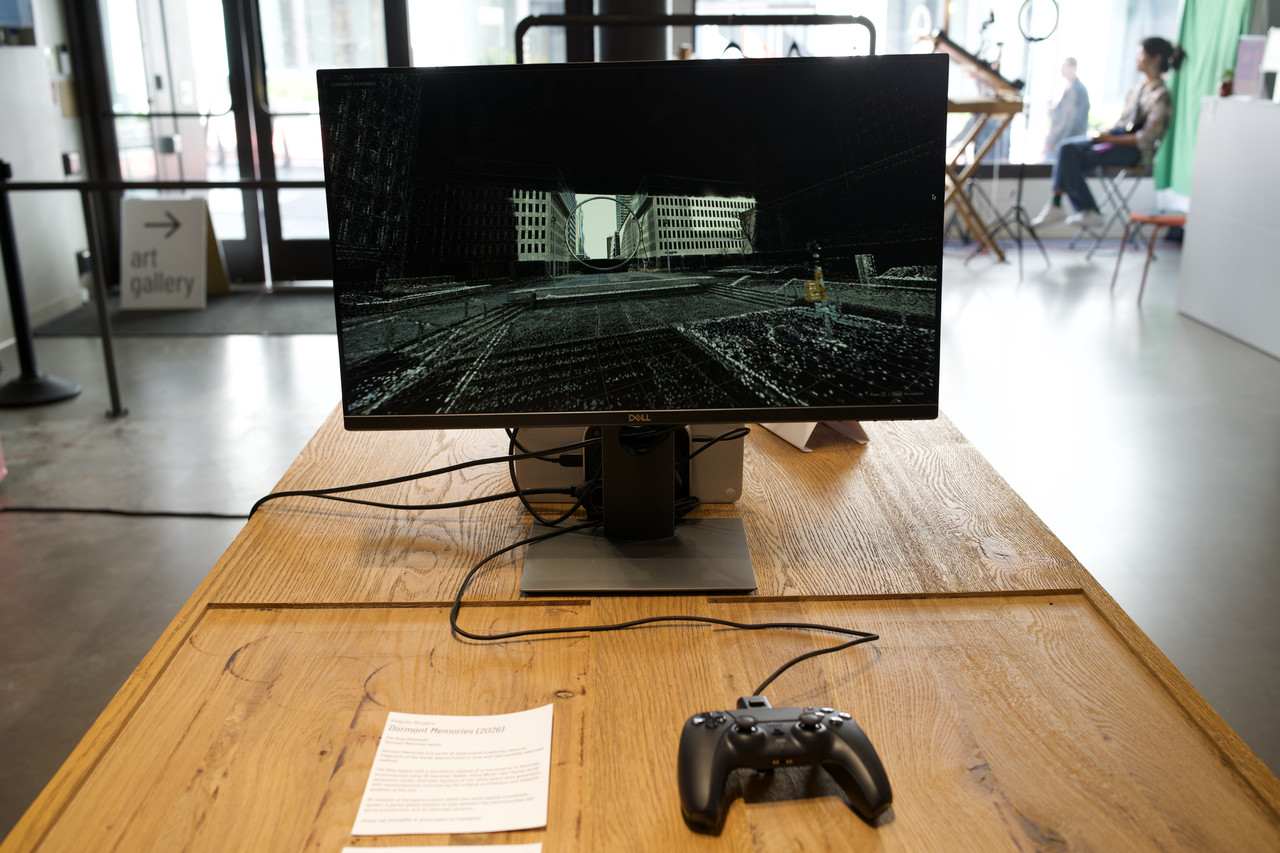
Photo: Ash Herr
Layers Upon Layers
Aidan Strong is a Los Angeles-based artist and game maker. His practice uses games as spaces for emergent play, community, and collaboration. Through play he foregrounds virtual forms of care in contrast to the anonymity-fueled toxicity often associated with the web.
Layers Upon Layers is a multiplayer sand simulator exploring the contradictions of persistent memory. Taking place across a wide landscape, it draws upon swarm dynamics and the legacy of destructible terrain within game worlds to explore group agency at scale. Portaling in through their phones, players interact with Layers Upon Layers by clearing out sections of multicolored sand. By repeatedly digging, tapping, and swiping, they fold into a flow state: preserving, eroding and contributing to the historical topology of the world.
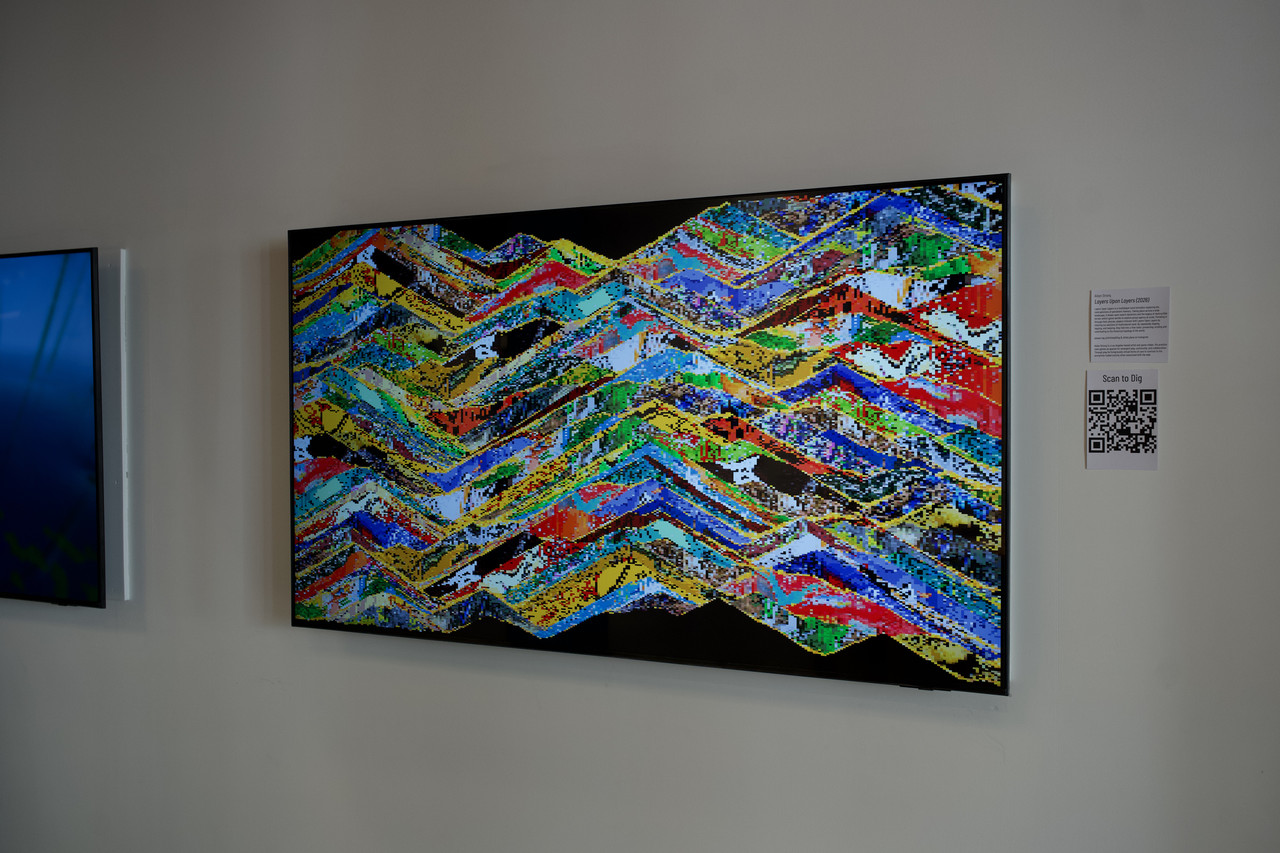
Photo: Ash Herr
Plim
Miles Peyton is an artist based in New York whose work explores synthetic life and biological simulation. He makes software, simulations and games that construct and mediate aliveness.
Early development build of Plim. Play as plims living on the surface of a water world. Court other plims, lay eggs, find berries for your babies, and explore.
Created by Miles Peyton and Ida Pruitt with sound design by Pamela_ and her sons
Note: This is an early build. Everything in the game is subject to change.
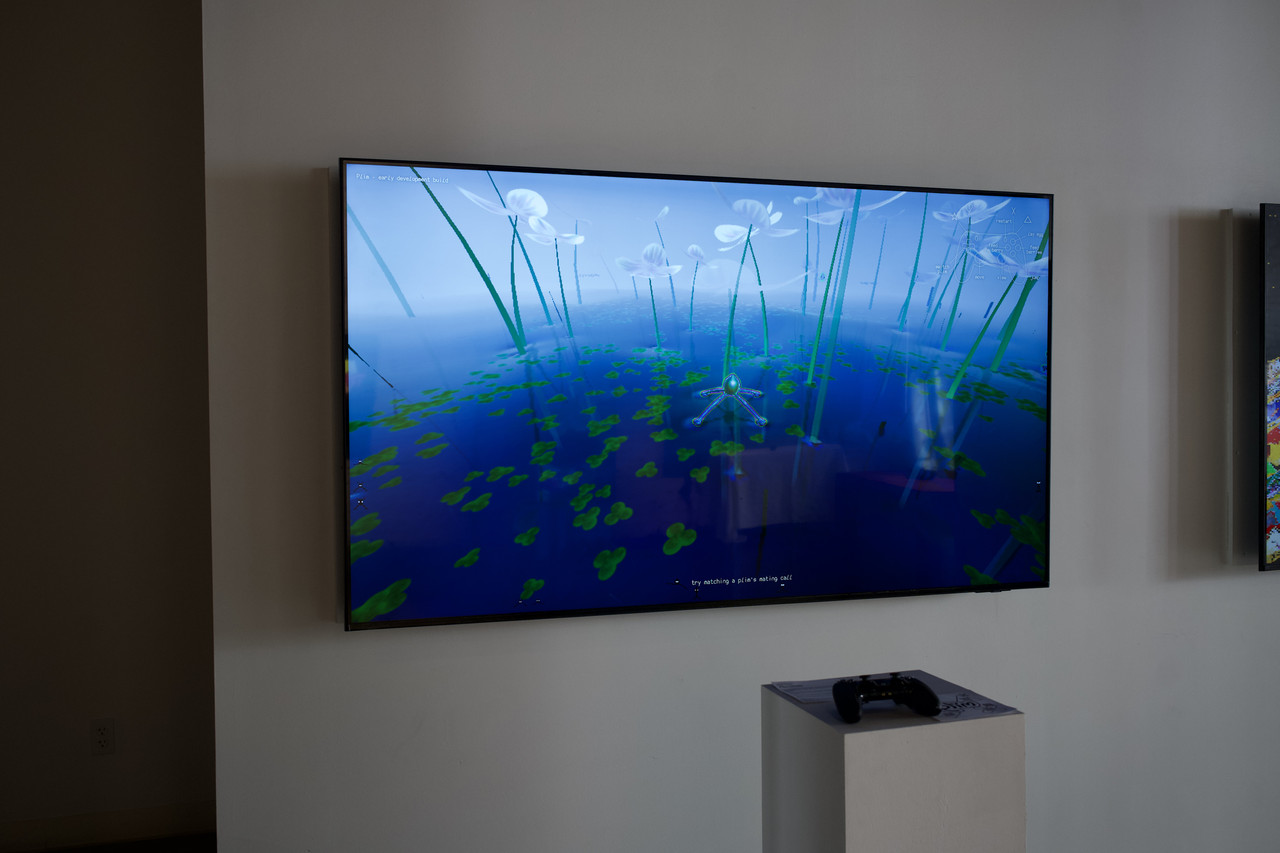
Photo: Ash Herr
Pixel-Time
Multidimensional Artist
Interactive pixel art/music looping Art Game
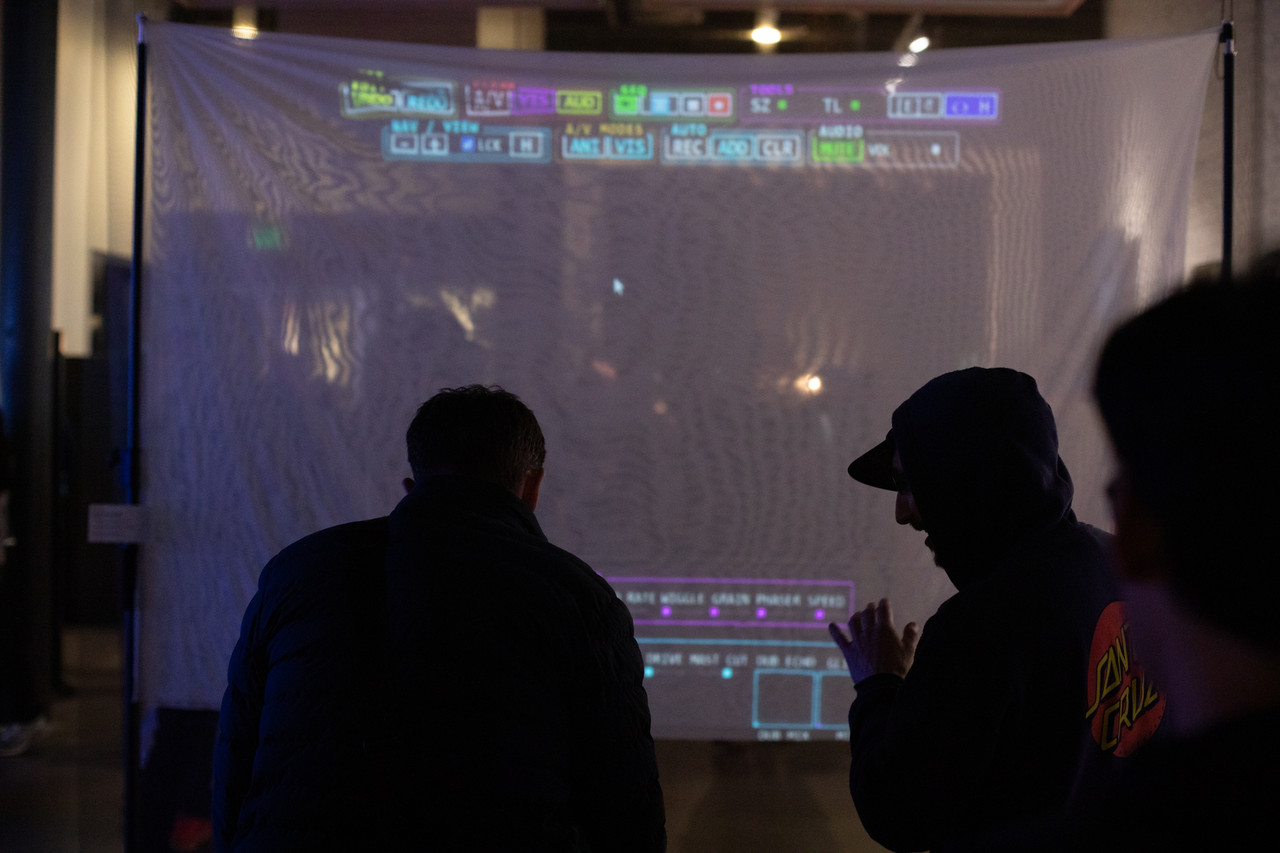
Photo: Matt Faller
BLABRECS
Max Kreminski is a computational poet and designer of playful interactive experiences. Their work explores the boundary between sense and nonsense; the capacity of computational processes to function as 'poetry losers' that lead human poets to surprising new corners of semantic space; and the new forms of poetic experience that can emerge from interaction with poetry machines. Outside of poetry, Max is a human-computer interaction researcher, a visiting scholar at UC Berkeley, and a soon-to-be assistant professor at Cornell Tech.
BLABRECS is an AI-based mod for the popular wordgame SCRABBLE. Rather than 'real' dictionary words, BLABRECS forces players to use nonsense words that are accepted as valid by a slightly janky classifier *trained on* the dictionary. BLABRECS aims to aestheticize the weirdness of having a computer tell you 'that's not a real word' – and to promote linguistic diversity, rather than homogenization, by pushing people away from familiar vocabulary. Invented words tend to reflect players' diverse linguistic backgrounds in unexpected ways.
As in SCRABBLE, BLABRECS players sit around a physical board and take turns making words by placing letter tiles drawn from a bag onto a crossword-like grid. BLABRECS is played with a standard SCRABBLE board and tiles, plus a phone or computer with a browser tab opened to the BLABRECS web interface. Players use the web UI to test words they want to play against the classifier, and to build up a list of nonsense words invented in this session; there's also space for a player-editable definition of each word.
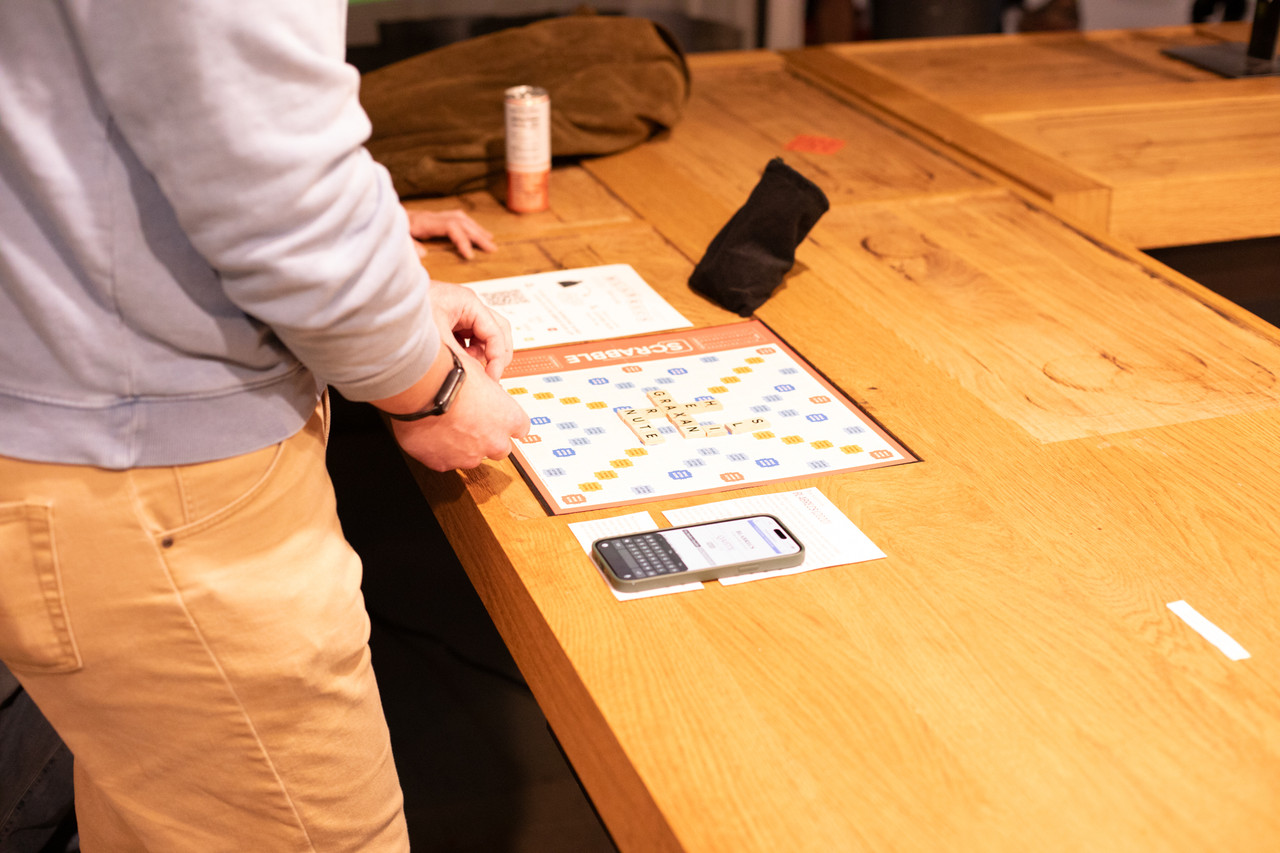
Photo: Matt Faller
Pretend
I’m a game creator who focuses on emotion in game. My work concentrates on how games as a medium transform emotion and interpret a concept. I love the game that meaningful, special and explore inner self.
Pretend is a abstract game try represent public opinion in three levels. In each scene, you will be able to use mouse control 'you' and your follower in different way.
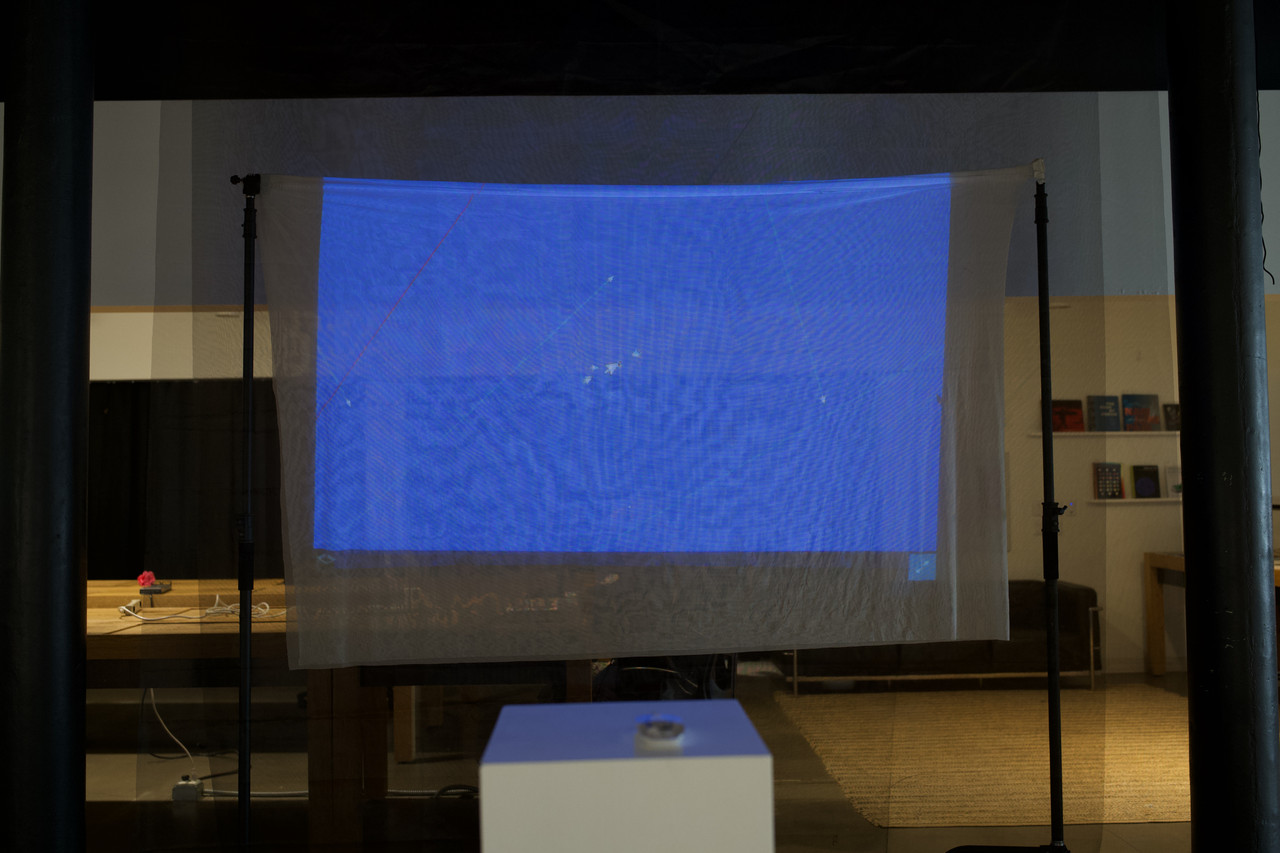
Photo: Ash Herr
Fishin' for Average Caucasian Boyfriends
Jackie Liu is an artist and designer based in NYC who makes experimental interactive narratives that combine websites, games, and comics. Often inspired by her childhood experiences of the web, she recreates and reimagines technology to explore new ways of relating with herself, others, and technology systems.
Go fishin' in this semi-autobiographical Game Boy game about expectations, queerness, and the possibility of dreaming bigger.
Based on a true conversation the artist had with her mom at a seafood restaurant, the game allows players to make the choice to fish–or not...
What if we refuse to play the game?
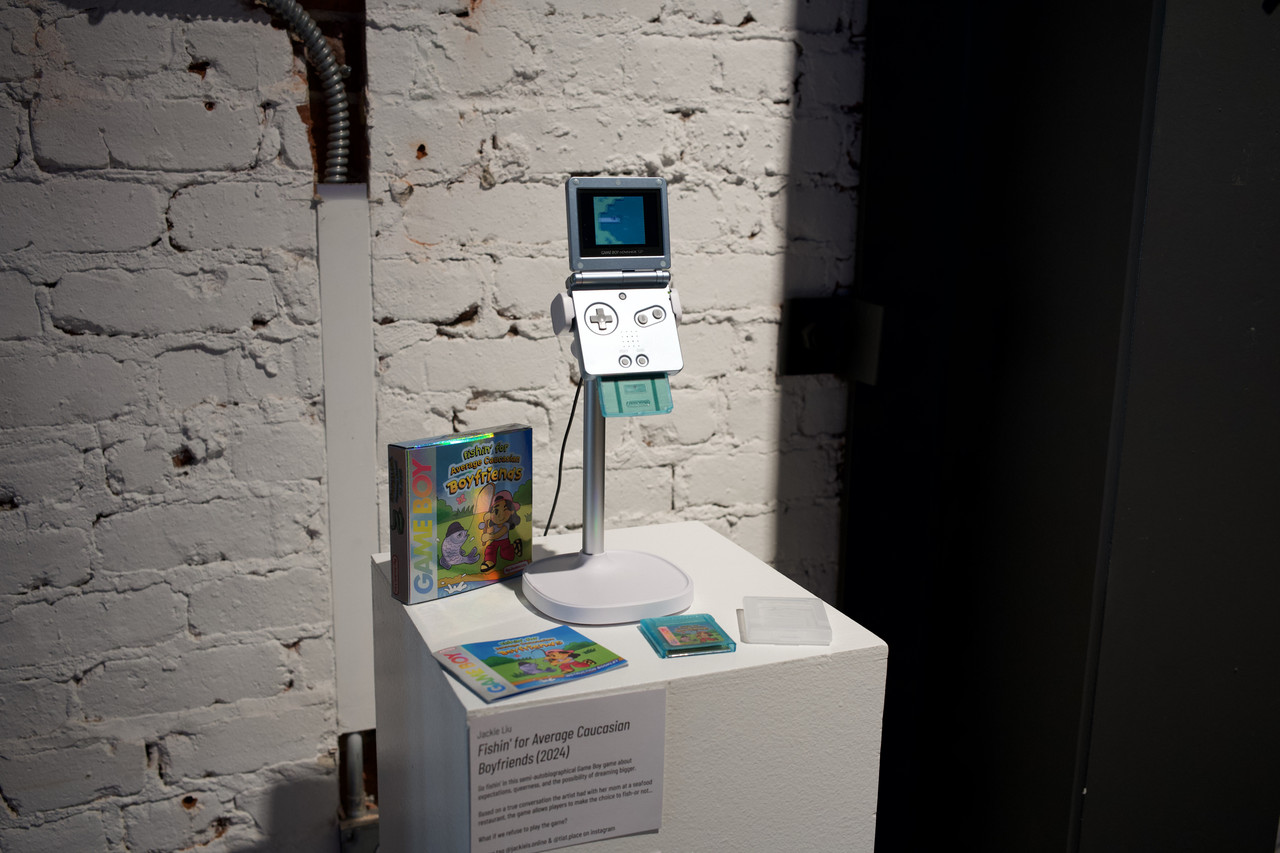
Photo: Ash Herr
Mote
Peter Whidden, Creator
Rayne Beckman, Sound Design
Mote is an interactive ecosystem simulation composed of hundreds of thousands of organisms. It integrates elements from both games and research to create a sandbox for physics, computational biology, and machine learning. It uses a custom GPU-based physics engine to model the interactions of many simple behaviors at a massive scale, producing a wide range of emergent phenomena.
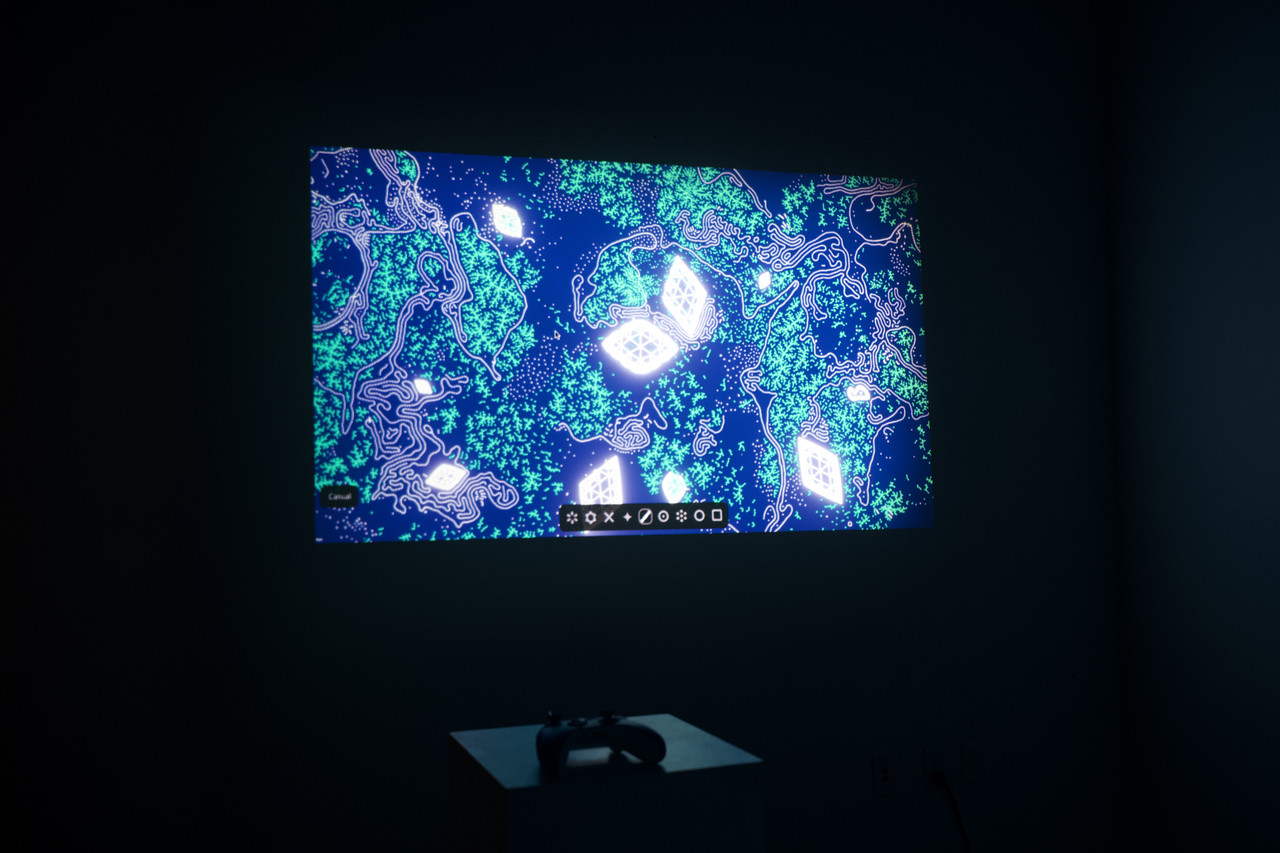
Photo: Ash Herr
Thoughts & Prayers
Brian Moore is a Los Angeles–based artist and creative director whose medium-agnostic work gleefully sabotages cultural, social, and technological norms. His projects—across products, digital interventions, and strange little experiences—have landed everywhere from mainstream outlets to underground press, earning him ADC Young Gun honors, multiple Webbys, and even an Emmy nomination for a video game he made (didn’t win). He’s also a founding member of the very serious art studio BRAIN.
Thoughts & Prayers the game: a 'game' where you use the power of thoughts and prayers to end gun violence in the United States. Hint: you never win.
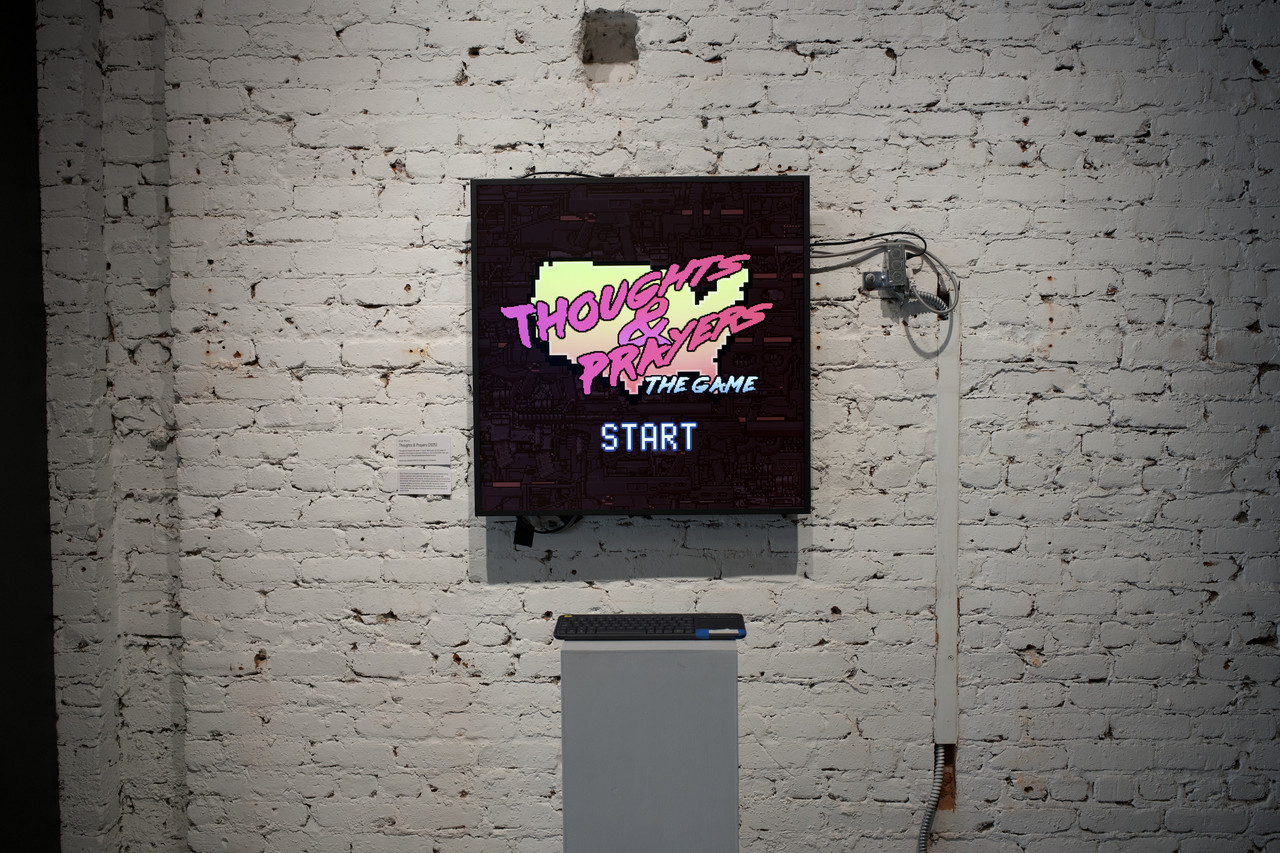
Photo: Ash Herr
<Wormhole>
Xinsect and Bug George have reached instar 4, the last stage of their lives. They've shed their shells for the last time and feel an immense need drawing them, like a whirlpool, to the centreof great bug maze. Help Xinsect and Bug George reach the maze centre before their time runs out.
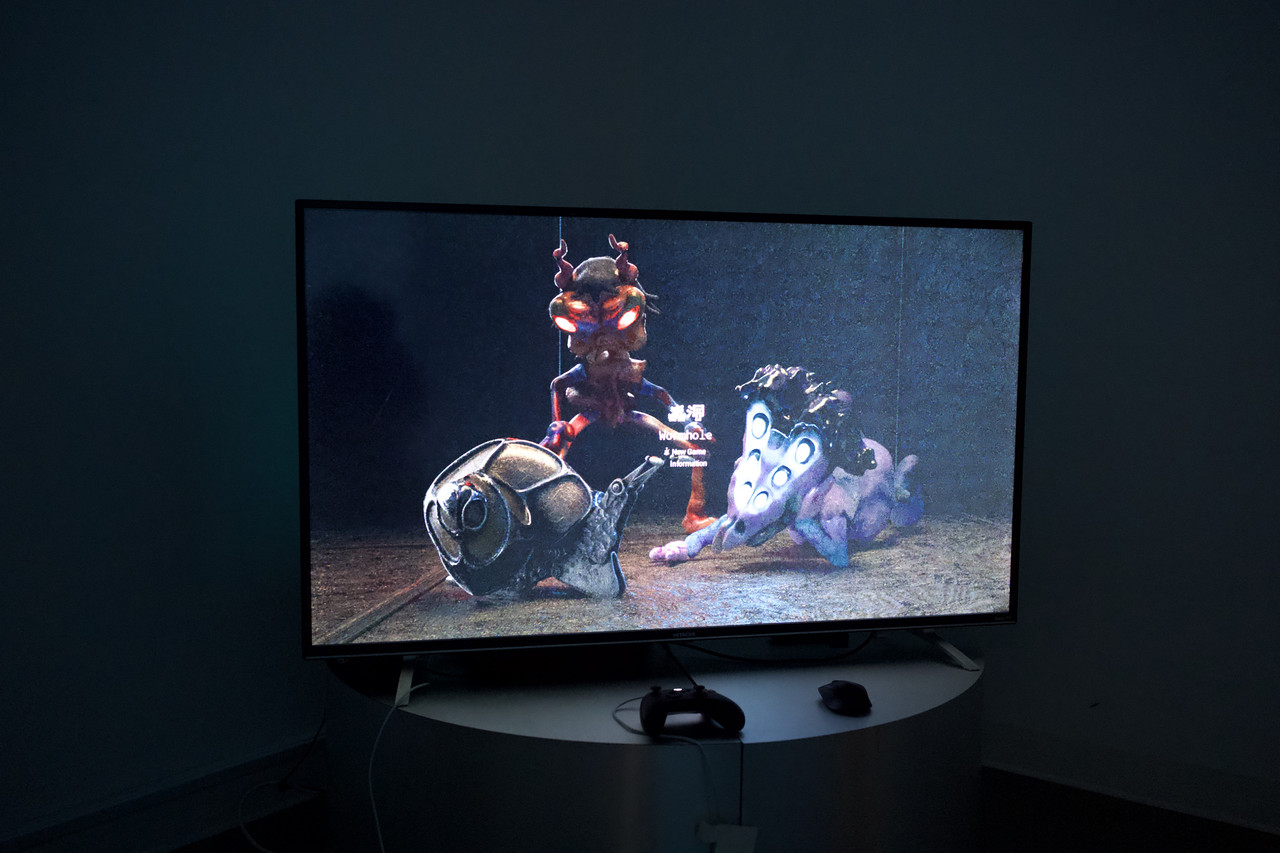
Photo: Ash Herr
Cool-It
Charlie Stigler is an artist and fabricator whose work ranges from monumental steel sculptures to digital installations and immersive experiences. His pieces explore curiosity and awe through forms that invite, and often require, viewer participation. He has also collaborated on major public artworks with Charles Gadeken, Dana Albany, and the Flaming Lotus Girls.
Cool-It, aka the Core Cooling System, is an audio game that juxtaposes the high-stakes adult world of nuclear power with the nostalgic, playful urgency of the Bop It children’s toy from the 1990s. It explores how in the right environment, even “serious systems” can start to feel like a game.
In Cool-It, you play the role of a nuclear reactor engineer, operating the core cooling system of a Cold War era fission reactor. You must follow audio commands to keep the core temperature in a healthy range, avoiding a supercriticality event and a potential nuclear meltdown.
Cool-It is a 'Nuclear Bop-It.' Players encounter a heavy-duty steel industrial control panel with a giant welded lever switch and a cast-iron valve wheel. The machine barks commands—“Set temperature to 70,” “Open Vent 4,” “Close Main Valve”—and players have only seconds to respond using the physical controls. The pace accelerates until a command is missed, ending the round.
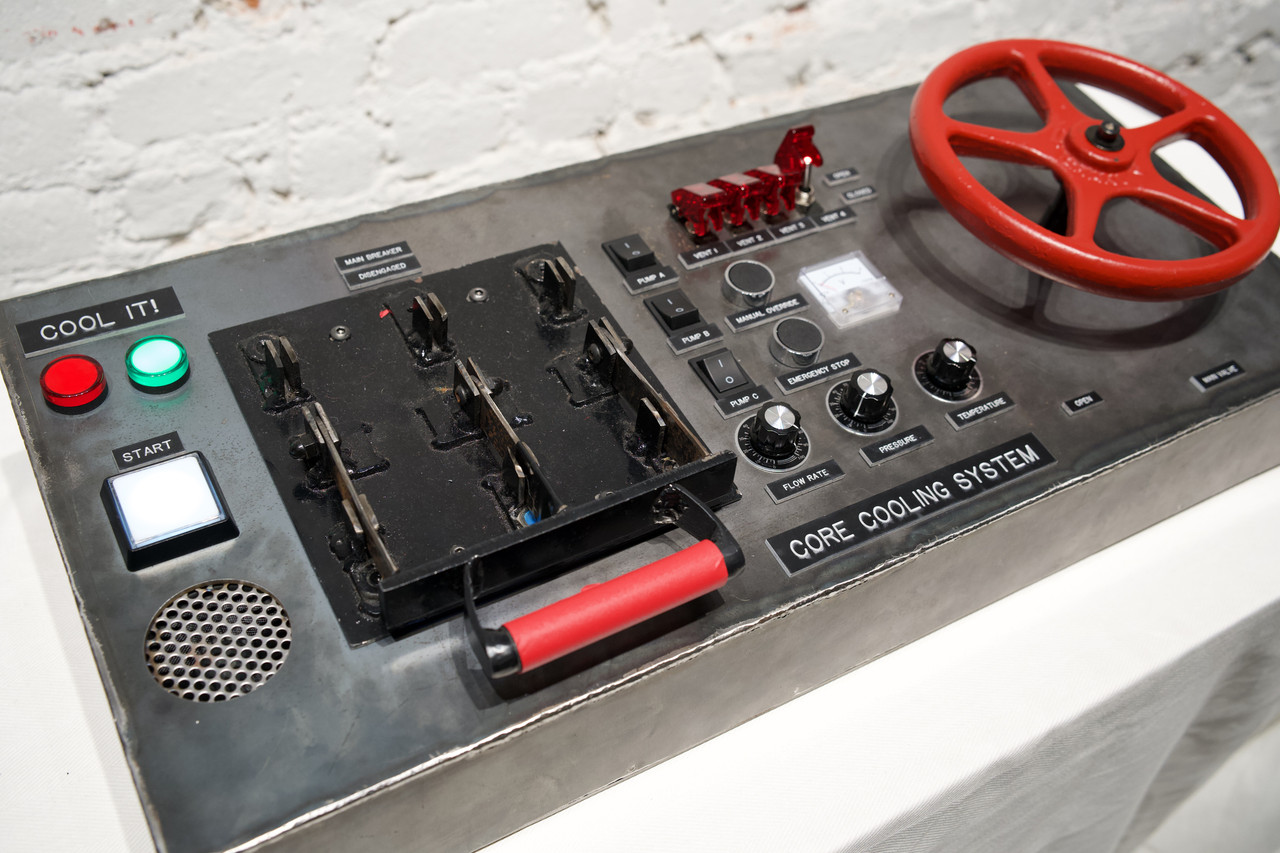
Photo: Ash Herr